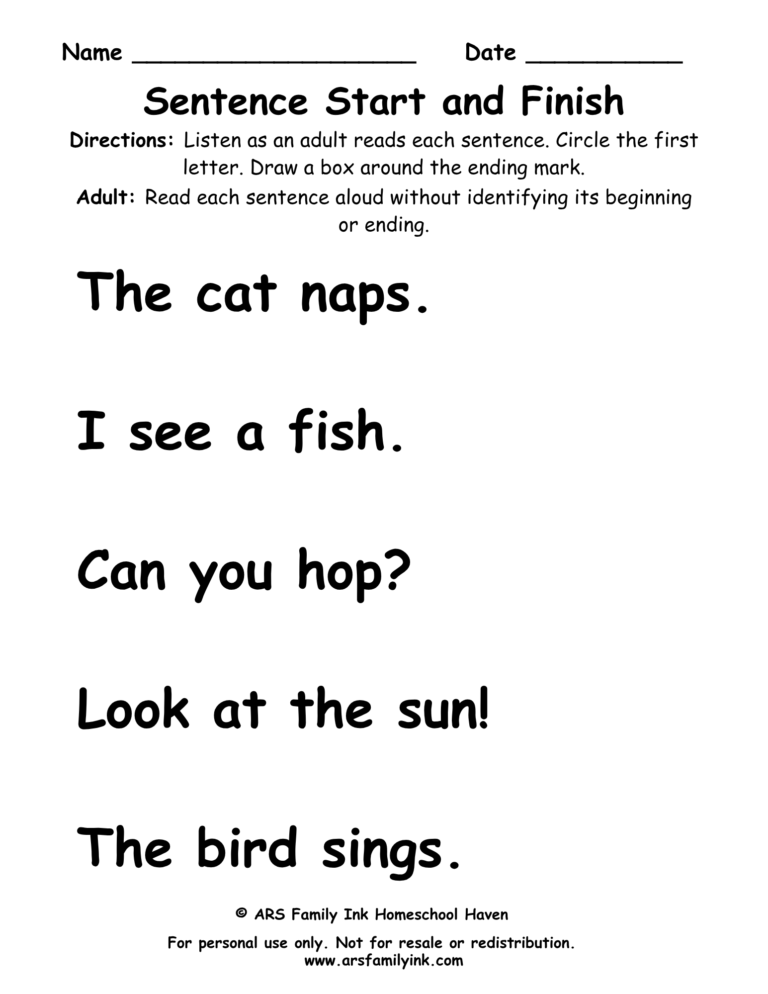
Help your child learn how to recognize where written sentences begin and end with this free Sentence Start and Finish kindergarten worksheet and teacher script.
This reading readiness activity introduces two important sentence clues: a capital letter at the beginning and a punctuation mark at the end.
Children listen as an adult reads five simple sentences, circle each sentence’s first capital letter, and draw a box around its ending punctuation mark.
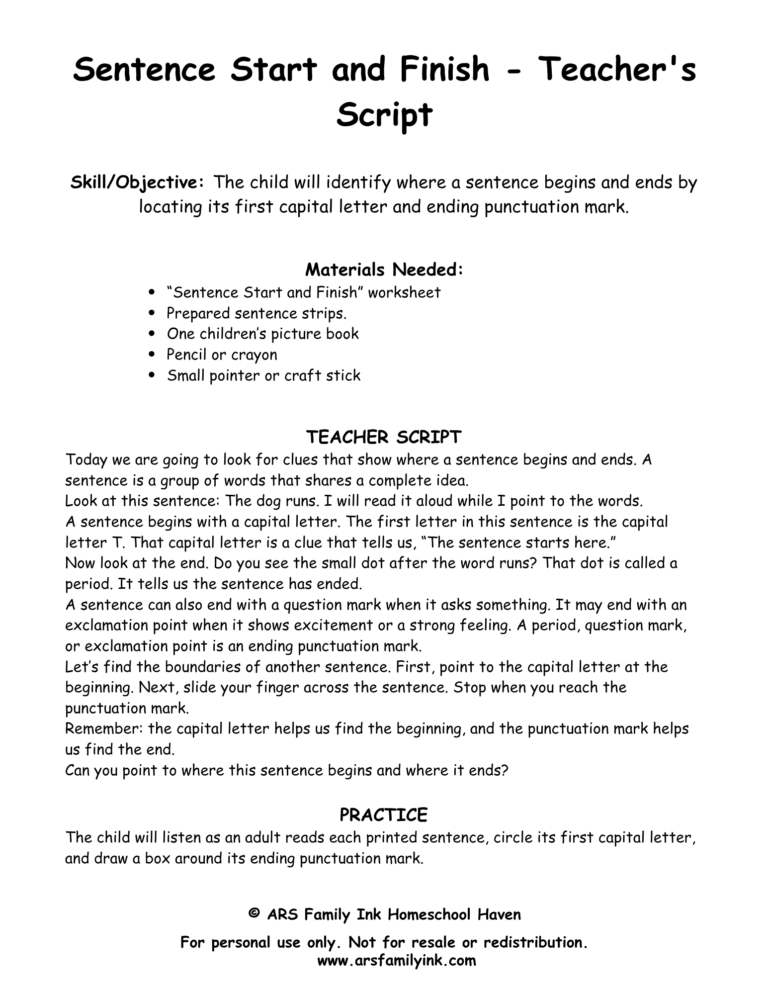
The accompanying four-page teacher script includes step-by-step instruction, guided practice, review questions, assessment guidance, and an example page to help parents and teachers introduce the skill before completing the worksheet.
Download your free worksheet below:
Teacher Script Included
This free worksheet comes with a four-page teacher script designed to help parents and educators introduce sentence beginnings and endings through structured, age-appropriate instruction.
The teacher script includes an explanation of capital letters and ending punctuation, guided practice, review questions, assessment guidance, and an example page featuring eight additional sentences.
Children are introduced to periods, question marks, and exclamation points. At this stage, the focus is on recognizing these symbols as ending punctuation marks rather than mastering the individual purpose of each mark.
The teacher script helps adults model the skill before children practice identifying sentence boundaries on their own.
Download your free worksheet below:
What This Worksheet Teaches
This worksheet introduces children to the visual clues that help readers recognize complete written sentences.
Children learn that sentences begin with capital letters and end with punctuation marks. They are introduced to three common ending marks: the period, question mark, and exclamation point.
Through listening, observing, and marking sentences, children develop an understanding of sentence boundaries without needing to decode every word.
The included teacher script provides explicit instruction and modeling before children complete the worksheet.
How To Use This Worksheet
After completing the teacher-led introduction and guided practice, give your child the Sentence Start and Finish worksheet.
Read each sentence aloud without pointing out where it begins or ends.
Ask your child to find and circle the first capital letter in each sentence. Next, have your child locate the ending punctuation mark and draw a box around it.
Encourage your child to work through each sentence carefully. Provide assistance when necessary, but allow opportunities to identify sentence boundaries independently.
Remember that independent reading is not required for this activity. The goal is to recognize the visual clues that identify the beginning and ending of a sentence.
How to Use the Teacher Script
Begin by reading through the teacher script and gathering the materials needed for the lesson.
Use the included example page to introduce the concept of sentence beginnings and endings. Read a sentence aloud while pointing to the words. Show your child how the first capital letter identifies where the sentence begins and how the ending punctuation mark identifies where it ends.
Demonstrate circling the first capital letter and drawing a box around the ending punctuation mark.
Use additional sentences from the example page for guided practice. Encourage your child to identify the beginning and ending of each sentence with less assistance as their confidence grows.
Once your child understands the activity, introduce the Sentence Start and Finish worksheet.
Finish the lesson using the review questions provided in the teacher script. You can also use the assessment guidance to check whether your child can identify sentence boundaries independently or still needs additional support.
Why This Skill Matters
Recognizing where a sentence begins and ends is an important part of early reading development.
Before children can confidently read and write complete sentences, they need to understand how written language is organized. Capital letters and ending punctuation provide visual clues that help readers identify individual sentences.
When children recognize these clues, they begin developing the print-awareness skills needed to understand how words work together to communicate complete ideas.
This early understanding prepares children for more advanced work with sentence reading, punctuation, capitalization, and writing.
Skills Practiced
This worksheet provides practice with several important kindergarten reading readiness and print-awareness skills:
Sentence Awareness: Recognizing that written sentences have a beginning and an ending.
Capital Letter Recognition: Identifying the capital letter that begins a written sentence.
Ending Punctuation Awareness: Recognizing periods, question marks, and exclamation points as sentence-ending marks.
Sentence Boundary Identification: Using capital letters and punctuation to locate the beginning and ending of printed sentences.
Print Tracking: Following a sentence from left to right during guided instruction.
Visual Discrimination: Distinguishing capital letters and punctuation marks from the other printed characters in a sentence.
Listening and Following Directions: Listening to adult-read sentences and responding to instructions.
Learning Goals
After completing this lesson and worksheet, children should be working toward being able to:
✓ Identify the first capital letter in a written sentence.
✓ Recognize that sentences begin with capital letters.
✓ Locate the punctuation mark at the end of a sentence.
✓ Recognize periods, question marks, and exclamation points as possible sentence-ending marks.
✓ Identify where a printed sentence begins and ends.
✓ Follow a written sentence from beginning to end with adult guidance.
Parent & Teacher Tips:
When introducing sentence beginnings and endings, focus on helping children recognize the visual clues rather than expecting them to understand every punctuation rule immediately.
Read the sentences aloud and demonstrate how to locate the first capital letter and ending punctuation mark.
If your child has difficulty identifying sentence boundaries, return to the example page for additional guided practice.
Celebrate progress as children become more confident identifying these important features of written language.
Extend the Learning
Continue practicing sentence beginnings and endings through simple activities at home or in the classroom.
Sentence Detective: Open a favorite picture book and ask your child to find a capital letter at the beginning of a sentence and a punctuation mark at the end.
Punctuation Hunt: Look through a children’s book together and search for periods, question marks, and exclamation points.
Make Your Own Sentences: Write several short sentences on paper. Read them aloud and have your child circle the first capital letter and box the ending punctuation mark.
Sentence Sorting: Write short sentences ending with different punctuation marks. Help your child sort them into groups based on their ending marks.
Be the Teacher: Allow your child to use the included example sheet to demonstrate how to identify the beginning and ending of a sentence.
These activities provide additional opportunities to recognize sentence boundaries in different contexts while reinforcing the skills introduced in the lesson.
Materials Needed
Before beginning the lesson, gather these simple materials:
Sentence Start and Finish worksheet
Included four-page teacher script and example sheet
One children’s picture book
Pencil or crayon
Small pointer, craft stick, or your child’s finger for tracking print
No additional sentence strips are necessary when using the included example page.
Perfect for Homeschool or Classroom Learning
The Sentence Start and Finish worksheet and teacher script are designed for flexible use in homeschool and classroom settings.
Homeschool families can use the teacher script for a short, structured reading readiness lesson. The included example page makes it easy to introduce and demonstrate the skill before completing the worksheet.
Classroom teachers can use the script for whole-group instruction or small-group lessons. The example page provides opportunities for teacher modeling and guided practice before students complete their individual worksheets.
This resource is suitable for kindergarten reading lessons, concepts of print instruction, literacy centers, small-group practice, one-on-one instruction, and additional learning at home.
Building Early Reading Readiness
Learning to identify sentence boundaries is an important step in understanding how written language works.
As children become familiar with capital letters and ending punctuation, they develop a stronger awareness of how sentences are organized on a page.
This knowledge builds upon early print-tracking skills and prepares children for later instruction in reading complete sentences, using punctuation, and writing their own sentences.
By combining explicit instruction with guided practice, children can develop these foundational skills at a comfortable pace.
You may also like:
Science
Simple science concepts, observation skills, and early exploration.
Numbers & Math
Counting, number recognition, basic math skills, and early problem-solving.
Reading & Writing
Early reading comprehension, handwriting, and sentence building skills.
Support Our Free Worksheets
If you enjoy these free worksheets, you can support our site by sharing with others, following us on social media, or joining our email list for more resources. It’s as easy as clicking the links at the bottom of the page. Your support helps us continue creating free printable learning materials.