Help your child discover that written words carry meaning and communicate a message with this free kindergarten reading readiness worksheet and teacher script.
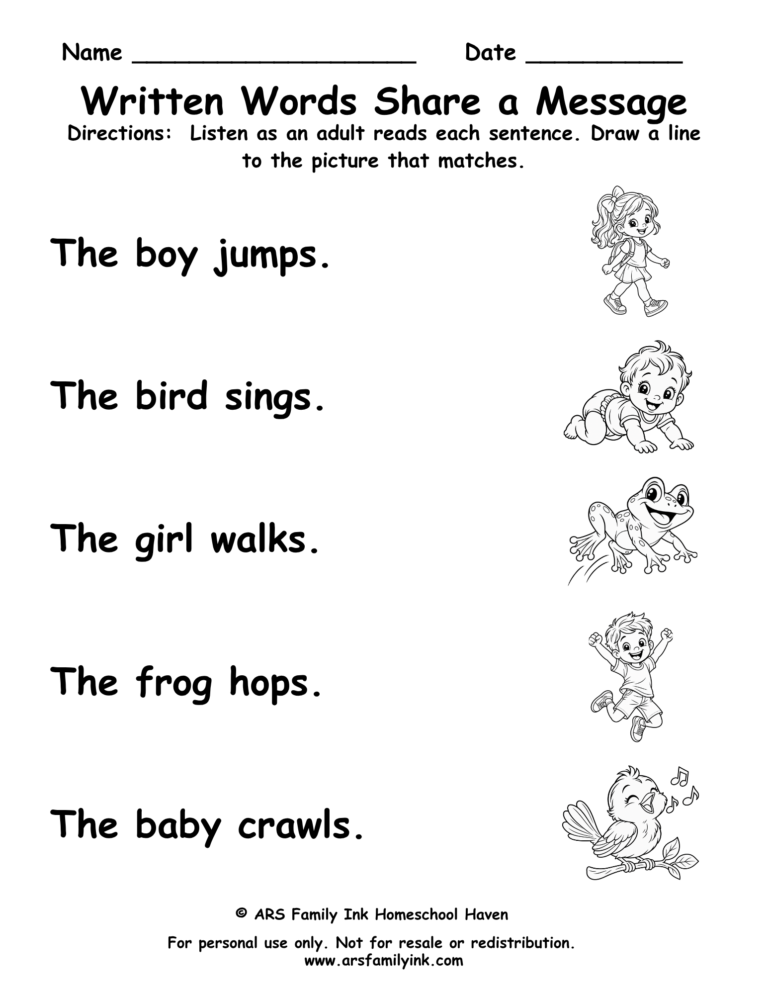
The Written Words Share a Message activity introduces an important early concept of print: the words we say can be represented by words we see on a page. Children listen as an adult reads each simple sentence aloud and then draw a line to the picture that matches its meaning.
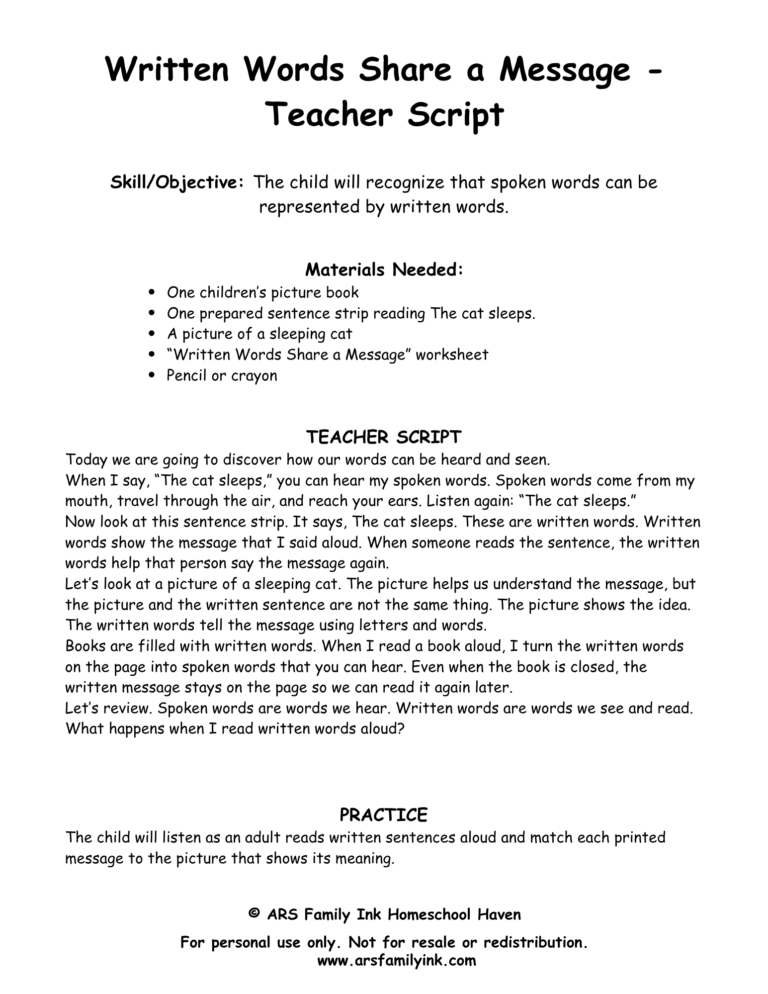
A 3-page teacher script and instructional resource is also included to help you introduce and teach the concept before your child completes the worksheet.
Download your free worksheet below:
Teacher Script Included
This worksheet comes with a 3-page teacher script and instructional resource designed to make the lesson easy to teach at home or in the classroom.
The teacher script introduces the difference between spoken words and written words using simple, child-friendly explanations. Children learn that spoken words are words we hear, while written words are words we can see and read.
The lesson also explains that pictures can help us understand an idea, but pictures and written sentences are not the same thing. Written words use letters and words to communicate the message.
An additional example/modeling page is included so the child can practice connecting a written sentence with its meaning before completing the worksheet.
Download your free worksheet below:
What This Worksheet Teaches
This activity helps children practice important kindergarten reading-readiness and concepts-of-print skills, including:
Understanding that spoken words can be represented by written words
Recognizing that written words communicate a message
Connecting printed sentences with their meanings
Listening to and understanding simple sentences
Matching written language to visual representations
Developing awareness of the purpose of print
Strengthening early reading comprehension
Building the connection between spoken language and written language
How To Use This Worksheet
Begin with the teacher script before giving your child the worksheet. Use the suggested example to demonstrate how something you say aloud can also be written down and read.
When you are ready for the worksheet, read each printed sentence aloud while pointing to the words. Encourage your child to listen to the entire sentence and think about what it means.
Have your child look at the pictures on the right side of the page and draw a line from each sentence to the picture that shows the correct action.
You can reread a sentence as many times as necessary. At this stage, the focus is on understanding that the printed words represent the message being spoken, rather than expecting independent reading.
How to Use the Teacher Script
Use the teacher script before your child completes the Written Words Share a Message worksheet. It is designed to introduce the concept through simple explanation, modeling, and guided practice so your child understands the skill before working independently.
Start by gathering the materials listed on the teacher script. Read the Teacher Script aloud, pausing when appropriate to demonstrate the difference between words that are spoken and words that are written. The lesson uses the example sentence “The cat sleeps.” to help your child hear a spoken message and then see how that same message can be represented with written words.
As you teach, encourage your child to listen, look at the printed sentence, and talk about what the words mean. Use the included example/modeling activity to provide additional practice connecting a written message with its meaning.
When your child shows an understanding that the written words represent the message being spoken, move on to the Written Words Share a Message worksheet. Read each sentence aloud and have your child draw a line to the picture that matches the sentence.
There is no need to rush through the lesson or require your child to read the sentences independently. The teacher script is meant to provide guided instruction and support, while the worksheet gives your child an opportunity to practice the concept.
You can also return to the teacher script or example activity later if your child needs additional practice.
Why This Skill Matters
Before children can become independent readers, they need to understand that print carries meaning. Written words are not simply letters and shapes on a page—they represent language and communicate messages that can be read and understood.
Learning that spoken words can be represented by written words helps children begin connecting the language they already know and use every day with the print they see in books, signs, labels, and other written materials.
This understanding supports later reading development because children begin to recognize that:
The words we say can be written down.
Written words can be read aloud.
A written message stays on the page and can be read again.
Words and sentences communicate ideas and information.
Pictures can help show meaning, but written words carry their own message.
The Written Words Share a Message lesson makes this abstract concept concrete by allowing children to hear a sentence, see the written sentence, and connect it with a picture showing its meaning.
These early experiences help prepare children for future work with word recognition, decoding, sentence reading, and reading comprehension.
Skills Practiced
This worksheet gives children practice with several important early reading and print-awareness skills:
Understanding that print carries meaning — Children learn that written words communicate ideas and messages.
Connecting spoken and written language — Children hear a sentence read aloud while seeing that the same message can be represented in print.
Listening comprehension — Children listen carefully to a simple sentence and think about what it means.
Sentence-to-picture matching — Children connect each written and spoken sentence with the picture that represents its meaning.
Recognizing written sentences as meaningful units — Children begin to understand that groups of written words work together to communicate a complete idea.
Distinguishing print from pictures — Children learn that pictures can illustrate an idea while written words communicate the message through print.
Building early reading comprehension — Children practice understanding a simple message and identifying a visual representation of that message.
This activity focuses on reading readiness and concepts of print, so children are not expected to read the sentences independently. An adult can read each sentence aloud while pointing to the words, allowing the child to focus on the connection between spoken language, written language, and meaning.
Learning Goals
After completing this lesson and worksheet, children should be able to:
✔ Understand that spoken words can be represented by written words
✔ Recognize that written words communicate a message
✔ Connect a written sentence with a picture that shows its meaning
✔ Understand that print represents meaningful language
✔ Listen to a simple sentence and identify what it means
✔ Distinguish between written words and the picture that represents their meaning
✔ Build awareness of the connection between spoken language, written language, and meaning
Parent & Teacher Tips:
Your child does not need to be able to read all five sentences independently to complete this lesson successfully.
Try pointing underneath the words as you read each sentence aloud. Then ask questions such as, “What did that sentence tell us?” or “Which picture shows that message?”
This keeps the emphasis on the purpose of written language and helps the child understand that the marks and words on the page aren’t random—they communicate something that another person can read and understand.
Extend the Learning
Keep practicing the idea that written words communicate messages during everyday activities. Try one or more of these simple activities:
Write What Your Child Says: Ask your child to tell you a short sentence, such as “The dog runs.” Write the sentence down, then read it back aloud. Explain that you turned their spoken words into written words.
Match Messages to Actions: Write a simple sentence such as “Clap your hands,” “Touch your nose,” or “Jump two times.” Read the message aloud and have your child perform the action.
Look for Messages in Books: While reading together, point to a sentence and explain that the written words tell the reader something. Read the sentence aloud and talk about its meaning.
Compare Words and Pictures: Choose a picture in a favorite book. Talk about what the picture shows, then read the words on the page. Discuss how the picture helps show the idea while the written words tell the message.
Make a Family Message: Write a simple note such as “I love you,” “Snack is ready,” or “We are going outside.” Read it together and talk about the message the written words communicate.
These simple activities help children see that print has a purpose and that written words are used every day to share ideas, information, and messages.
Materials Needed
Before beginning the Written Words Share a Message lesson, gather these simple materials:
Written Words Share a Message Teacher Script
Included example sheet
Written Words Share a Message worksheet
One children’s picture book
Pencil or crayon
Everything needed for the modeling activity is provided on the included example sheet, making the lesson easy to prepare and use at home or in the classroom.
Perfect for Homeschool or Classroom Learning
The Written Words Share a Message lesson is designed to be simple, flexible, and easy to use in a variety of early learning settings.
Homeschool families can use the teacher script for a short, guided one-on-one lesson before completing the worksheet together. The included example sheet provides the modeling practice needed for the lesson, keeping preparation simple.
Teachers and classroom educators can use the teacher script for whole-group or small-group instruction. The example sheet can be used to model the skill before students complete their own worksheets for guided or independent practice.
This resource is perfect for:
✔ Homeschool reading lessons
✔ Kindergarten classrooms
✔ Small-group reading instruction
✔ One-on-one learning
✔ Reading readiness practice
✔ Print concepts instruction
✔ Literacy centers or review
✔ Extra practice at home
Whether used at home or in the classroom, the lesson helps children build an important early understanding: the words we say can be written down, and written words communicate meaningful messages.
Building Early Reading Readiness
Understanding that print carries meaning is an important part of learning how reading works.
When children see an adult point to written words while reading them aloud, they begin connecting the language they hear with the print they see. They learn that the words remain on the page and can be read again to communicate the same message.
This understanding creates a foundation for later reading skills, including word recognition, decoding, sentence reading, and reading comprehension.
The Written Words Share a Message activity gives children a simple, concrete way to experience this connection:
You may also like:
Science
Simple science concepts, observation skills, and early exploration.
Numbers & Math
Counting, number recognition, basic math skills, and early problem-solving.
Reading & Writing
Early reading comprehension, handwriting, and sentence building skills.
Support Our Free Worksheets
If you enjoy these free worksheets, you can support our site by sharing with others, following us on social media, or joining our email list for more resources. It’s as easy as clicking the links at the bottom of the page. Your support helps us continue creating free printable learning materials.