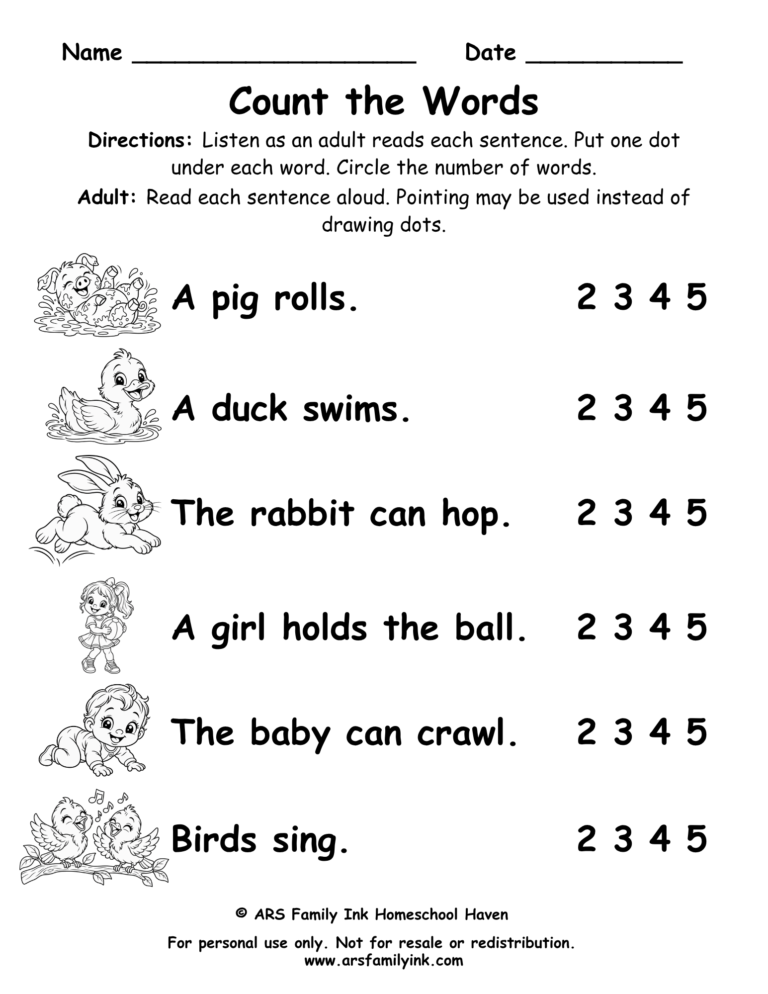
Help your child discover that sentences are made of separate words with this free Count the Words kindergarten worksheet and teacher script.
In this beginning reading activity, children listen as an adult reads each sentence aloud. They place one dot under each printed word—or simply point to each word—and then circle the number that tells how many words are in the sentence.
The accompanying 3-page teacher script provides guided instruction, practice, review, assessment guidance, and an included example page so parents and teachers can introduce the concept before children complete the worksheet.
Download your free worksheet below:
Teacher Script Included
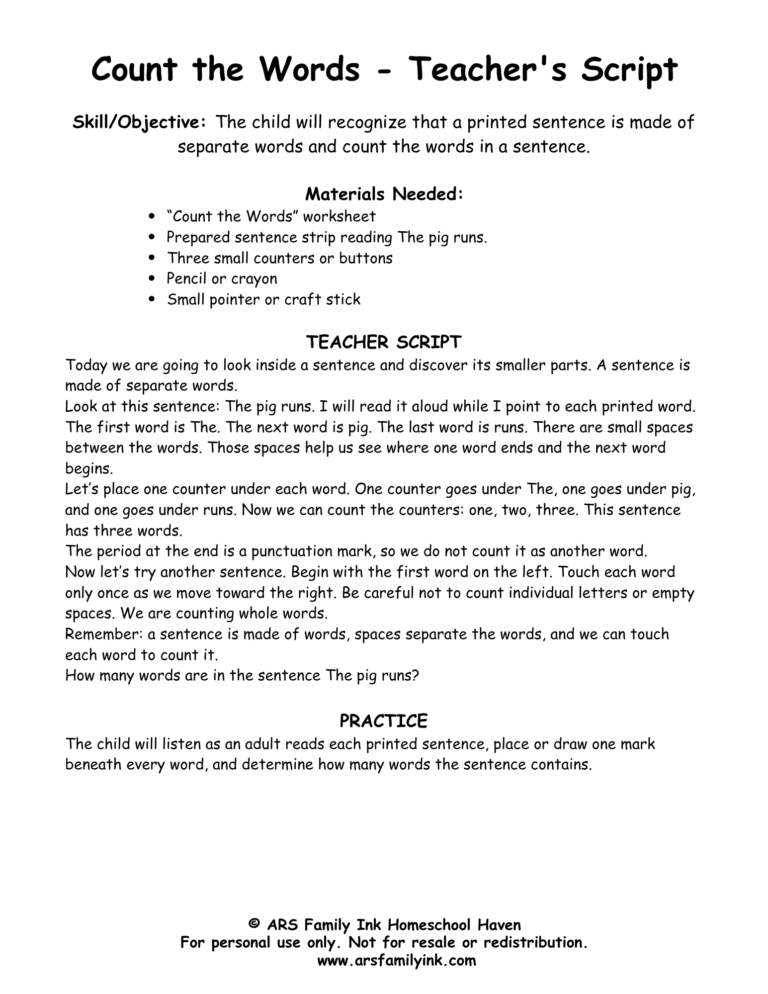
This worksheet includes a 3-page teacher script that provides structured instruction before the child completes the student activity.
The teacher script explains that a sentence is made of separate words and demonstrates how spaces help us see where one word ends and another begins. Children learn to touch or mark each printed word once and then count the total.
The lesson also explicitly teaches children that a punctuation mark is not another word.
Download your free worksheet below:
What This Worksheet Teaches
This worksheet introduces children to the important concept that a sentence is made of separate printed words.
Children learn to look for the spaces that separate one word from another and to touch, point to, or mark each word only once as they move through a sentence.
They also begin learning what does not count as a separate word. Individual letters, blank spaces, and punctuation marks should not be included when counting the words in a sentence.
How To Use This Worksheet
After completing the teacher-led lesson and example activity, give your child the Count the Words worksheet.
Read the first sentence aloud. Encourage your child to begin with the first word on the left and place one dot underneath each printed word.
If drawing dots makes the activity unnecessarily difficult, your child can simply point to each word once instead.
After identifying each word, have your child count the dots or words and circle the correct number.
Continue in the same way with the remaining sentences.
Remember that the goal is not independent sentence reading. The adult should read each sentence aloud while the child concentrates on identifying and counting the separate printed words.
How to Use the Teacher Script
Begin with the teacher script before completing the student worksheet.
Use the included example page to model how to count the words in a sentence. Read a sentence aloud and point to each printed word from left to right. Help your child notice the spaces separating the words.
Demonstrate placing one mark, counter, or finger under each word. Then count the words together. Point out that the punctuation mark at the end of the sentence is not counted as another word.
Continue with additional sentences from the included example page. Gradually allow your child to take over the pointing and counting as they become comfortable with the process.
Once your child can touch each word once and count the words with reasonable confidence, move on to the Count the Words worksheet.
Finish with the review and assessment activities in the teacher script to determine whether your child understands the concept or would benefit from additional guided practice.
Why This Skill Matters
Understanding that sentences are made of individual words is an important part of developing concepts of print.
When young children hear spoken language, words often seem to flow together. Printed language gives children a visual way to begin recognizing that sentences can be broken into separate words.
Learning to notice the spaces between words helps children understand word boundaries—where one printed word ends and another begins.
This awareness supports later reading and writing development as children begin recognizing individual words, tracking print, reading sentences, and learning to leave spaces between words when they write.
Skills Practiced
This worksheet gives children practice with several important early reading and print-awareness skills:
Word Awareness: Recognizing that a sentence is made up of separate words.
Word Boundary Recognition: Using spaces to notice where one printed word ends and another begins.
Counting Words in Sentences: Touching, pointing to, or marking each word once and determining the total number of words.
Print Tracking: Moving through the words of a sentence from left to right.
Print Discrimination: Learning not to count individual letters, spaces, or punctuation marks as separate words.
One-to-One Correspondence: Matching one touch, point, or dot to each printed word.
Listening and Following Directions: Listening as an adult reads a sentence and completing the corresponding word-counting task.
Learning Goals
After completing this lesson and worksheet, children should be working toward being able to:
✔ Understand that a printed sentence is made of separate words
✔ Recognize spaces as separators between printed words
✔ Touch or mark each word in a sentence one time
✔ Count the number of words in a short printed sentence
✔ Distinguish whole words from individual letters and spaces
✔ Recognize that punctuation marks are not counted as words
✔ Follow printed words from left to right while counting
Parent & Teacher Tips:
If your child accidentally counts letters, spaces, or punctuation, return to a short sentence and model the activity slowly.
Point to one complete word at a time and say each word as you touch it. Draw attention to the spaces that separate the words.
For children who find making dots distracting, use a finger, craft stick, or small counters instead. The important skill is understanding that each complete printed word counts as one word.
Independent decoding is not expected during this lesson, so continue reading the sentences aloud while your child focuses on the print-awareness skill.
Extend the Learning
Continue practicing word awareness with simple activities throughout the day:
Count Words in a Book: Choose a short sentence from a favorite picture book. Read it aloud and have your child touch each printed word while counting.
Make Your Own Sentence: Say a short sentence together, write it on paper, and count the printed words.
Use Counters: Place one button, block, or small object below each printed word. Count the objects to find the number of words.
Find the Spaces: Ask your child to point to the spaces between the words in a sentence and explain what the spaces help us see.
Word Detective: Write a short sentence and ask your child to find the first word, last word, and total number of words.
Compare Sentences: Write two short sentences and count the words in each. Ask which sentence has more words or whether they have the same number.
These simple activities reinforce the idea that sentences are made of individual words separated by spaces.
Materials Needed
Before beginning the Count the Words lesson, gather these simple materials:
Count the Words Teacher Script
Included example sheet
Count the Words worksheet
Three small counters or buttons (optional—the child can also point or make marks)
Pencil or crayon
Small pointer, craft stick, or finger for tracking words
The included example sheet provides the sentences needed for modeling and guided practice, so there is no need to prepare separate sentence strips.
Perfect for Homeschool or Classroom Learning
The Count the Words worksheet and teacher script are designed to work well in both homeschool and classroom settings.
Homeschool families can use the teacher script for a short one-on-one reading readiness lesson. The included example page provides opportunities to model and practice the skill before moving on to the worksheet.
Teachers and classroom educators can use the script and examples for whole-group or small-group instruction before students complete the worksheet individually or with support.
This resource is perfect for:
✔ Homeschool reading lessons
✔ Kindergarten classrooms
✔ Reading readiness instruction
✔ Concepts of print practice
✔ Small-group literacy instruction
✔ One-on-one learning
✔ Literacy centers
✔ Extra practice or review
Whether used at home or in the classroom, the activity gives children hands-on practice recognizing individual words within printed sentences.
Building Early Reading Readiness
Recognizing individual words within a sentence is an important step toward understanding how print works.
Children first learn that a page contains print and that print carries meaning. As their print awareness develops, they begin noticing that sentences contain smaller units called words.
By touching or marking each word, children can physically connect what they see on the page with the idea that a sentence contains separate words.
This understanding builds a foundation for later skills such as tracking print while reading, recognizing familiar words, reading sentences, and spacing words correctly when beginning to write.
Sentence → Separate Words → Count Each Word
You may also like:
Science
Simple science concepts, observation skills, and early exploration.
Numbers & Math
Counting, number recognition, basic math skills, and early problem-solving.
Reading & Writing
Early reading comprehension, handwriting, and sentence building skills.
Support Our Free Worksheets
If you enjoy these free worksheets, you can support our site by sharing with others, following us on social media, or joining our email list for more resources. It’s as easy as clicking the links at the bottom of the page. Your support helps us continue creating free printable learning materials.