Introduce your child to one of the most important practices in science: looking closely and noticing details.
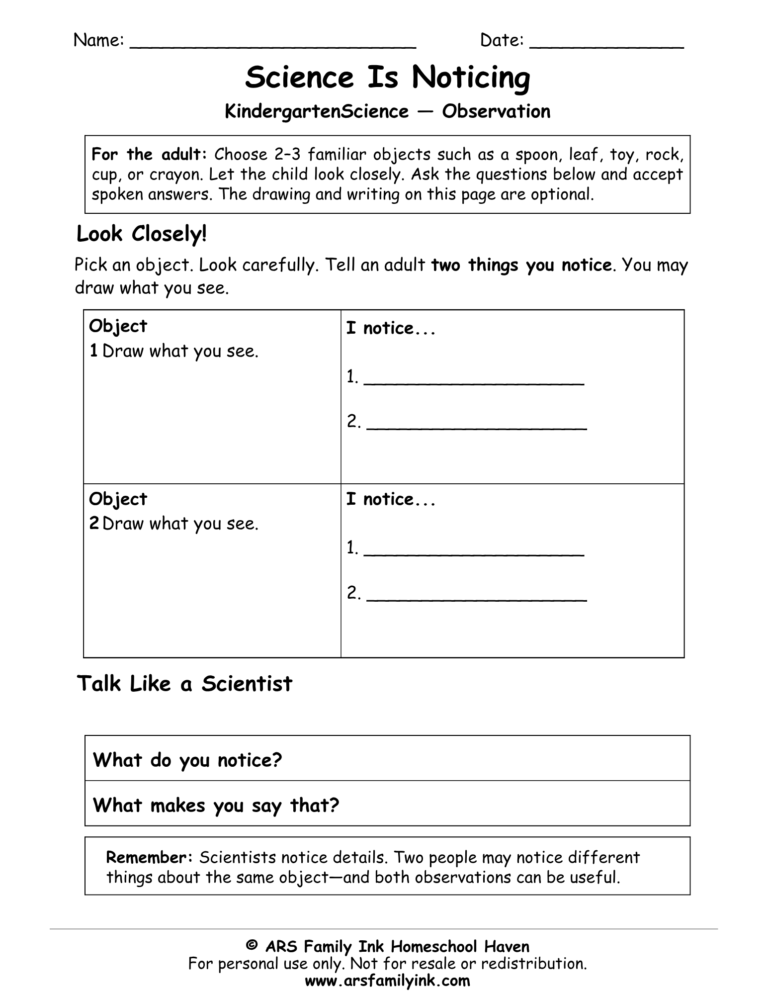
The free Science Is Noticing kindergarten worksheet encourages children to examine familiar objects carefully, describe what they notice, and talk about the evidence behind their observations.
Children can respond orally, draw what they see, or record simple observations with adult support. The drawing and writing portions are optional, allowing the activity to focus on scientific observation rather than writing ability.
Download your free worksheet below:
What This Worksheet Teaches
This worksheet introduces the idea that science begins with careful observation.
Children practice slowing down, looking closely, and noticing details about objects rather than simply naming them.
They also learn that two people can observe the same object and notice different things. Both observations can provide useful information.
The activity emphasizes talking, looking, drawing, and thinking rather than expecting kindergarten children to produce lengthy written responses.
How to Use This Worksheet
Begin by choosing two or three familiar objects for your child to examine.
Ask your child to select one object and look closely. Give them enough time to examine it rather than immediately asking for an answer.
Then ask:
“What do you notice?”
Encourage your child to tell you at least two things. Accept spoken observations. Writing is not necessary for demonstrating the science skill.
Your child may draw the object in the space provided and, if appropriate, write their observations or have an adult help record what they say.
Repeat the activity with a second object.
Finish with the Talk Like a Scientist prompts. Ask what your child notices and follow with:
“What makes you say that?”
Encourage your child to point out the detail or observation that helped them form their answer.
Why This Skill Matters
Observation is a foundational science practice.
Before children can compare objects, sort materials, recognize patterns, ask investigable questions, record information, or explain what they discover, they need opportunities to look carefully and notice details.
Young children naturally observe the world around them. Science instruction can help them become more intentional about that process by encouraging them to slow down, describe what they actually notice, and explain what led them to an idea.
The question “What makes you say that?” also begins encouraging children to connect what they say with what they observed—an early foundation for using observations as evidence.
Skills Practiced
This worksheet gives children practice with several important beginning science skills:
Observation: Looking carefully at an object and noticing its features.
Describing Details: Using words to communicate what is observed.
Scientific Discussion: Talking about observations with an adult or group.
Evidence-Based Thinking: Beginning to explain what was observed that supports an idea.
Scientific Drawing: Using a drawing to represent what an object looks like.
Attention to Detail: Looking beyond the object’s name to notice specific characteristics.
Communication: Sharing observations orally, through drawing, or through simple writing.
Comparing Observations: Recognizing that people may notice different details about the same object.
Learning Goals
After completing this activity, children should be working toward being able to:
✔ Understand that scientists look closely and notice details
✔ Carefully observe a familiar object
✔ Describe at least two things they notice about an object
✔ Talk about an observation using their own words
✔ Explain what they noticed that led to an idea
✔ Represent an observation through drawing when appropriate
✔ Recognize that different people may notice different things about the same object
✔ Participate in a simple science discussion
Parent & Teacher Tips:
Keep the focus on noticing, not on getting a particular answer.
If your child says, “It’s a rock,” encourage a closer observation with a question such as:
“What do you notice about the rock?”
They might notice that it is rough, smooth, small, dark, spotted, round, or has an uneven edge.
Avoid requiring lengthy written responses. If your child can clearly tell you what they notice, they are practicing the intended science skill. You can write down their words for them when desired.
Most importantly, give your child time to look. Sometimes the most interesting observations appear after the obvious ones.
Extend the Learning
Continue practicing observation during everyday activities:
Nature Noticing: Take a leaf, flower, stick, or rock outside and describe several details you notice.
Mystery Object: Place an object in a bag. Allow your child to feel it without looking and describe what they notice before revealing it.
Look Again: Examine an object for 10 seconds and share observations. Then look for another 30 seconds and see what new details your child notices.
Same Object, Different Observations: Have two people observe the same object separately and compare what each person noticed.
Observation Drawing: Choose an interesting object and have your child draw it as carefully as possible while looking back at the real object.
What Makes You Say That?: When your child makes an observation, occasionally ask what they noticed that helped them reach that conclusion.
The goal is not to find one “correct” observation. Encourage children to describe details they can genuinely notice.
Materials Needed
Before beginning the activity, gather:
Science Is Noticing worksheet
2–3 safe, familiar objects to observe
Pencil
Crayons or colored pencils, if desired
Possible objects include a spoon, leaf, toy, rock, cup, or crayon.
Choose objects that are safe for the child to handle and easy to examine closely.
Perfect for Homeschool or Classroom Learning
The Science Is Noticing worksheet is designed for flexible use in homeschool and classroom settings.
Homeschool families can use the activity as an introductory kindergarten science lesson using ordinary objects already available around the home.
Teachers and classroom educators can use it for whole-group modeling, science centers, partner observations, small-group instruction, or individual exploration.
This worksheet is perfect for:
✔ Homeschool kindergarten science
✔ Kindergarten classrooms
✔ Beginning science lessons
✔ Observation practice
✔ Science centers
✔ Small-group investigations
✔ One-on-one learning
✔ Scientific discussion
✔ Early science skill development
Building Early Science Skills
Kindergarten science should give children opportunities to actively investigate and talk about the world around them.
Careful observation provides a starting point for many other science practices.
Children can use observations to begin:
Looking closely → Noticing details → Describing what they see → Comparing observations → Explaining their thinking
These habits can later be applied when children investigate plants, animals, materials, weather, motion, and other science topics.
By starting with familiar objects, children can concentrate on learning how to observe before applying the skill to more complex investigations.
You may also like:
Science
Simple science concepts, observation skills, and early exploration.
Numbers & Math
Counting, number recognition, basic math skills, and early problem-solving.
Reading & Writing
Early reading comprehension, handwriting, and sentence building skills.
Support Our Free Worksheets
If you enjoy these free worksheets, you can support our site by sharing with others, following us on social media, or joining our email list for more resources. It’s as easy as clicking the links at the bottom of the page. Your support helps us continue creating free printable learning materials.