Help your child practice recognizing the connection between uppercase and lowercase letters with this free kindergarten letter recognition worksheet.
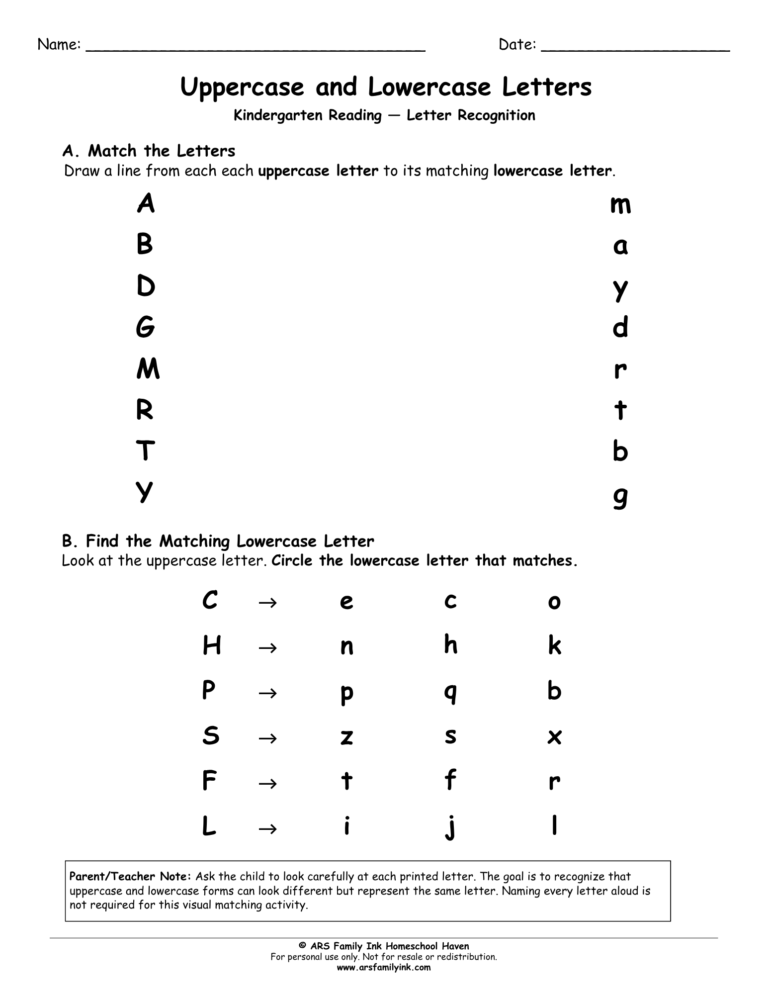
Children complete two activities that encourage them to look carefully at printed letter forms and determine which uppercase and lowercase letters belong together.
The focus of this activity is visual letter recognition and matching. Children are learning that an uppercase letter and its lowercase form can look different while still representing the same letter.
Download your free worksheet below:
What This Worksheet Teaches
This worksheet teaches children that letters of the alphabet have uppercase and lowercase forms.
Some letter pairs look very similar, while others can look noticeably different. Children practice looking carefully at each printed letter and recognizing which two forms represent the same letter.
The activity emphasizes recognition and visual matching, rather than requiring children to write the letters or independently name every letter aloud.
How To Use This Worksheet
Begin by reminding your child that every letter of the alphabet has an uppercase form and a lowercase form.
For Part A, have your child look at the first uppercase letter on the left. Then look through the lowercase letters on the right and find the one that represents the same letter. Draw a line connecting the pair. Continue until all eight uppercase letters have been matched.
For Part B, look at each uppercase letter and the three lowercase choices beside it. Have your child circle the lowercase letter that matches.
Encourage careful looking rather than guessing. If your child is unsure, you can help by naming the uppercase letter and asking them to find its lowercase partner.
Naming every letter aloud is not required for this visual matching activity.
Why This Skill Matters
Children encounter both uppercase and lowercase letters throughout books, worksheets, signs, names, and everyday print.
Learning to recognize both forms helps children understand that a letter’s appearance can change while its identity remains the same. For example, A and a look different, but they represent the same letter.
Developing this flexibility is an important part of alphabet knowledge. As children become more confident recognizing letters in different forms, they are better prepared to work with letter names, letter sounds, printed words, phonics, reading, and writing.
Skills Practiced
This worksheet gives children practice with several important early literacy and alphabet skills:
Uppercase Letter Recognition: Visually identifying capital letter forms.
Lowercase Letter Recognition: Visually identifying lowercase letter forms.
Uppercase-to-Lowercase Matching: Connecting two different forms of the same letter.
Visual Letter Discrimination: Looking carefully at letter shapes and distinguishing one printed letter from another.
Letter-Form Awareness: Understanding that the same letter can have different uppercase and lowercase appearances.
Visual Matching: Selecting the correct lowercase letter from several possible choices.
Alphabet Knowledge: Strengthening familiarity with the printed forms of alphabet letters.
Learning Goals
After completing this worksheet, children should be working toward being able to:
✔ Recognize that letters have uppercase and lowercase forms
✔ Match an uppercase letter with its corresponding lowercase letter
✔ Identify a lowercase match from several letter choices
✔ Recognize uppercase and lowercase forms even when they look different
✔ Carefully compare the visual features of printed letters
✔ Strengthen overall letter recognition and alphabet knowledge
Parent & Teacher Tips:
Some uppercase and lowercase letter pairs look very similar, while others look quite different.
If your child has difficulty finding a match, name the uppercase letter and show its lowercase form. Then allow your child to compare the two visually.
Avoid turning every mistake into a memorization drill. Instead, provide repeated opportunities to look, compare, and match the letter forms.
As recognition improves, you can begin asking your child to name the letters or say their sounds as additional practice.
Extend the Learning
Continue practicing uppercase and lowercase letter matching with simple activities at home or in the classroom:
Alphabet Card Match: Make uppercase and lowercase letter cards and have your child match the pairs.
Letter Hunt: Choose an uppercase letter and search through a book or magazine for its lowercase form.
Find My Partner: Write several uppercase and lowercase letters on small pieces of paper, mix them up, and find the matching pairs.
Name Match: Write your child’s name with the first letter uppercase. Talk about which letters are uppercase and which are lowercase.
Sort the Letters: Mix uppercase and lowercase letter cards and sort them into two groups.
Which One Matches? Write one uppercase letter followed by three lowercase choices and have your child identify its partner.
As your child becomes more confident, gradually include additional letters until they can recognize and match uppercase and lowercase forms across the alphabet.
Materials Needed
This activity requires very little preparation. You will need:
Uppercase and Lowercase Letters worksheet
Pencil, crayon, or marker
No additional materials are required.
Perfect for Homeschool or Classroom Learning
The Uppercase and Lowercase Letters worksheet is an easy-to-use activity for both homeschool and classroom learning.
Homeschool families can use it during a kindergarten reading or alphabet lesson, as additional letter-recognition practice, or as a quick review activity.
Teachers and classroom educators can use the worksheet during whole-group follow-up practice, small-group instruction, literacy centers, morning work, or independent practice.
This worksheet is perfect for:
✔ Homeschool reading lessons
✔ Kindergarten classrooms
✔ Alphabet and letter-recognition practice
✔ Uppercase and lowercase letter review
✔ Small-group literacy instruction
✔ Literacy centers
✔ One-on-one learning
✔ Extra practice or review
Building Early Reading Readiness
Strong letter recognition helps provide a foundation for learning to read.
Before children can consistently connect letters with sounds and use those relationships to read words, they need opportunities to become familiar with the visual forms of letters.
Recognizing both uppercase and lowercase forms is particularly important because beginning readers will encounter both forms in print. Lowercase letters appear frequently within words and sentences, while uppercase letters appear in names, at the beginnings of sentences, and in other contexts.
Practicing letter matching helps children build more flexible and automatic recognition of printed letters.
See the uppercase letter → Examine the lowercase forms → Find its match
You may also like:
Science
Simple science concepts, observation skills, and early exploration.
Numbers & Math
Counting, number recognition, basic math skills, and early problem-solving.
Reading & Writing
Early reading comprehension, handwriting, and sentence building skills.
Support Our Free Worksheets
If you enjoy these free worksheets, you can support our site by sharing with others, following us on social media, or joining our email list for more resources. It’s as easy as clicking the links at the bottom of the page. Your support helps us continue creating free printable learning materials.