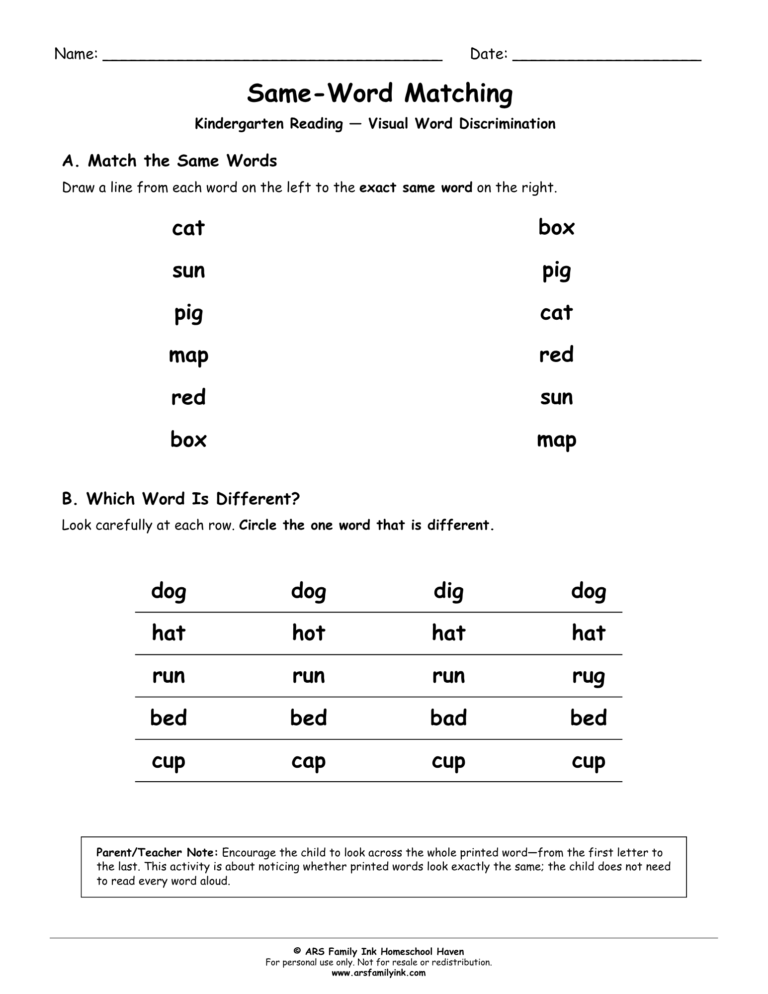
Help your child strengthen visual word discrimination with this free Same-Word Matching kindergarten worksheet.
Children practice looking carefully at complete printed words to determine whether they look exactly the same or different. The worksheet includes two activities: matching identical words and finding the one word that is different within a group of similar-looking words.
Children do not need to read every word independently. The focus is on carefully examining the printed letters from the beginning of a word to the end and noticing whether two printed words are visually the same.
Download your free worksheet below:
What This Worksheet Teaches
This worksheet teaches children to pay attention to the visual details of printed words.
Rather than assuming that words are the same because they begin with the same letter or have a similar overall appearance, children practice looking across the entire word.
They compare the letters in order and notice when one letter changes. This helps children develop more precise visual attention to print while building an understanding that changing a letter creates a different printed word.
How To Use This Worksheet
Begin by explaining that your child is going to be a word detective and look carefully for words that are exactly the same.
For Part A, have your child look at the first word on the left. Encourage them to look across the entire word—from the first letter to the last. Then find the exact same word on the right and draw a line connecting the pair. Continue until all six words have been matched.
For Part B, look across each row of four words. Three words are exactly the same, while one is different. Have your child compare the words carefully and circle the one that does not match.
If your child begins guessing based only on the first letter, encourage them to slow down and compare every letter in the word.
Children do not need to read each word aloud to successfully complete this activity.
Why This Skill Matters
Beginning readers need to learn to look carefully at the letters within words.
A child who relies only on the first letter or the general shape of a word may confuse words that look similar. Visual word discrimination activities encourage children to examine the complete printed word and notice similarities and differences in its letters.
This careful attention to print supports later development in accurate word recognition, phonics, decoding, spelling, and reading.
The goal of this activity is not to memorize the words by sight. Instead, children are practicing the important habit of looking all the way through a printed word.
Skills Practiced
This worksheet gives children practice with several important early reading skills:
Visual Word Discrimination: Determining whether printed words look the same or different.
Same-Word Matching: Finding an exact visual match for a printed word.
Letter-by-Letter Comparison: Looking across an entire word rather than relying only on its first letter.
Noticing Letter Differences: Identifying when one letter makes a printed word different from the others.
Letter-Order Awareness: Paying attention to the sequence of letters within a word.
Visual Attention to Print: Carefully examining printed information before making a choice.
Early Word Recognition Readiness: Building careful print-processing habits that support later word reading.
Learning Goals
After completing this worksheet, children should be working toward being able to:
✔ Recognize when two printed words look exactly the same
✔ Identify a printed word that is different from otherwise matching words
✔ Compare words from the first letter through the last letter
✔ Notice small differences between similar-looking words
✔ Pay attention to the order of letters within a printed word
✔ Understand that changing a letter creates a different printed word
✔ Develop careful visual attention to print
Parent & Teacher Tips:
Encourage your child to look across the whole printed word—from the first letter to the last.
If your child makes a mistake, avoid simply giving the correct answer. Instead, point to the two words and encourage them to compare the letters one at a time.
Ask questions such as:
“Are all the letters the same?”
“Can you find the letter that changed?”
“Is the different letter at the beginning, middle, or end?”
Remember that this activity is about noticing whether printed words look exactly the same. Your child does not need to read every word aloud.
Extend the Learning
Continue practicing visual word discrimination with simple activities at home or in the classroom:
Word Match: Write two identical words on separate cards and mix them with other words. Ask your child to find the matching pair.
Spot the Difference: Write three identical words and one slightly different word. Have your child find the word that does not match.
What Changed? Write a simple word such as cat. Change one letter to make hat. Ask your child to point to the letter that changed.
Beginning, Middle, or End? Compare two similar words and ask whether the different letter is at the beginning, middle, or end.
Word Detective in a Book: Choose a short, easy-to-see word in a children’s book and see whether your child can find another occurrence of the exact same printed word.
Keep the focus on careful visual comparison rather than requiring your child to read unfamiliar words independently.
Materials Needed
This activity requires very little preparation. You will need:
Same-Word Matching worksheet
Pencil, crayon, or marker
That’s it! No additional materials or independent reading are required.
Perfect for Homeschool or Classroom Learning
The Same-Word Matching worksheet is an easy-to-use activity for both homeschool and classroom learning.
Homeschool families can use it as a short kindergarten reading readiness lesson, independent practice activity, or review of visual discrimination skills.
Teachers and classroom educators can use the worksheet during small-group reading instruction, literacy centers, morning work, independent practice, or additional skill review.
This worksheet is perfect for:
✔ Homeschool reading lessons
✔ Kindergarten classrooms
✔ Reading readiness practice
✔ Visual word discrimination practice
✔ Small-group literacy instruction
✔ Literacy centers
✔ One-on-one learning
✔ Extra practice or review
Building Early Reading Readiness
Learning to pay careful attention to print helps prepare children for more advanced reading skills.
As children begin learning to read, they need to notice not only individual letters but also where those letters appear within words. Words that look similar can have very different meanings and pronunciations when even one letter changes.
Visual discrimination practice helps children develop the habit of looking carefully across a printed word rather than guessing from its first letter or overall appearance.
Look at the whole word → Compare the letters → Decide if they match
This careful attention to print can support future work with phonics, decoding, word recognition, and spelling.
You may also like:
Science
Simple science concepts, observation skills, and early exploration.
Numbers & Math
Counting, number recognition, basic math skills, and early problem-solving.
Reading & Writing
Early reading comprehension, handwriting, and sentence building skills.
Support Our Free Worksheets
If you enjoy these free worksheets, you can support our site by sharing with others, following us on social media, or joining our email list for more resources. It’s as easy as clicking the links at the bottom of the page. Your support helps us continue creating free printable learning materials.