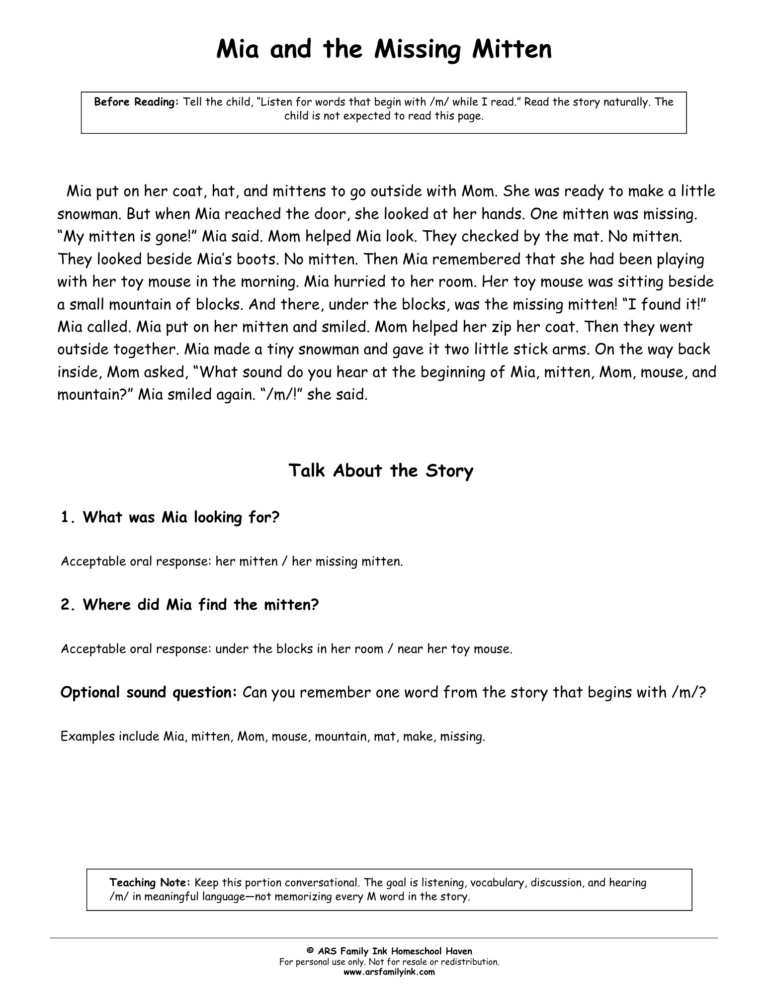
Bring the Letter M and the /m/ sound into a meaningful story with this free kindergarten read-aloud, Mia and the Missing Mitten.
In this adult-led activity, children listen to a short story about Mia searching for her missing mitten while paying attention to words that begin with /m/.
After listening, children answer two simple oral comprehension questions about the story. An optional sound question encourages them to remember a word beginning with /m/.
The child is not expected to read the story independently. The focus is listening, understanding, talking about the story, and hearing /m/ naturally within meaningful spoken language.
Download your free worksheet below:
What This Activity Teaches
This activity helps children hear the /m/ sound within meaningful spoken language rather than only practicing the sound through isolated words.
At the same time, the story gives children an opportunity to practice listening carefully, remembering important information, answering questions, and discussing what happened.
The activity connects early phonics instruction with oral language and comprehension without expecting beginning readers to decode a passage that is beyond their current independent reading ability.
How to Use This Read-Aloud
Before reading, tell your child:
“Listen for words that begin with /m/ while I read.”
Then read Mia and the Missing Mitten aloud naturally. Your child does not need to follow the printed words or attempt to read the passage independently.
After finishing the story, use the Talk About the Story questions to check listening comprehension.
Ask:
“What was Mia looking for?”
An acceptable response is her mitten or her missing mitten.
Then ask:
“Where did Mia find the mitten?”
An acceptable response is under the blocks in her room or near her toy mouse.
Finally, if appropriate, ask the optional sound question:
“Can you remember one word from the story that begins with /m/?”
Possible responses include Mia, mitten, Mom, mouse, mountain, mat, make, or missing.
Keep the conversation relaxed. Children do not need to memorize or identify every M word in the story.
Why This Skill Matters
Learning a letter-sound relationship becomes more meaningful when children begin noticing that sound in real spoken words.
After learning that M and m represent /m/, listening for /m/ within a story gives children another opportunity to recognize and apply that connection.
Read-alouds also support important language and comprehension development. Children can listen to and discuss language that may be more complex than what they can currently read independently.
This allows early phonics practice and comprehension development to grow alongside one another without making independent reading a requirement.
Skills Practiced
This read-aloud gives children practice with several important early literacy skills:
Listening Comprehension: Listening to a complete story and understanding what happens.
Story Recall: Remembering important details after hearing a story.
Oral Language: Talking about the story and answering questions aloud.
Beginning-Sound Awareness: Listening for /m/ at the beginning of spoken words.
Phonemic Awareness: Attending to an individual beginning sound within meaningful spoken language.
Letter-Sound Reinforcement: Reinforcing the connection between M/m and /m/.
Vocabulary Development: Hearing words used naturally within the context of a story.
Discussion Skills: Responding to questions and talking about ideas from a read-aloud.
Learning Goals
After participating in this read-aloud activity, children should be working toward being able to:
✔ Listen attentively to a short story read aloud
✔ Recall important information from a story
✔ Answer simple oral comprehension questions
✔ Identify what a character was looking for
✔ Recall where an important event occurred
✔ Listen for /m/ at the beginning of spoken words
✔ Recall at least one /m/ word from the story with appropriate support
✔ Connect the Letter M sound with meaningful spoken language
Parent & Teacher Tips:
Read the story naturally rather than heavily emphasizing every word that begins with M.
The goal is for children to begin noticing /m/ within meaningful spoken language—not to memorize every M word in the passage.
After reading, give your child time to think and answer the comprehension questions in their own words. Responses do not need to match the suggested wording exactly if they demonstrate understanding.
Most importantly, remember that this is an adult read-aloud. Your kindergarten child is not expected to independently read the story.
Extend the Learning
Continue exploring M/m and /m/ after reading the story with a few simple activities:
Remember an M Word: Ask your child to name one or two words from the story beginning with /m/.
Mia’s M Words: Say Mia, mitten, Mom, mouse, and mountain. Stretch /m/ slightly and listen to what they have in common.
Find More M Words: Think of other /m/ words together, such as milk, moon, map, or mop.
Retell the Story: Ask your child to tell what happened to Mia in their own words.
First, Next, Last: Talk about what happened at the beginning, middle, and end of Mia’s search.
Draw the Story: Have your child draw Mia finding her missing mitten and tell you about the picture.
These activities can extend the lesson while keeping the emphasis on oral language and meaningful interaction.
Materials Needed
This activity requires very little preparation. You will need:
Mia and the Missing Mitten printable read-aloud
An adult or older reader to read the story aloud
No pencil or written student response is required. The discussion and comprehension questions can be answered orally.
Perfect for Homeschool or Classroom Learning
Mia and the Missing Mitten is designed for flexible use during kindergarten reading instruction.
Homeschool families can use the story as a short read-aloud after Letter M instruction, providing an easy way to combine beginning-sound practice with conversation and comprehension.
Teachers and classroom educators can use it for whole-group read-alouds, small-group instruction, phonics follow-up, listening comprehension, or oral-language practice.
This resource is perfect for:
✔ Homeschool kindergarten reading
✔ Kindergarten classrooms
✔ Letter M lessons
✔ Beginning-sound practice
✔ Read-aloud time
✔ Listening comprehension
✔ Oral language development
✔ Small-group literacy instruction
✔ One-on-one learning
Building Early Reading Readiness
Early reading development includes both learning how written words work and developing the language and comprehension needed to understand what is read.
This activity brings several of those areas together.
Children hear /m/ in meaningful words while listening to a complete story. They then think about what happened, recall important details, and respond orally.
This creates a natural progression:
Hear the story → Listen for /m/ → Understand the message → Talk about what happened
Because an adult handles the reading, children can concentrate on listening, language, sound awareness, and comprehension without the additional demand of decoding the passage themselves.
You may also like:
Science
Simple science concepts, observation skills, and early exploration.
Numbers & Math
Counting, number recognition, basic math skills, and early problem-solving.
Reading & Writing
Early reading comprehension, handwriting, and sentence building skills.
Support Our Free Worksheets
If you enjoy these free worksheets, you can support our site by sharing with others, following us on social media, or joining our email list for more resources. It’s as easy as clicking the links at the bottom of the page. Your support helps us continue creating free printable learning materials.