Help your child discover that scientists can gather information by listening carefully, not just by looking.
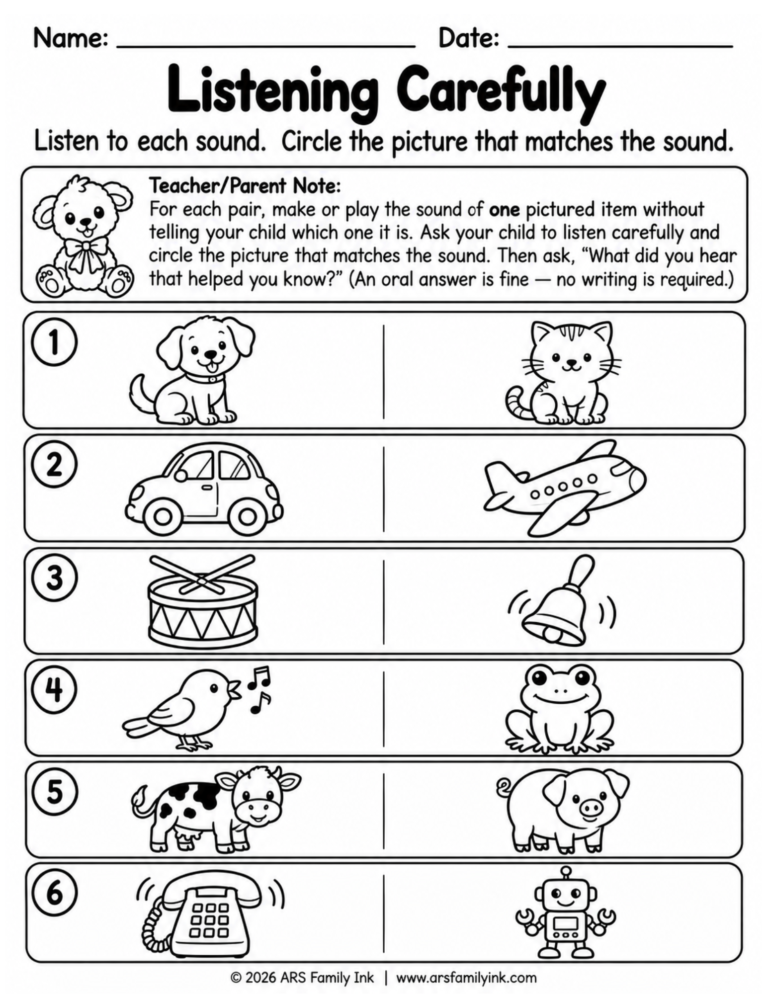
The free Listening Carefully kindergarten science worksheet gives children practice using their sense of hearing to identify familiar sounds. For each picture pair, an adult makes or plays the sound of one pictured item without revealing which one it is. The child listens carefully and circles the picture that matches.
Afterward, ask:
“What did you hear that helped you know?”
This simple question encourages children to think about the evidence they heard when making their choice.
Download your free worksheet below:
What This Worksheet Teaches
This worksheet teaches children that observations can involve more than what we see.
Children use their sense of hearing to gather information and distinguish between familiar sounds. They must listen for characteristics of a sound and connect what they hear with a possible source.
The follow-up question, “What did you hear that helped you know?”, encourages children to go one step further by explaining the evidence behind their choice.
The goal is not simply to guess the correct picture. It is to listen carefully, make an observation, and use that observation to make a decision.
How to Use This Worksheet
Begin by giving your child time to look carefully at both pictures.
Ask:
“What do you notice about the teddy bear?”
Then ask:
“What do you notice about the ball?”
After discussing several observations, ask:
“What is one way these two objects are the same?”
Encourage your child to use something visible in the pictures to support the answer.
Next ask:
“What is one way they are different?”
Have your child record an answer in each box or write their spoken response for them.
Avoid looking for one specific “correct” comparison. More than one answer may be reasonable as long as the child can connect the response to something observable in the pictures.
Why This Skill Matters
Science begins with gathering information about the world around us. Although young children often associate observation with looking, scientists can use different senses and tools to gather information.
Careful listening helps children notice that sounds can provide useful clues about objects, animals, and events.
When children explain what they heard that helped them identify a sound, they also begin practicing an important scientific habit: connecting a conclusion to evidence.
This creates an age-appropriate foundation for later investigations in which children observe, compare, describe, record, and explain what they discover.
Skills Practiced
This worksheet gives children practice with several important beginning science skills:
Auditory Observation: Using hearing to gather information about a sound.
Careful Listening: Paying close attention to characteristics of familiar sounds.
Sound Discrimination: Distinguishing one familiar sound from another.
Matching Evidence to a Source: Connecting an observed sound with the object or animal that could produce it.
Evidence-Based Thinking: Explaining what was heard that supported a choice.
Scientific Communication: Describing observations aloud.
Making Comparisons: Considering two possible sound sources and deciding which matches the evidence.
Attention and Focus: Concentrating on auditory information before responding.
Learning Goals
After completing this activity, children should be working toward being able to:
✔ Understand that hearing can be used to gather information
✔ Listen carefully to a familiar sound
✔ Distinguish between two possible sound sources
✔ Match a sound with the object or animal that could produce it
✔ Describe something they noticed about a sound
✔ Explain what they heard that helped them make a choice
✔ Use auditory information as evidence
✔ Participate in a simple science observation and discussion
Parent & Teacher Tips:
Try not to give away the answer through your wording, facial expression, or by pointing toward one of the pictures.
Let your child listen before making a choice.
After your child answers, focus on how they knew, not just whether they selected the picture you expected.
For example, rather than stopping after your child identifies a cow, ask:
“What did you hear that made you think it was the cow?”
If your child can explain that they heard a “moo”, they are connecting an auditory observation with evidence.
An oral explanation is completely appropriate. No written response is required.
Extend the Learning
Continue exploring sound and careful listening with simple activities:
Mystery Sound: Make a familiar sound while your child closes their eyes and ask them to identify its source.
Sound Walk: Sit outside or take a short walk and identify different sounds you hear.
Near or Far?: Listen to a sound and discuss whether it seems close by or farther away.
Loud and Quiet: Compare two safe sounds and describe which sounds louder or quieter.
Same or Different?: Make two sounds and ask whether they sound the same or different.
Describe the Sound: Encourage words such as loud, quiet, high, low, long, or short when they appropriately describe what your child hears.
Switch the Sounds: Repeat this worksheet another day using the opposite picture from some of the pairs.
Always keep sounds at a comfortable volume and avoid playing anything unexpectedly loud near a child’s ears.
Materials Needed
You will need:
Listening Carefully worksheet
Pencil or crayon
A way to make or play the sounds represented on the worksheet
You can make appropriate sounds yourself when practical or use short sound recordings.
The six pairs are dog/cat, car/airplane, drum/bell, bird/frog, cow/pig, and phone/robot.
There is no fixed answer key because the correct answer depends on which sound the adult chooses to make or play for each pair.
Perfect for Homeschool or Classroom Learning
The Listening Carefully worksheet can be used easily in homeschool or classroom science lessons.
Homeschool families can make many of the sounds themselves or play short sound recordings, making this a simple hands-on lesson that requires very little preparation.
Teachers and classroom educators can use the worksheet during whole-group instruction, small groups, science centers, listening activities, or one-on-one assessment.
This resource is especially useful for:
✔ Homeschool kindergarten science
✔ Kindergarten classrooms
✔ Observation lessons
✔ Five-senses investigations
✔ Listening activities
✔ Science centers
✔ Small-group instruction
✔ Evidence-based discussion
✔ One-on-one learning
Building Early Science Skills
This worksheet expands the observation work children have already begun in activities such as Science Is Noticing, Observation or Guess?, and Looking Carefully.
Those activities primarily encouraged children to gather information by looking closely. Listening Carefully introduces the idea that useful observations can also come through hearing.
The progression becomes:
Listen carefully → Notice characteristics of a sound → Identify its possible source → Explain the evidence
This helps children develop a broader understanding of observation before they move into activities involving multiple senses and simple scientific tools.
You may also like:
Science
Simple science concepts, observation skills, and early exploration.
Numbers & Math
Counting, number recognition, basic math skills, and early problem-solving.
Reading & Writing
Early reading comprehension, handwriting, and sentence building skills.
Support Our Free Worksheets
If you enjoy these free worksheets, you can support our site by sharing with others, following us on social media, or joining our email list for more resources. It’s as easy as clicking the links at the bottom of the page. Your support helps us continue creating free printable learning materials.