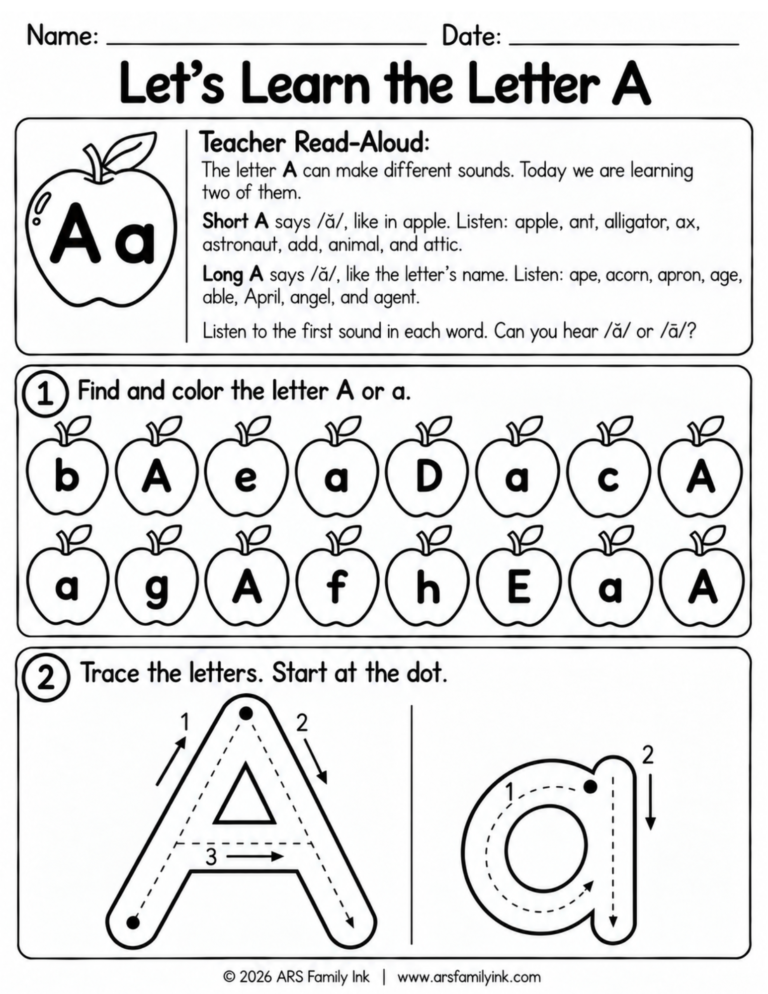
Introduce your child to uppercase A, lowercase a, and two common sounds of the letter A with this free kindergarten reading worksheet.
The Let’s Learn the Letter A activity begins with a short teacher or parent read-aloud introducing short A, as in apple, and long A, as in ape.
Children then practice finding uppercase A and lowercase a among other letters before tracing both forms using starting dots, numbered steps, and directional arrows.
This gives children several ways to interact with the letter A through listening, looking, identifying, and tracing.
Download your free worksheet below:
What This Worksheet Teaches
This worksheet introduces children to several important features of the letter A.
Children learn to recognize uppercase A and lowercase a and distinguish them from other printed letters.
They also hear that the letter A does not always represent exactly the same sound. The adult read-aloud introduces two common possibilities: short A /ă/ and long A /ā/.
The tracing activity then gives children guided practice following the movements used to form uppercase A and lowercase a.
The goal is introductory exposure and practice—not expecting children to master every spelling pattern associated with the sounds of A from this one worksheet.
How to Use This Worksheet
Begin with the Teacher Read-Aloud at the top of the worksheet.
Explain that the letter A can make different sounds and that today you will listen to two of them.
Read the short-A examples naturally, followed by the long-A examples. Encourage your child to listen to the beginning of each word.
You can repeat individual words when necessary, but this first activity should remain an introduction rather than a test.
For Part 1, ask your child to look carefully at each apple and color only those containing uppercase A or lowercase a.
For Part 2, have your child begin at the dot and follow the numbered and directional cues to trace uppercase A and lowercase a.
Encourage slow, controlled tracing rather than rushing to finish the letters.
Why This Skill Matters
Strong alphabet knowledge involves recognizing letters, connecting letters with sounds, and becoming familiar with how letters are formed.
The letter A is particularly useful for showing children that a letter can be associated with more than one sound.
Learning to recognize A/a and hear its sounds contributes to the letter-sound knowledge children will later use when learning to decode and spell words.
Tracing also gives children an opportunity to connect the visual form of the letter with the physical movements used to produce it.
Bringing these skills together helps children develop a more complete understanding of the letter.
Skills Practiced
This worksheet gives children practice with several important early literacy skills:
Uppercase Letter Recognition: Finding and identifying uppercase A.
Lowercase Letter Recognition: Finding and identifying lowercase a.
Visual Letter Discrimination: Distinguishing A/a from other printed letters.
Letter-Sound Awareness: Connecting the letter A with spoken sounds.
Short Vowel Awareness: Listening to examples containing initial short A /ă/.
Long Vowel Awareness: Listening to examples containing initial long A /ā/.
Auditory Discrimination: Listening for differences between two vowel sounds.
Letter Formation: Following guided movements to trace uppercase A and lowercase a.
Fine-Motor Practice: Using controlled hand movements while coloring and tracing.
Learning Goals
After completing this activity, children should be working toward being able to:
✔ Recognize uppercase A
✔ Recognize lowercase a
✔ Distinguish A and a from other printed letters
✔ Understand that the letter A can represent different sounds
✔ Hear short A /ă/ in spoken examples
✔ Hear long A /ā/ in spoken examples
✔ Begin distinguishing short A from long A when listening to familiar words
✔ Follow visual cues to trace uppercase A
✔ Follow visual cues to trace lowercase a
✔ Strengthen the connection between a letter’s appearance, sounds, and formation
Parent & Teacher Tips:
Keep the short-A and long-A portion focused on listening.
Your child does not need to read words such as astronaut, attic, acorn, or agent. The adult reads the examples aloud while the child listens to the beginning sound.
It is also okay if distinguishing /ă/ and /ā/ is difficult at first. The worksheet is introducing the contrast and providing exposure.
When tracing, encourage your child to follow the starting dots, numbers, and arrows rather than simply coloring over the letter shape. This helps make the activity intentional letter-formation practice.
Extend the Learning
Continue exploring the letter A with simple activities:
Find A: Search for uppercase A and lowercase a in books, labels, signs, or other print.
Short A Listening: Say simple words such as apple, ant, and ax and listen to their beginning sounds.
Long A Listening: Compare with words such as ape, acorn, and apron.
Which A Sound?: Say one familiar example at a time and ask whether the beginning sounds more like apple or ape.
A Picture Hunt: Find or draw pictures of objects whose names begin with A.
Air Writing: Use a finger to make a large uppercase A and lowercase a in the air.
Independent Writing: After tracing, let your child try forming A and a on blank paper or another writing surface.
Keep sound practice brief and playful. Children do not need to master all of the ways the letter A can be spelled or pronounced during this introductory lesson.
Materials Needed
You will need:
Let’s Learn the Letter A worksheet
Pencil
Crayon or colored pencil for the letter-finding activity
An adult to read the sound lesson and example words aloud
Perfect for Homeschool or Classroom Learning
The Let’s Learn the Letter A worksheet can be used for focused alphabet and beginning phonics instruction in both homeschool and classroom settings.
Homeschool families can use the read-aloud portion as a short instructional lesson before completing the letter-recognition and tracing activities.
Teachers and classroom educators can use the worksheet during explicit alphabet instruction, phonics lessons, small groups, literacy centers, or additional practice.
This worksheet is especially useful for:
✔ Homeschool kindergarten reading
✔ Kindergarten classrooms
✔ Letter A introduction
✔ Alphabet recognition
✔ Beginning phonics
✔ Short and long vowel introduction
✔ Letter formation practice
✔ Small-group literacy instruction
✔ One-on-one practice
Building Early Reading Readiness
Early reading instruction gradually connects spoken sounds with printed letters.
This worksheet gives children several opportunities to build that connection with the letter A:
Hear the sounds → See A and a → Find the letters → Trace their forms
Children also begin learning an important idea about English print: a letter does not necessarily represent only one sound in every word.
At this stage, children do not need to memorize complex vowel rules. The purpose is to build familiarity with A/a while giving them meaningful exposure to short and long A.
As letter-sound knowledge grows, children will be better prepared to use these connections when blending, decoding, and spelling words.
You may also like:
Science
Simple science concepts, observation skills, and early exploration.
Numbers & Math
Counting, number recognition, basic math skills, and early problem-solving.
Reading & Writing
Early reading comprehension, handwriting, and sentence building skills.
Support Our Free Worksheets
If you enjoy these free worksheets, you can support our site by sharing with others, following us on social media, or joining our email list for more resources. It’s as easy as clicking the links at the bottom of the page. Your support helps us continue creating free printable learning materials.