Understanding the difference between a letter, word, number, and picture is an important early reading-readiness and print-concepts skill.
This free Letters, Words, Numbers, or Pictures? kindergarten worksheet and teacher script provides children with hands-on practice identifying and sorting these different types of symbols and images.
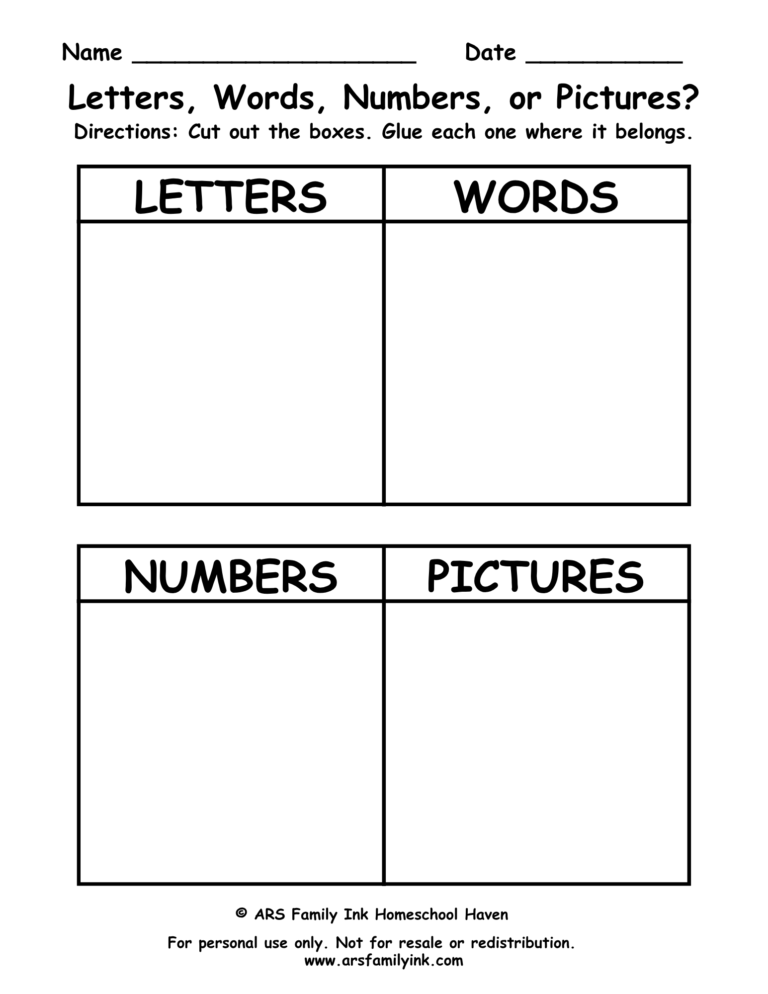
The student activity includes two printable pages. Children cut apart 16 items and sort them onto a mat labeled Letters, Words, Numbers, and Pictures. A coordinating three-page teacher script provides explicit instruction, guided practice, review questions, and an assessment to help parents and teachers introduce the skill before independent practice.
Download your free worksheet below:
Teacher Script Included
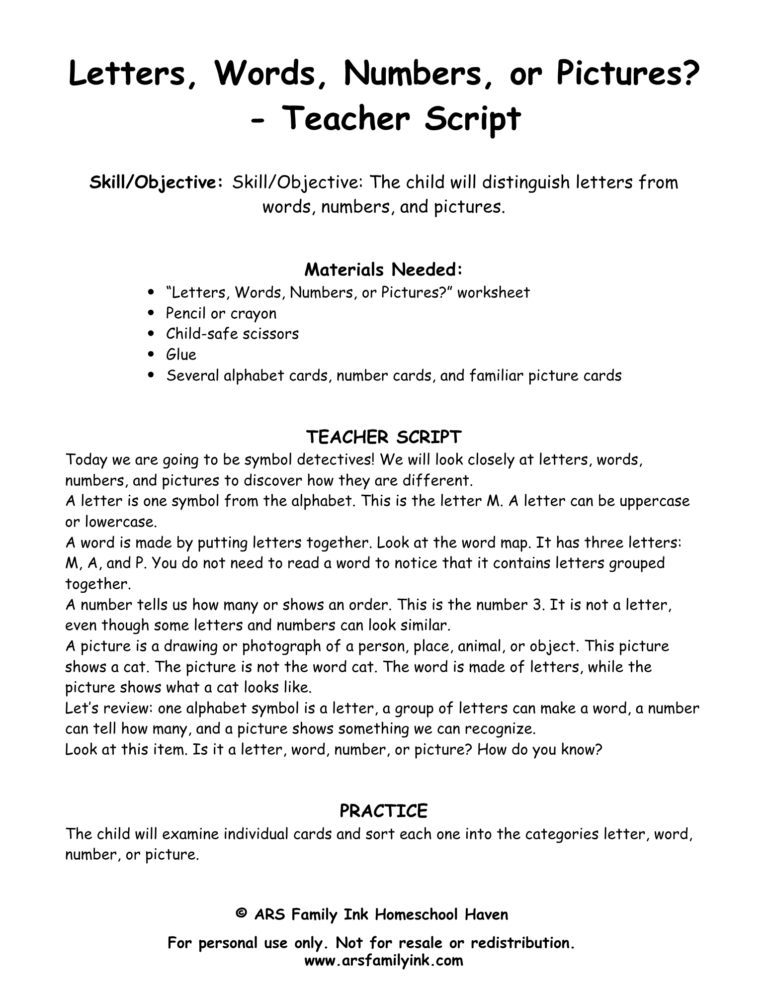
This resource also includes a coordinating three-page teacher script designed to help an adult teach the concept before the child completes the sorting activity.
The teacher script introduces each category individually and helps children understand that:
A letter is one symbol from the alphabet.
A word is made by putting letters together.
A number can tell how many or show an order.
A picture is a drawing or photograph representing something we can recognize.
The lesson then progresses through guided practice, independent practice, review, and assessment.
Download your free worksheet below:
What This Worksheet Teaches
This worksheet teaches children to visually distinguish among letters, words, numbers, and pictures.
This distinction is important because beginning readers need to understand that not every mark or image on a page functions in the same way.
A single alphabet symbol can be a letter, while several letters grouped together can form a word. Numerals represent numbers, while pictures visually represent people, animals, objects, or places.
The activity allows children to compare these categories directly and decide where each item belongs.
How To Use This Worksheet
Begin with the included teacher script or a short hands-on demonstration.
Show your child one example of each category: a single letter, a printed word, a number, and a familiar picture.
Talk about what makes each one different.
Then give your child the two-page worksheet.
Keep the sorting mat on Page 1 intact. Cut apart the individual boxes on Page 2.
Have your child examine one item at a time and decide whether it belongs under Letters, Words, Numbers, or Pictures.
Before gluing the pieces down, consider having your child place all 16 pieces into the appropriate categories first. Check the completed sorting activity together and then allow the child to glue the pieces into place.
How to Use the Teacher Script
The teacher script can be used immediately before the worksheet to turn the printable into a more complete kindergarten lesson.
Gather a few alphabet cards, number cards, and familiar picture cards along with the worksheet, scissors, glue, and a pencil or crayon. These are the materials identified in the lesson.
Introduce the four categories and model examples before asking your child to classify items independently.
During guided practice, ask questions such as:
“Is this one letter or a group of letters?”
“Does it show a number?”
“Is it a drawing of something?”
“Which group should it join?”
“How do you know?”
These questions encourage children not only to sort an item but also to think about why it belongs in a particular category.
Why This Skill Matters
Learning to distinguish letters, words, numbers, and pictures helps children understand how information is represented on a printed page.
A young learner may recognize a familiar logo, picture, letter, or numeral without yet understanding that these elements serve different purposes.
Sorting them into separate categories helps make those differences more concrete.
This creates a foundation for later concepts such as identifying words in sentences, recognizing spaces between words, distinguishing letters from whole words, and understanding how print carries language.
Skills Practiced
Distinguishing letters from words
Recognizing individual alphabet symbols
Recognizing groups of letters as words
Distinguishing letters from numbers
Distinguishing words from pictures
Recognizing numerals
Categorizing visual information
Comparing printed symbols
Visual discrimination
Sorting and classification
Following oral directions
Cutting and gluing
Fine-motor coordination
Early concepts of print
Reading readiness
Learning Goals
After completing the lesson and worksheet, children should be working toward being able to:
Identify an individual alphabet symbol as a letter.
Recognize that a group of letters can form a word.
Distinguish letters and words from numbers.
Distinguish printed words from pictures.
Sort examples into letter, word, number, and picture categories.
Explain simple visual differences among the four categories.
Apply the concept to unfamiliar examples.
The central objective of the teacher script is for the child to distinguish letters from words, numbers, and pictures.
Parent & Teacher Tips:
Keep the focus on classification rather than reading. A child can correctly identify an item as a word without being able to read that word.
Ask your child to explain how they know where an item belongs. Their explanation can reveal whether they understand the concept or are simply guessing.
If your child confuses letters and numbers, place one of each side by side and talk about their different purposes.
If your child confuses words and pictures, compare a printed word with a picture representing the same thing.
For children who are not yet comfortable cutting, an adult can cut apart the pieces so the child can focus on the literacy skill.
For children ready for a challenge, provide new examples that were not included on the worksheet and ask them to classify those as well.
Extend the Learning
Sort Around the House: Find examples of letters, words, numbers, and pictures on food packages, books, calendars, and other everyday materials.
Make Four Piles: Use alphabet cards, number cards, simple word cards, and picture cards to create four sorting groups.
Letter or Word?: Show one letter and then a short word. Ask your child to explain what makes them different.
Word or Picture?: Draw a simple object and write its name beside it. Ask which one is the picture and which one is the word.
Symbol Detective: Open a children’s book and ask your child to find a letter, a word, a number if one appears, and a picture.
Materials Needed
2-page Letters, Words, Numbers, or Pictures? worksheet
3-page teacher script
Pencil or crayon
Child-safe scissors
Glue
Alphabet cards
Number cards
Familiar picture cards
Perfect for Homeschool or Classroom Learning
This printable lesson works well for kindergarten reading readiness, concepts of print instruction, beginning literacy lessons, homeschool reading practice, literacy centers, small groups, and one-on-one instruction.
Because the resource combines explicit teaching, hands-on sorting, guided practice, independent practice, review, and assessment, it can be used as a complete mini-lesson rather than only as an individual worksheet.
Building Early Reading Readiness
Before children can successfully work with printed words, they need to develop an understanding of what print is and how it differs from other symbols and pictures.
Recognizing that a word is made from a group of letters is an important early concept of print. A child does not necessarily have to read the word to recognize that several alphabet letters have been grouped together to form one.
The included teacher script specifically reinforces this distinction. For example, it recommends comparing the printed word dog directly with a picture of a dog so the child can see that the word is made from letters while the picture visually represents the animal.
This type of comparison helps children begin looking at print more intentionally and prepares them for later work with letters, words, sentences, and early reading.
You may also like:
Science
Simple science concepts, observation skills, and early exploration.
Numbers & Math
Counting, number recognition, basic math skills, and early problem-solving.
Reading & Writing
Early reading comprehension, handwriting, and sentence building skills.
Support Our Free Worksheets
If you enjoy these free worksheets, you can support our site by sharing with others, following us on social media, or joining our email list for more resources. It’s as easy as clicking the links at the bottom of the page. Your support helps us continue creating free printable learning materials.