Learning where to begin reading and how to follow print across a page is an important part of early reading readiness. This free Follow the Words kindergarten worksheet and teacher script gives children guided practice moving from left to right, tracking words in order, and moving down to the next line of print.
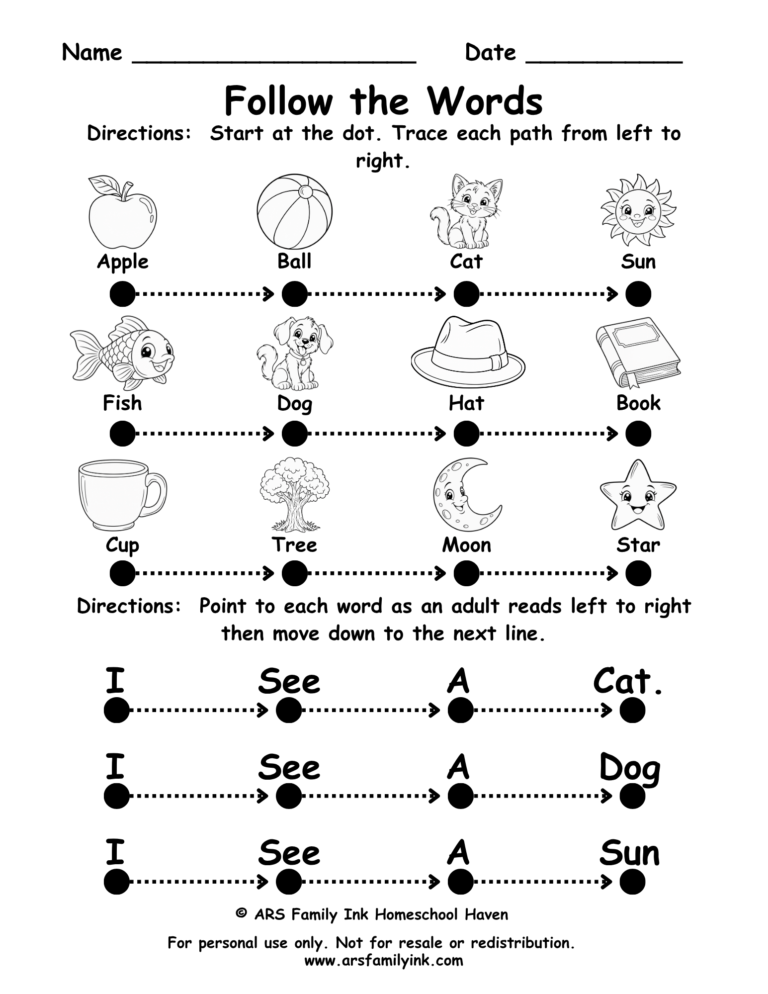
The worksheet begins with simple picture paths so children can physically practice the left-to-right movement used during English reading. Children then point to individual words while an adult reads short sentences aloud, helping them connect that directional movement with real print.
A coordinating teacher script is included to provide explicit instruction and hands-on practice before children complete the worksheet.
Download your free worksheet below:
Teacher Script Included
This printable includes a coordinating Follow the Words teacher script that introduces children to the way our eyes and fingers move when following English print.
The lesson explicitly teaches children to begin on the left, move toward the right, return to the left at the end of a line, and move down to the next line. The script also introduces the term return sweep and provides a simple demonstration using a children’s picture book.

Download your free worksheet below:
What This Worksheet Teaches
The Follow the Words worksheet focuses on print directionality and early print tracking.
Children first trace three picture paths from left to right. These paths provide a simple visual and motor introduction to the direction used when reading English print.
Children then practice following three short sentences:
I see a cat.
I see a dog.
I see a sun.
An adult reads each sentence aloud while the child points to each word from left to right. After completing one line, the child moves back to the left and down to the beginning of the next line.
How To Use This Worksheet
Begin with the picture section at the top of the worksheet. Ask your child to place a pencil, crayon, or finger on the first black dot. Have the child follow the dotted path and arrows from left to right.
Repeat with all three picture rows.
As your child moves across each row, you can reinforce the direction by saying:
“Start on the left. Move toward the right.”
Next, move to the sentences at the bottom of the worksheet.
Read the directions aloud. Have your child place a finger on the dot beneath the first word. Slowly read the sentence aloud while your child points to each word in order.
At the end of the sentence, help your child return to the left side of the page and move down to the next sentence.
Repeat until all three sentences have been tracked.
How to Use the Teacher Script
Before completing the worksheet, use the included teacher script with a children’s picture book that has large, easy-to-see print.
Model where reading begins and slowly move your finger underneath the words from left to right.
When you reach the end of a line, demonstrate how your finger returns to the left and moves down to the next line. Explain that this movement is called a return sweep.
Then allow your child to imitate the movement with a finger, craft stick, index finger, or small pointer.
Once your child understands the movement, transition to the Follow the Words worksheet for additional guided practice.
Why Start With Pictures Before Words?
The picture paths at the beginning of this worksheet are intentional.
They allow children to practice the physical movement of going from left to right before they are asked to follow actual printed words.
Because children do not need to decode the pictures, they can concentrate on directionality first. The second part of the worksheet then transfers the same left-to-right movement to simple printed sentences.
This creates a gradual progression from visual directionality → print directionality → word tracking.
Skills Practiced
Left-to-right directionality
Tracking print across a line
Beginning at the left side of a line
Moving from the top of a page toward the bottom
Returning to the left for a new line
Developing return-sweep awareness
Pointing to words individually
Connecting spoken words with printed words
Recognizing that spaces separate words
Following oral directions
Visual tracking
Early concepts of print
Reading readiness
Learning Goals
After completing the lesson and worksheet, children should be working toward being able to:
Show where reading begins on a line of English print.
Track print from left to right.
Point to words in sequence as an adult reads.
Recognize that readers move down the page from one line to another.
Return to the left after reaching the end of a line.
Demonstrate beginning awareness of a return sweep.
Apply print-direction concepts during shared reading.
Parent & Teacher Tips:
Move slowly when first modeling print tracking. Children need time to coordinate what they hear with what they see on the page.
Encourage your child to point beneath each word rather than sliding quickly across the entire sentence.
If your child loses their place, return to the first word and model the sentence again.
Do not require the child to independently read all of the words. The primary goal of this activity is understanding how to follow print, not testing decoding ability.
Repeat the activity with familiar picture books during read-aloud time. Pointing to print occasionally while reading can help children see these concepts being used in real books.
Extend the Learning
Follow My Finger: During a favorite read-aloud, occasionally run your finger beneath a short line of text from left to right.
Find the Beginning: Open a book to a page and ask, “Where should I start reading?”
Which Way Do We Go? Place your finger at the beginning of a line and ask your child to point in the direction you should move.
Practice the Return Sweep: Draw several horizontal lines on paper. Have your child trace across one line, return to the left, move down, and trace the next.
Be the Teacher: Let your child use a pointer and show a stuffed animal how we follow words across a page.
Materials Needed
Follow the Words worksheet
Follow the Words teacher script
Children’s picture book with large print
Pencil or crayon
Finger, craft stick, or small pointer
Perfect for Homeschool or Classroom Learning
This free printable is appropriate for kindergarten reading readiness, concepts of print instruction, beginning-of-the-year literacy lessons, homeschool reading instruction, small-group literacy practice, and one-on-one intervention or review.
The teacher script, picture paths, word-tracking activity, and real-book practice work together to provide children with multiple opportunities to learn and apply print directionality.
Building Early Reading Readiness
Before children can read sentences independently, they need to understand how print works on a page. Early readers learn that English print follows an organized path rather than being read randomly.
Children gradually learn that reading begins on the left, words are followed from left to right, and readers move down the page as they progress through multiple lines of text.
The Follow the Words activity allows children to practice these concepts without requiring them to independently decode every word. An adult provides the reading while the child concentrates on following the print.
This helps separate the mechanics of tracking print from the more difficult task of decoding, making the activity appropriate for children who are still developing beginning reading skills.
You may also like:
Science
Simple science concepts, observation skills, and early exploration.
Numbers & Math
Counting, number recognition, basic math skills, and early problem-solving.
Reading & Writing
Early reading comprehension, handwriting, and sentence building skills.
Support Our Free Worksheets
If you enjoy these free worksheets, you can support our site by sharing with others, following us on social media, or joining our email list for more resources. It’s as easy as clicking the links at the bottom of the page. Your support helps us continue creating free printable learning materials.