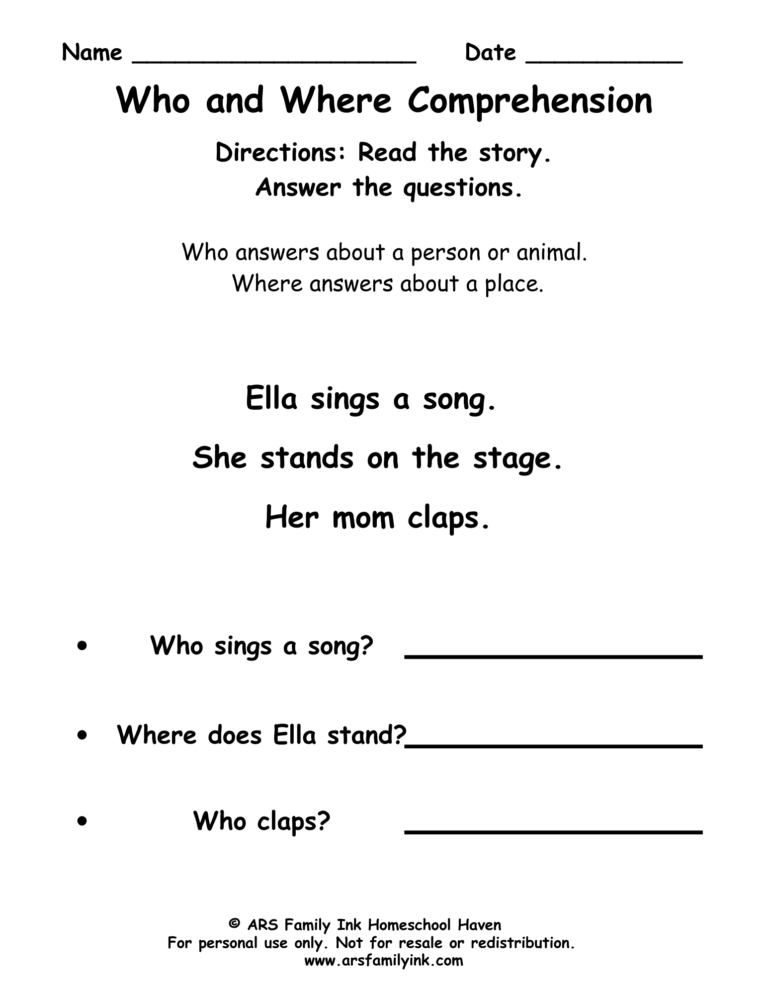
Help your beginning reader practice finding important information in a short passage with this free Who and Where Reading Comprehension Worksheet.
Children read three simple sentences about Ella singing a song on stage and answer questions about who sings, where Ella stands, and who claps.
This printable provides focused reading comprehension practice for kindergarten and beginning first grade learners.
Download your free worksheet below:
What Children Will Practice
This worksheet helps children practice:
✔ Reading a short passage
✔ Answering Who questions
✔ Answering Where questions
✔ Identifying people in a story
✔ Identifying where an action takes place
✔ Finding directly stated information
✔ Understanding simple pronouns
✔ Recalling important story details
How To Use This Worksheet
Have your child read the three-sentence passage independently or read it aloud together.
After reading, ask your child to answer each question using information found directly in the passage. Encourage your child to look back at the story whenever an answer is not immediately remembered.
Beginning readers can also answer the questions orally before writing their responses.
Why Who and Where Questions Matter
Understanding who is involved in a story and where an event takes place helps children build a foundation for reading comprehension.
These questions teach young readers to pay attention to important story information rather than focusing only on reading individual words.
As children become comfortable finding people and places in simple passages, they are better prepared to understand characters, settings, actions, and events in longer texts.
Skills Covered
Answering Who Questions
Children identify Ella as the person who sings the song.
They also identify Ella’s mom as the person who claps.
This gives children two opportunities to answer a Who question using different people from the same passage.
Answering Where Questions
Students determine that Ella stands on the stage.
Pronoun Comprehension
The passage introduces Ella and then says:
“She stands on the stage.”
Children practice understanding that she refers to Ella.
Finding Text Evidence
All three answers are stated directly in the passage, allowing beginning readers to practice locating information without requiring inference.
Learning Goals
After completing this worksheet, children should be able to:
✔ Identify people mentioned in a short passage
✔ Identify where an action occurs
✔ Answer simple Who and Where questions
✔ Connect the pronoun “she” with Ella
✔ Find answers stated directly in a text
✔ Recall important details after reading
Parent & Teacher Tips:
Encourage your child to find the sentence containing the answer before writing.
For “Who sings a song?”, the child can return to:
“Ella sings a song.”
For “Where does Ella stand?”, the child can find:
“She stands on the stage.”
This simple habit begins teaching children that answers to reading comprehension questions can often be supported with evidence from the text.
If writing is difficult, allow your child to answer orally first and then help with writing as needed.
Extend the Learning
Find the Who:
Ask your child to name both people mentioned in the passage: Ella and her mom.
Find the Where:
Ask, “Where is Ella?” Answer: On the stage.
Pronoun Practice:
Ask, “Who does she mean in the second sentence?” Answer: Ella.
Act It Out:
Have your child pretend to sing on a stage while another person pretends to clap.
Draw the Story:
Have your child draw Ella singing on stage with her mom watching.
Questions To Ask Children:
Who sings the song?
Where does Ella stand?
Who claps?
Why do you think Ella’s mom claps?
How do you think Ella feels while singing?
The final two questions provide optional inference practice beyond the literal comprehension required on the worksheet.
Building Early Reading Comprehension
Short passages give beginning readers an opportunity to practice understanding complete ideas without becoming overwhelmed by a large amount of text.
This worksheet adds an especially useful variation because there are two people in the passage. Children must distinguish between Ella, who sings, and her mom, who claps. This requires slightly more careful attention than a passage containing only one character.
You may also like:
Science
Simple science concepts, observation skills, and early exploration.
Numbers & Math
Counting, number recognition, basic math skills, and early problem-solving.
Reading & Writing
Early reading comprehension, handwriting, and sentence building skills.
Support Our Free Worksheets
If you enjoy these free worksheets, you can support our site by sharing with others, following us on social media, or joining our email list for more resources. It’s as easy as clicking the links at the bottom of the page. Your support helps us continue creating free printable learning materials.