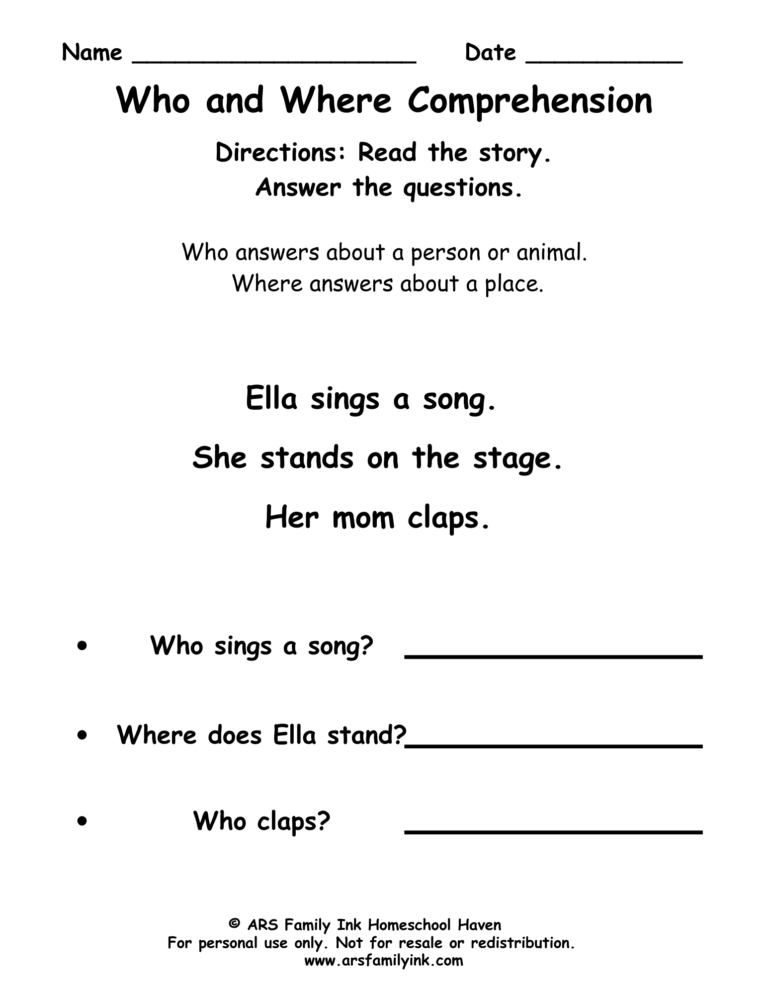
Help your beginning reader practice finding important information in a short passage with this free Who and Where Reading Comprehension Worksheet.
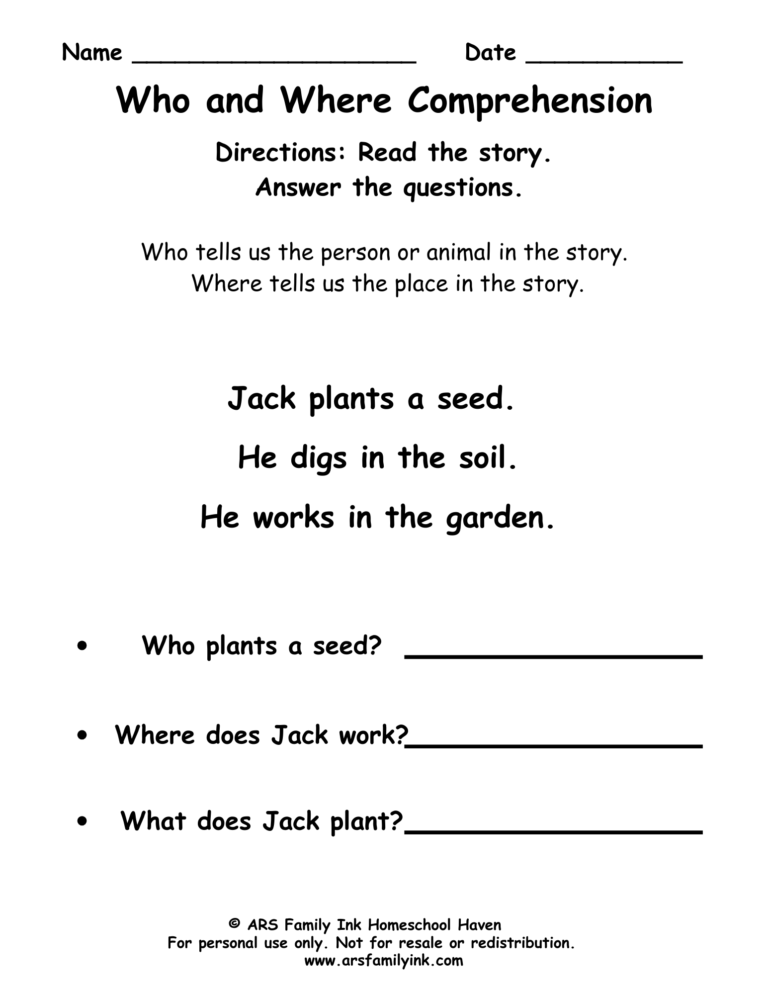
Children read three simple sentences about Jack planting a seed and working in the garden. They then answer questions about who plants the seed, where Jack works, and what he plants.
This printable provides simple, focused reading comprehension practice for kindergarten and beginning first grade learners.
Download your free worksheet below:
What Children Will Practice
This worksheet helps children practice:
✔ Reading a short passage
✔ Answering Who questions
✔ Answering Where questions
✔ Identifying the person in a story
✔ Identifying where an action takes place
✔ Finding directly stated information
✔ Understanding the pronoun “he”
✔ Recalling an important story detail
How To Use This Worksheet
Have your child read the three-sentence passage independently or read it aloud together.
After reading, have your child answer each question using information found in the passage. Encourage your child to return to the story and locate the sentence containing the answer.
For children who are still developing their writing skills, allow them to answer orally before writing their responses.
Why Who and Where Questions Matter
Who and Where questions teach beginning readers to identify two important parts of a text: who is involved and where something happens.
Learning to locate these details helps children move beyond simply decoding words and begin thinking about what those words mean together.
With repeated practice, children build foundational comprehension skills that prepare them for identifying characters, settings, actions, events, and other important details in longer stories.
Skills Covered
Answering Who Questions
Children determine that Jack is the person who plants a seed.
Answering Where Questions
Children determine that Jack works in the garden.
Finding an Important Detail
Children identify a seed as the thing Jack plants.
Pronoun Comprehension
The passage begins by naming Jack and then uses the pronoun “he” in the following two sentences.
Children practice recognizing that he refers to Jack.
Finding Text Evidence
Each answer is directly stated in the passage, making the worksheet appropriate for children who are developing literal reading comprehension.
Learning Goals
After completing this worksheet, children should be able to:
✔ Identify the person in a short passage
✔ Identify where an action takes place
✔ Answer basic Who, Where, and What questions
✔ Connect the pronoun “he” with Jack
✔ Recall an important detail
✔ Find answers directly within a text
Parent & Teacher Tips:
Encourage your child to go back to the passage when answering each question.
For example, when answering “Where does Jack work?”, have your child locate:
“He works in the garden.”
Then ask which words tell where Jack works.
For “What does Jack plant?”, have the child return to:
“Jack plants a seed.”
This helps children develop the important habit of using information from the text to support their answers.
Extend the Learning
Find the Who:
Ask, “Who is this passage about?” Answer: Jack.
Find the Where:
Ask, “Where does Jack work?” Answer: In the garden.
Pronoun Practice:
Ask, “Who does he mean in the story?” Answer: Jack.
Sequence the Actions:
Ask your child what Jack does in the passage: he plants, digs, and works in the garden.
Draw the Story:
Have your child draw Jack planting a seed in the garden.
Make a Prediction:
Ask, “What do you think might grow from Jack’s seed?”
Questions To Ask Children:
Who plants the seed?
What does Jack dig in?
Where does Jack work?
What does Jack plant?
What do you think Jack’s seed might grow into?
Building Early Reading Comprehension
Short passages like this allow beginning readers to practice understanding a complete text while keeping the reading demand manageable.
This worksheet also reinforces an important early comprehension skill through the repeated use of “he.” Children must understand that Jack, he, and he all refer to the same person across the three sentences.
You may also like:
Science
Simple science concepts, observation skills, and early exploration.
Numbers & Math
Counting, number recognition, basic math skills, and early problem-solving.
Reading & Writing
Early reading comprehension, handwriting, and sentence building skills.
Support Our Free Worksheets
If you enjoy these free worksheets, you can support our site by sharing with others, following us on social media, or joining our email list for more resources. It’s as easy as clicking the links at the bottom of the page. Your support helps us continue creating free printable learning materials.