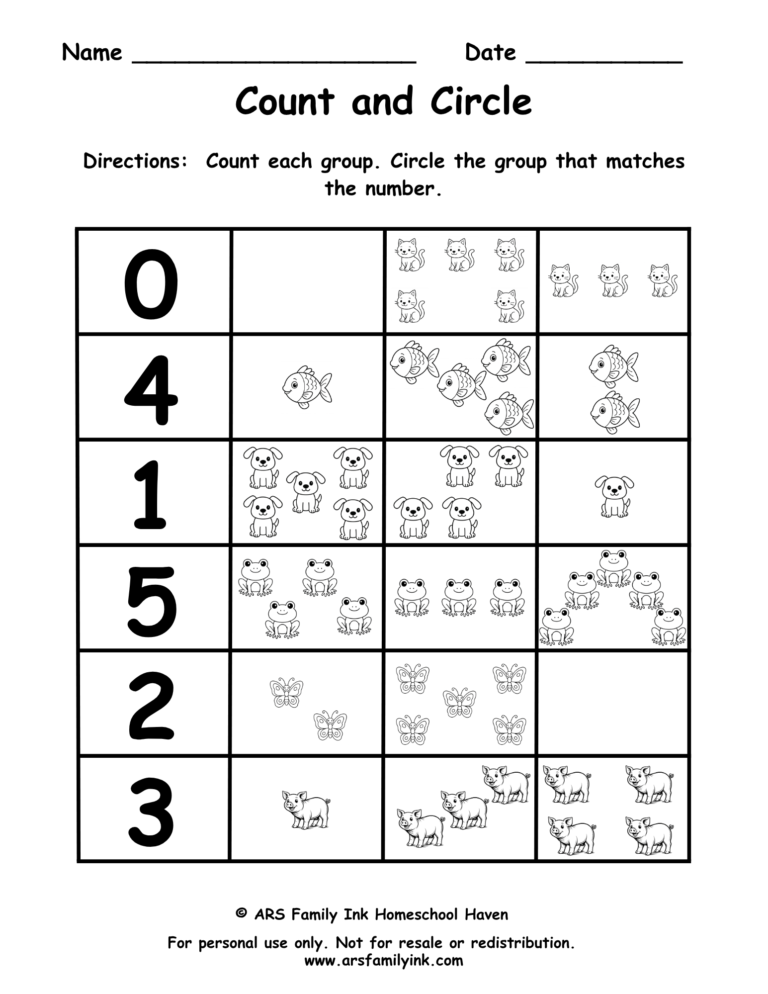
Help your preschooler discover that zero means none with this free printable preschool math worksheet from ARS Family Ink Homeschool Haven!
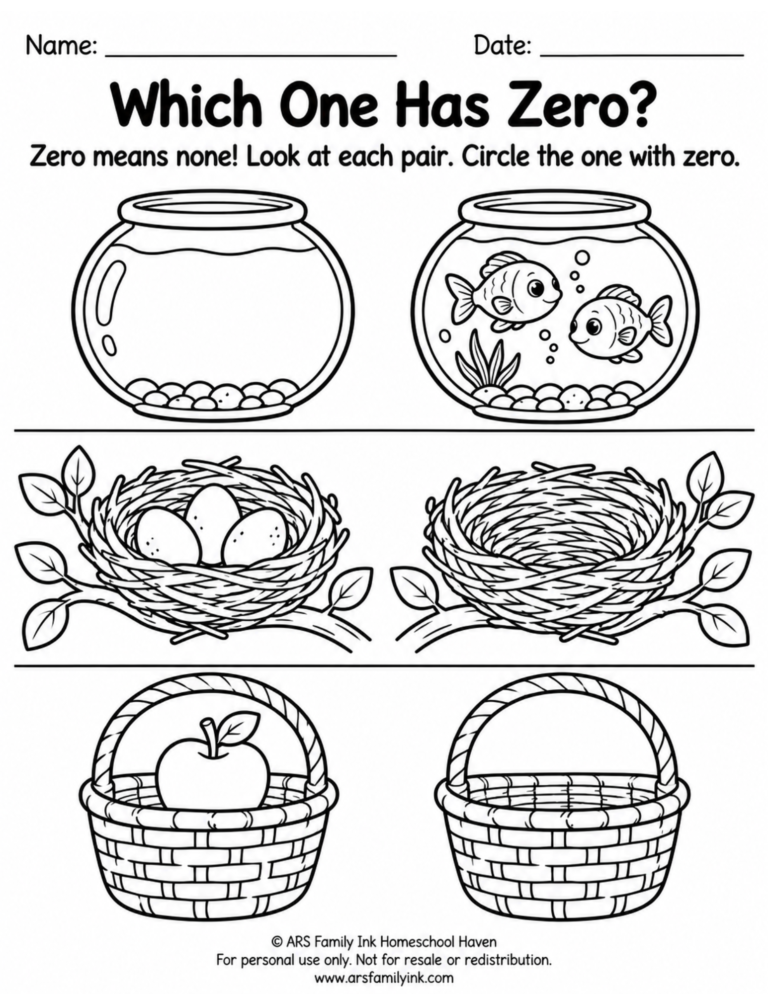
In Which One Has Zero?, children look at three pairs of familiar pictures and identify which one contains no objects. With fishbowls, bird nests, and apple baskets, this simple activity makes the concept of zero easier to see and understand.
Perfect for homeschool lessons, preschool math practice, or a quick classroom activity, this worksheet gives young learners an opportunity to explore an important early number concept.
Download your free worksheet below:
What This Worksheet Teaches
This preschool math worksheet introduces the meaning of zero through visual examples. Children learn that when a group has no objects, the quantity is zero.
The worksheet includes three comparisons:
Fishbowls: One fishbowl is empty, while the other contains two fish.
Bird Nests: One nest contains three eggs, while the other has none.
Apple Baskets: One basket contains an apple, while the other is empty.
Children examine each pair and circle the picture showing zero objects.
The activity encourages children to connect the spoken word zero with an empty group while practicing observation and comparison.
How to Use This Worksheet
Download and print the free worksheet.
Introduce zero. Explain that zero means none or nothing in a group.
Look at the first pair together. Ask your child to find the fishbowl with no fish.
Circle the empty picture. Have your child circle the picture showing zero.
Continue with the nests and baskets. Encourage your child to look carefully before choosing.
Review the answers. Talk about why each circled picture represents zero.
For children who are just beginning to recognize empty groups, point to each picture and ask, “Do you see any fish, eggs, or apples?”
Children who are ready for more independence can complete the comparisons with less assistance.
Why This Skill Matters
Understanding zero is an important part of developing early number sense. Children may learn to count objects before they fully understand that a group can also contain none.
Recognizing empty groups helps preschoolers begin to understand that numbers describe quantities, including a quantity of zero.
This concept also supports later learning about comparing amounts, counting, and simple subtraction.
By using familiar objects and clear visual differences, this worksheet gives young learners a concrete introduction to the meaning of zero.
Skills Practiced
Recognizing zero as none
Identifying empty groups
Comparing groups with and without objects
Observing pictures for differences
Following simple directions
Using visual information to make a choice
Practicing pencil control through circling
Learning Goals
With developmentally appropriate guidance, children will have opportunities to:
Understand that zero represents a group with no objects.
Identify an empty group in a pair of pictures.
Distinguish between a group containing objects and a group containing none.
Use the word zero when describing an empty group.
Follow the direction to circle the picture showing zero.
Children may need repeated experiences with real objects before they can confidently recognize zero in pictures. This worksheet can be revisited as their understanding develops.
Parent & Teacher Tips:
Start with real objects. Place two or three small toys on a table, then remove them. Ask, “How many toys are left?” Explain that when none remain, there are zero.
Use everyday language. Reinforce the connection between none, empty, and zero during familiar routines.
Encourage observation. Give children time to compare each picture before circling their answer.
Support developing motor skills. If circling is difficult, let children point to the correct picture while an adult helps mark it.
Keep the activity positive. Some preschoolers will recognize empty groups immediately, while others benefit from additional hands-on practice.
Extend the Learning
Continue exploring zero with simple activities using items you already have at home or in the classroom.
Empty and Full: Show two containers, one holding several blocks and one empty. Ask which contains zero blocks.
Snack-Time Zero: After a child finishes their crackers, ask how many remain on the plate.
Toy Counting: Place a few toy animals in a box, then remove them all. Talk about the box having zero animals.
Find Zero: Look for empty baskets, cups, or containers around the room.
Optional Challenge: Show the written numeral 0 and explain that it is the number symbol for zero.
These activities help connect the worksheet’s pictures to meaningful everyday experiences.
Materials Needed
Printed Which One Has Zero? worksheet
Pencil or crayon
Optional: Small toys, blocks, or other safe counting objects for hands-on demonstrations.
No cutting, gluing, or additional worksheet pages are required.
Perfect for Homeschool or Classroom Learning
This free preschool math worksheet works well for homeschool families, preschool classrooms, small-group lessons, and individual practice.
Parents can introduce the concept of zero during a short, guided activity, while teachers can use the worksheet to reinforce hands-on lessons about empty groups.
Because the worksheet features three picture comparisons, it can be completed in a brief learning session without requiring a lengthy lesson.
The black-and-white design also allows children to color the pictures afterward if they enjoy adding a creative element to their math activities.
Building Early Number Sense by Understanding Zero
Early number sense involves more than learning to count aloud. Children also begin to understand that numbers represent quantities and that those quantities can change.
Zero is a special part of this understanding because it represents the absence of objects in a group.
In Which One Has Zero?, preschoolers compare pictures containing objects with pictures containing none. This visual approach helps children notice the difference between an empty group and a group that contains one or more items.
As children become comfortable identifying zero in familiar pictures, parents and teachers can introduce the written numeral 0 and explore zero through hands-on counting activities.
These early experiences provide a useful foundation for future work with number relationships and beginning operations.
You may also like:
Alphabet & Phonics
Letter recognition, letter sounds, phonics skills, and early reading development.
Numbers & Math
Counting, number recognition, basic math skills, and early problem-solving.
Reading & Writing
Early reading comprehension, handwriting, and sentence building skills.
Support Our Free Worksheets
If you enjoy these free worksheets, you can support our site by sharing with others, following us on social media, or joining our email list for more resources. It’s as easy as clicking the links at the bottom of the page. Your support helps us continue creating free printable learning materials.