Make early counting practice fun with our Five Little Fish! Free Preschool Counting Worksheet from ARS Family Ink Homeschool Haven!
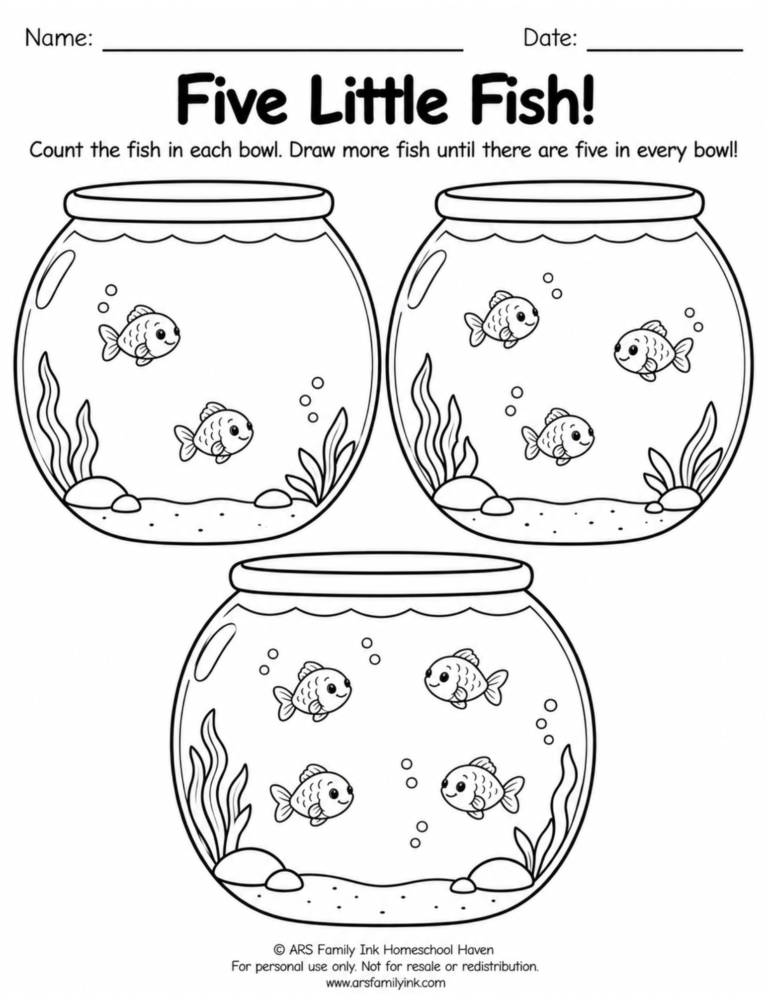
In this engaging preschool math activity, children explore three fishbowls filled with different numbers of fish. Their job is to count the fish in each bowl and draw more until every bowl contains exactly five.
This simple, hands-on printable helps young learners connect counting with quantities while introducing the idea that smaller groups can be completed to make a larger number.
Perfect for homeschool lessons, preschool math centers, or extra counting practice, this worksheet offers a playful way to explore numbers through drawing and observation.
Download your free worksheet below:
What This Worksheet Teaches
The Five Little Fish! worksheet introduces children to counting and completing groups of five using familiar, easy-to-recognize pictures.
Each fishbowl begins with a different number of fish. Children count the fish already pictured, determine how many more are needed, and draw additional fish to make five.
Through this activity, children explore:
Counting objects accurately within five.
Matching spoken number words to individual objects.
Recognizing that different starting quantities can become the same total.
Understanding that adding more objects increases a group’s quantity.
Using drawing to represent additional objects.
The activity encourages children to think about quantities rather than simply reciting numbers in order.
How to Use This Worksheet
Print the worksheet. Give your child a copy of Five Little Fish! and a pencil or crayon.
Read the directions together. Explain that every fishbowl needs five fish.
Count the fish. Have your child point to each fish while counting aloud.
Draw more fish. Encourage your child to draw enough additional fish to make five in each bowl.
Count again. After drawing, count all the fish in each bowl to check that there are exactly five.
Celebrate the learning. Ask your child to explain how many fish were already there and how many they added.
For children who are still developing counting skills, use small objects such as counters or blocks to demonstrate how to make a group of five before completing the worksheet.
Why This Skill Matters
Learning to count objects and understand small quantities is an important part of early mathematical development.
When children count fish and determine how many more are needed to make five, they begin to recognize relationships between numbers. They discover that a group can grow when additional objects are added and that different combinations can produce the same total.
This early understanding supports later work with number combinations, addition, and problem-solving.
Drawing the missing fish also gives children an opportunity to practice pencil control and represent their mathematical thinking visually.
At the preschool level, the goal is to build understanding through playful exploration, repetition, and supportive conversation rather than expecting children to solve formal addition equations.
Skills Practiced
Counting to Five: Counting individual fish in each bowl.
One-to-One Correspondence: Matching one number word to each fish counted.
Number Sense: Understanding the quantities two, three, four, and five.
Completing Sets: Determining how many additional fish are needed to make five.
Early Addition Concepts: Exploring how smaller groups can be combined to make five.
Visual Observation: Identifying and distinguishing individual fish within a picture.
Fine Motor Development: Drawing additional fish using a pencil or crayon.
Mathematical Communication: Describing how many fish were present and how many were added.
Learning Goals
With developmentally appropriate support, children will have opportunities to:
Count pictured objects in groups of up to five.
Point to objects while counting to support one-to-one correspondence.
Recognize when a group contains fewer than five objects.
Add drawings to complete a group of five.
Recount completed groups to check their work.
Begin describing number relationships using everyday language.
Children may approach these goals at different levels of readiness. Some may complete the activity independently, while others benefit from counting alongside an adult or using physical objects first.
Parent & Teacher Tips:
Count Together First: If your child is new to counting objects, point to each fish together while saying the number words slowly.
Use Real Objects: Place five small counters, blocks, or other safe manipulatives on the table. Start with two, three, or four and let your child add more until there are five.
Keep Drawing Simple: The additional fish do not need to be detailed. Simple fish shapes are perfectly fine. The focus is understanding the quantity.
Ask Helpful Questions: Try asking, “How many fish do you see?” or “How many more fish does this bowl need?”
Offer a Simpler Starting Point: Begin with the bowl containing four fish. Your child only needs to add one more fish to complete the group.
Provide an Optional Challenge: Invite children who are ready to explain the number combinations they created, such as “Three fish and two more fish make five.”
Encourage effort and curiosity. Preschool children benefit from positive experiences with numbers and opportunities to try again without pressure.
Extend the Learning
Continue exploring groups of five with these simple hands-on activities.
1. Make Five with Toys
Place a small group of toy animals or blocks on the table. Ask your child to add enough objects to make five.
2. Fishbowl Counting Game
Draw a large fishbowl on paper and use five small paper fish. Place different numbers of fish inside and ask your child how many more are needed.
3. Count and Move
Invite your child to complete five movements, such as claps, jumps, or taps. Start with a smaller number and count how many more movements are needed.
4. Explore Number Combinations
Use five counters to show different ways to make five, including one and four or two and three.
5. Create a Fish Picture
After finishing the worksheet, encourage your child to draw an underwater scene with five fish. Count the fish together and talk about their picture.
These optional activities help children revisit the same mathematical idea through play, movement, and creativity.
Materials Needed
You only need a few basic supplies to complete this preschool counting activity.
Printed Five Little Fish! worksheet
Pencil or crayons
Optional materials:
Small counting blocks or counters
Paper fish cutouts for hands-on practice
Extra paper for drawing and counting activities
No special equipment or preparation is required beyond printing the worksheet.
Perfect for Homeschool or Classroom Learning
The Five Little Fish! worksheet is a flexible activity that fits naturally into preschool math lessons.
For Homeschool Families: Use the worksheet during a short math lesson, as an independent practice activity when your child is ready, or alongside hands-on counting games.
For Preschool Classrooms: Include it in a math center, small-group activity, or guided counting lesson.
For Extra Practice: Revisit the activity when children need more experience counting objects or making groups of five.
Because the worksheet uses simple illustrations and a familiar counting goal, adults can easily adjust the level of support to meet each child’s needs.
Children can complete the activity at their own pace while developing confidence with early math concepts.
Building Early Number Sense and Understanding Groups of Five
Understanding that numbers represent quantities is an essential part of preschool mathematics.
The Five Little Fish! worksheet helps children explore this relationship by showing groups of two, three, and four fish and inviting them to complete each group to make five.
Rather than introducing formal addition problems, this activity provides a concrete visual experience with combining quantities.
Children can see that two fish need three more to make five, three fish need two more, and four fish need one more.
These experiences help lay the groundwork for understanding number relationships and early addition concepts.
By combining counting, observation, and drawing, children can explore mathematical ideas in a developmentally appropriate way that encourages active participation and discovery.
You may also like:
Alphabet & Phonics
Letter recognition, letter sounds, phonics skills, and early reading development.
Numbers & Math
Counting, number recognition, basic math skills, and early problem-solving.
Reading & Writing
Early reading comprehension, handwriting, and sentence building skills.
Support Our Free Worksheets
If you enjoy these free worksheets, you can support our site by sharing with others, following us on social media, or joining our email list for more resources. It’s as easy as clicking the links at the bottom of the page. Your support helps us continue creating free printable learning materials.