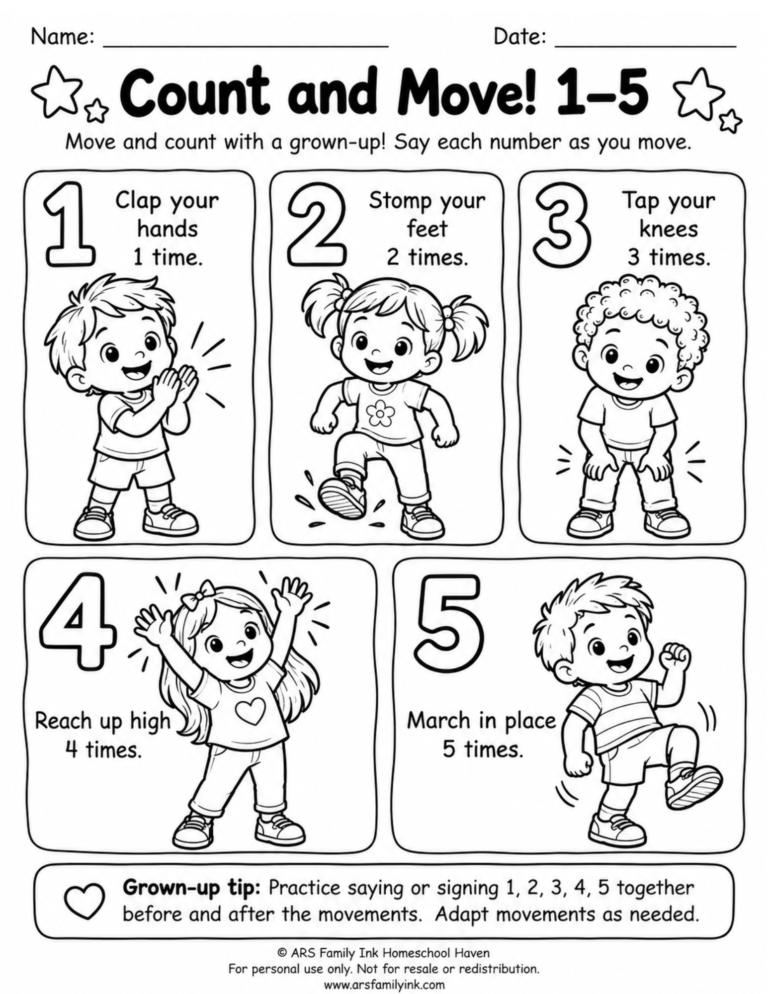
Make early counting practice active and engaging with our Count and Move! 1–5 Preschool Counting Worksheet!
This free printable combines numbers and movement to help young learners explore counting from 1 to 5. Instead of sitting and completing written problems, children clap, stomp, tap, reach, and march while saying each number aloud.
With cheerful illustrations and simple directions, this activity encourages preschoolers to connect number words with physical actions. It’s a playful way to practice early math skills at home or in the classroom.
Download your free worksheet below:
What This Worksheet Teaches
The Count and Move! 1–5 worksheet introduces young learners to counting through five simple movement activities.
Children practice:
Recognizing written numerals from 1 to 5.
Saying number words in the correct order.
Counting individual movements one at a time.
Connecting a number with a matching quantity of actions.
Following simple directions with adult support.
Exploring counting through whole-body movement.
By pairing each number with a physical action, children have an opportunity to experience counting in a concrete, playful way.
How to Use This Worksheet
This worksheet is designed for children to complete with a parent, teacher, or another trusted grown-up.
Start with the numbers. Point to the numerals 1 through 5 and say them together.
Clap 1 time. Have your child clap their hands once while saying “one.”
Stomp 2 times. Encourage your child to stomp their feet twice, counting each stomp aloud.
Tap knees 3 times. Count “one, two, three” while tapping knees.
Reach up 4 times. Stretch arms upward four times, counting each reach.
March in place 5 times. Count five marching steps together.
After completing the movements, practice saying or singing the numbers 1 through 5 again.
Adapt the movements as needed so children can participate comfortably and safely. Children may complete the activity with assistance or repeat individual movements for additional practice.
Why This Skill Matters
Counting is an important part of early mathematical development. Before children work with larger numbers or written math problems, they benefit from opportunities to explore number words, quantities, and counting sequences through everyday experiences.
Movement-based counting gives preschoolers a way to connect each spoken number with an action they can feel and observe.
For example, clapping three times allows a child to experience three separate actions while hearing the numbers one, two, and three.
These experiences can help children develop familiarity with counting order and begin understanding that numbers represent quantities.
Combining counting with movement also provides an active alternative to traditional paper-and-pencil practice, making it especially useful for young learners who enjoy hands-on activities.
Skills Practiced
This preschool math activity provides opportunities to practice several early learning skills:
Number Recognition: Seeing and becoming familiar with numerals 1–5.
Number Sequence: Practicing counting words in order.
One-to-One Counting: Connecting one spoken number with each movement.
Quantity Awareness: Exploring how many times an action is performed.
Listening Skills: Hearing and responding to simple instructions.
Gross Motor Coordination: Using larger body movements such as reaching, stomping, and marching.
Following Directions: Completing an action according to the number shown.
Children can work on these skills at their own pace, with support and repetition as needed.
Learning Goals
With practice and appropriate adult guidance, children can work toward the following learning goals:
Participate in counting activities involving numbers 1 through 5.
Say or join in saying counting words in sequence.
Begin connecting written numerals with spoken number words.
Count individual movements while performing them.
Follow simple movement directions.
Develop confidence participating in early math activities.
Preschoolers develop counting skills at different rates. Some children may initially need an adult to model each action, while others may be ready to complete the movements more independently.
Parent & Teacher Tips:
Keep this activity relaxed, playful, and encouraging.
Model the movements first. Demonstrate each action while counting slowly.
Count together. Invite children to say each number, but allow them to listen and participate through movement if they are not ready to count aloud.
Use a comfortable pace. Pause between movements so children can connect each action with its number.
Repeat favorite activities. Repetition provides additional opportunities to practice counting.
Offer simpler starting points. Begin with one or two movements before working toward all five.
Adapt movements when needed. Seated claps, gentle taps, or arm movements can replace actions that are difficult or uncomfortable.
Focus on participation and growing familiarity rather than expecting perfect counting on the first attempt.
Extend the Learning
Continue practicing counting throughout the day with these simple activities:
Count Everyday Actions
Count steps while walking, taps on a table, or blocks placed into a container.
Make Your Own Movement Game
Invite your child to choose a movement, such as waving or touching their shoulders. Select a number from 1 to 5 and perform the action that many times.
Match Numbers with Objects
Place one to five familiar objects on a table. Count them together and compare the quantity with the matching number on the worksheet.
Try a Number Challenge
For children ready for an additional challenge, show a numeral from 1 to 5 and invite them to choose a movement and complete it the matching number of times.
These optional activities provide additional opportunities to connect counting with play and everyday experiences.
Materials Needed
This preschool counting activity requires very few materials.
Printed Count and Move! 1–5 worksheet.
A parent, teacher, or another grown-up to guide the activity.
A comfortable, safe space for movement.
Optional: Use a pencil or crayon to point to or mark each completed number activity.
No special equipment is needed.
Perfect for Homeschool or Classroom Learning
The Count and Move! 1–5 worksheet is a flexible addition to preschool math instruction.
Homeschool families can use it as a short daily counting activity, an active break between lessons, or an introduction to numbers 1 through 5.
Preschool teachers can incorporate it into small-group instruction, circle time, or movement-based math practice.
Because the activity does not require writing, children can focus on listening, moving, recognizing numbers, and practicing counting.
The movements can also be adjusted for different abilities and developmental readiness levels, making the activity accessible to a wider range of young learners.
Building Early Counting and Number Recognition Skills
Early math learning begins with meaningful experiences involving numbers and quantities. Preschoolers benefit from opportunities to hear number words, observe written numerals, and explore counting through play.
The Count and Move! 1–5 worksheet brings these experiences together by pairing each numeral with a simple physical activity.
As children clap, stomp, tap, reach, and march, they can practice connecting spoken numbers with individual actions.
These experiences support emerging number awareness and provide a foundation for continued exploration of counting, quantities, and early mathematical relationships.
For young children, learning through movement can make counting feel like a natural part of play rather than a separate academic task.
You may also like:
Alphabet & Phonics
Letter recognition, letter sounds, phonics skills, and early reading development.
Numbers & Math
Counting, number recognition, basic math skills, and early problem-solving.
Reading & Writing
Early reading comprehension, handwriting, and sentence building skills.
Support Our Free Worksheets
If you enjoy these free worksheets, you can support our site by sharing with others, following us on social media, or joining our email list for more resources. It’s as easy as clicking the links at the bottom of the page. Your support helps us continue creating free printable learning materials.