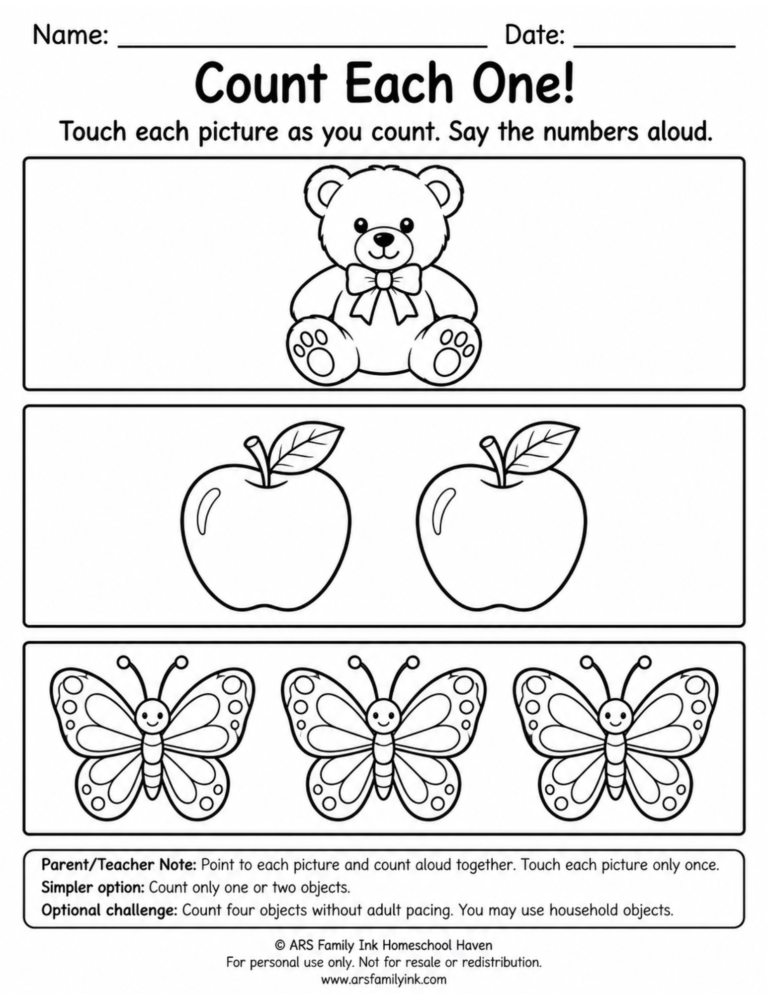
Make early counting practice simple and fun with this free Count Each One! preschool math worksheet from ARS Family Ink Homeschool Haven.
Children practice touching and counting pictures while saying the numbers aloud. With one teddy bear, two apples, and three butterflies, this printable introduces small groups of objects in a clear, approachable way.
Designed for preschool children ages 3–5, this activity supports early counting and one-to-one correspondence through guided, hands-on practice.
Download your free worksheet below:
What This Worksheet Teaches
This worksheet introduces one-to-one correspondence, an important early math skill that involves counting each object exactly once. Children begin with one teddy bear, move to two apples, and finish with three butterflies. As they touch each picture and say the numbers aloud, they practice coordinating their movements with the spoken counting sequence. The activity also provides opportunities to notice that different groups contain different numbers of objects. Children can participate with adult guidance and progress at their own pace.
How to Use This Worksheet
How to Use This Worksheet
Print the Count Each One! worksheet.
Begin with the teddy bear. Ask your child to touch the picture and say “one.”
Move to the apples. Encourage your child to touch each apple once while counting “one, two.”
Repeat with the butterflies, touching each picture and counting “one, two, three.”
Count together again if your child would benefit from additional practice.
The parent/teacher note at the bottom of the worksheet provides a simpler option and an optional challenge. Children who are just beginning can count only one or two objects. Children ready for more practice can try counting four household objects without adult pacing.
Why This Skill Matters
One-to-one correspondence helps children understand that each object in a group receives one counting word. This is an important foundation for accurately counting objects and developing number sense.
Touching each picture while counting can help young learners keep track of which objects they have already counted. Repeated experiences with small groups also help children connect spoken number words with quantities.
Preschool counting develops gradually. Some children may need an adult to model the activity several times before they are comfortable counting independently.
Skills Practiced
One-to-one correspondence
Counting objects from 1 to 3
Saying number words in sequence
Coordinating pointing or touching with counting
Paying attention to individual objects in a group
Exploring the connection between spoken numbers and quantities
Learning Goals
With appropriate support, children will have opportunities to:
Touch each picture once while counting.
Practice saying counting words in the correct order from one to three.
Count small groups of familiar pictures.
Begin connecting the final counting word with the number of objects in a group.
Build confidence participating in simple counting activities.
These are flexible learning goals, not expectations that every preschooler must master the activity immediately.
Parent & Teacher Tips:
Model the activity first. Point to each picture slowly and count aloud so your child can see how the counting words match the objects.
Encourage touching each picture once. If your child skips or recounts an object, gently demonstrate how to begin again.
Start with smaller groups. The worksheet’s simpler option recommends counting only one or two objects when appropriate.
Keep the experience positive. Give children time to respond, repeat the activity as needed, and celebrate their willingness to try.
Use real objects for extra practice. Small groups of blocks, toy animals, or other familiar household items can make counting more hands-on.
Extend the Learning
Count favorite toys. Place one, two, or three toys on a table and invite your child to touch each toy while counting.
Count during everyday routines. Practice counting a few spoons, cups, or other familiar items while setting the table or cleaning up.
Make a group of four. For children ready for an optional challenge, place four household objects together and encourage independent counting without adult pacing.
Move and count. Invite your child to make one clap, two taps, or three gentle stomps while saying the counting words aloud.
These activities reinforce the same counting skill without requiring additional worksheets.
Materials Needed
Printed Count Each One! worksheet
Printer and paper
Optional: crayons for coloring the pictures
Optional: small household objects for extra counting practice
No scissors, glue, or additional preparation are required for the worksheet activity.
Perfect for Homeschool or Classroom Learning
This free preschool counting worksheet works well for homeschool lessons, preschool math centers, small-group instruction, or individual practice.
Parents can use it as a short guided activity during a daily learning routine. Teachers can model the counting process with a small group before allowing children to try with appropriate support.
Because the worksheet focuses on just three small groups, it provides a manageable introduction to touching and counting objects without overwhelming beginning learners.
Building Early Counting and One-to-One Correspondence Skills
Early math learning begins with meaningful experiences involving real objects, pictures, and spoken number words.
The Count Each One! worksheet gives preschoolers an opportunity to explore how counting works by matching one spoken number word to each picture. Children can practice with one teddy bear, two apples, and three butterflies before extending the same skill to familiar objects around them.
Pairing printable activities with playful counting experiences helps children develop their understanding of quantities at a comfortable, developmentally appropriate pace.
You may also like:
Alphabet & Phonics
Letter recognition, letter sounds, phonics skills, and early reading development.
Numbers & Math
Counting, number recognition, basic math skills, and early problem-solving.
Reading & Writing
Early reading comprehension, handwriting, and sentence building skills.
Support Our Free Worksheets
If you enjoy these free worksheets, you can support our site by sharing with others, following us on social media, or joining our email list for more resources. It’s as easy as clicking the links at the bottom of the page. Your support helps us continue creating free printable learning materials.