Help your child explore how objects can feel different when we touch them with this free kindergarten science sorting activity.
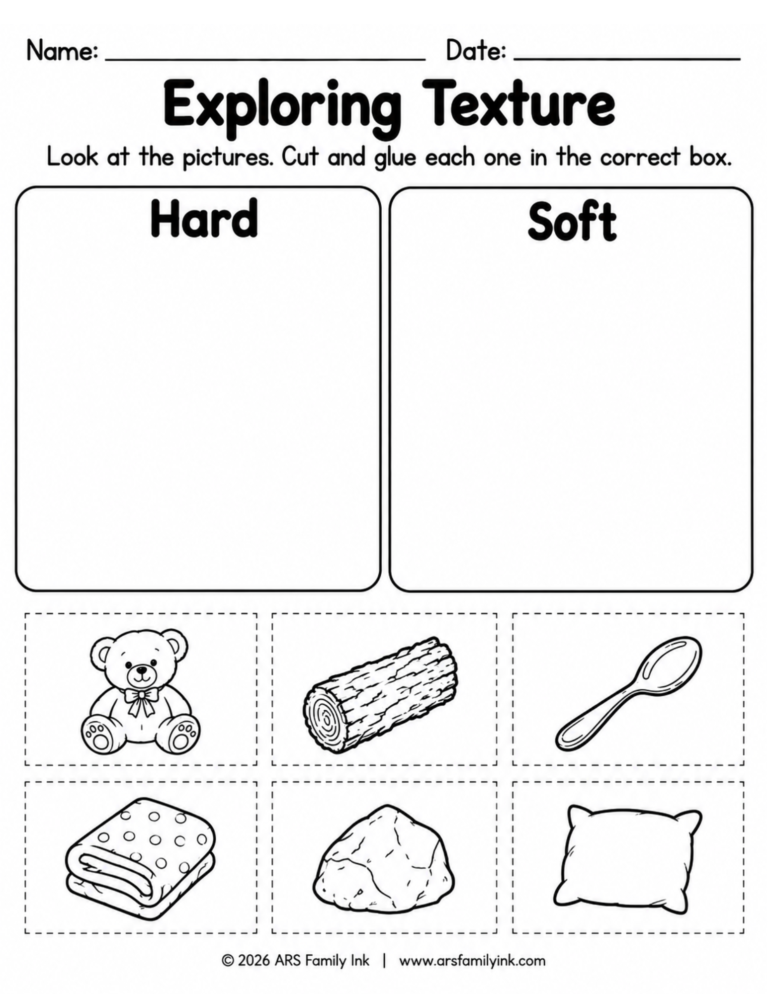
The Exploring Texture worksheet introduces children to the observable properties hard and soft. Children examine six familiar objects and cut and glue each picture into the correct category.
Whenever possible, let your child touch similar real objects before completing the worksheet. This helps connect the pictures on the page with a property they can actually investigate through touch.
Download your free worksheet below:
What This Worksheet Teaches
This worksheet introduces children to the idea that objects can be described by their observable physical properties.
In this activity, children focus specifically on whether familiar objects are hard or soft.
They practice considering a characteristic of each object, comparing that characteristic with other objects, and using it to decide how the objects should be grouped.
The cut-and-paste format provides a hands-on way for children to demonstrate their classifications.
How to Use This Worksheet
Before cutting out the pictures, introduce the words hard and soft.
If possible, give your child a few safe objects to touch. Ask questions such as:
“How does this feel?”
“Would you describe it as hard or soft?”
“What do you notice that makes you say that?”
Then look at the six pictures on the worksheet together.
Have your child cut out each picture along the dashed lines. One at a time, decide whether the pictured object belongs in the Hard or Soft category.
Your child can place all of the pictures first before gluing them down. This provides an opportunity to reconsider and discuss the classifications before making them permanent.
Then glue each picture into the appropriate box.
Why This Skill Matters
Scientists describe and compare objects by examining their properties.
For young children, familiar characteristics such as hard, soft, smooth, rough, flexible, rigid, heavy, and light can provide accessible ways to begin thinking about materials and objects scientifically.
Sorting by a property such as hard or soft helps children understand that objects can be grouped according to shared characteristics, not simply by what the objects are called or what they are used for.
These early observation and classification skills prepare children for later investigations of materials, their properties, and how different materials are suited for different purposes.
Skills Practiced
This worksheet gives children practice with several important beginning science skills:
Observing Physical Properties: Noticing characteristics of familiar objects.
Using the Sense of Touch: Exploring how objects feel when safely handled.
Describing: Using the words hard and soft to communicate observations.
Comparing: Considering how the physical properties of two or more objects are alike or different.
Classifying: Grouping objects according to a shared characteristic.
Sorting: Placing objects into Hard and Soft categories.
Scientific Reasoning: Using an object’s observable property to decide where it belongs.
Scientific Communication: Explaining why an object was classified as hard or soft.
The cutting and gluing also provides additional fine-motor practice, although the primary purpose of the worksheet is science learning.
Learning Goals
After completing this activity, children should be working toward being able to:
✔ Recognize that objects have observable physical properties
✔ Understand the descriptive words hard and soft
✔ Compare familiar objects by how they feel
✔ Identify objects that are generally hard
✔ Identify objects that are generally soft
✔ Sort objects according to a shared physical property
✔ Explain why an object belongs in a particular group
✔ Use observations to make a simple classification
Parent & Teacher Tips:
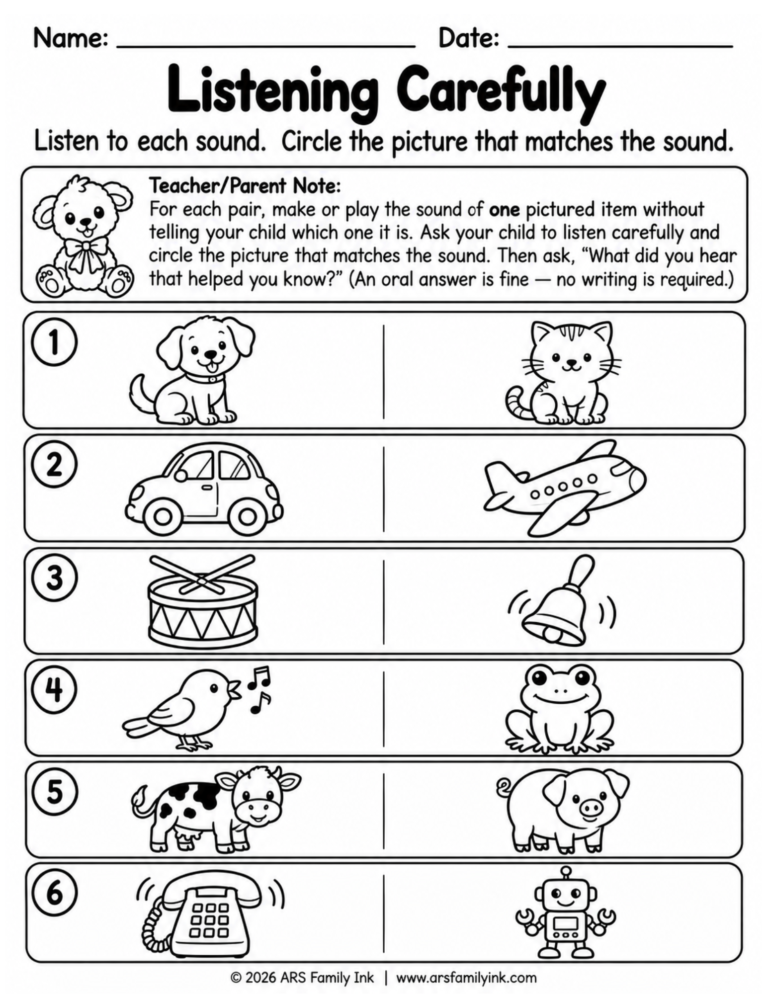
Try not to give away the answer through your wording, facial expression, or by pointing toward one of the pictures.
Let your child listen before making a choice.
After your child answers, focus on how they knew, not just whether they selected the picture you expected.
For example, rather than stopping after your child identifies a cow, ask:
“What did you hear that made you think it was the cow?”
If your child can explain that they heard a “moo”, they are connecting an auditory observation with evidence.
An oral explanation is completely appropriate. No written response is required.
Extend the Learning
Continue exploring hard and soft materials beyond the worksheet:
Hard and Soft Hunt: Find several safe objects around the room and decide whether each is hard or soft.
Mystery Touch Bag: Place a safe familiar object in a bag and let your child feel it without looking. Ask them to describe what they notice.
Sort Real Objects: Gather several small items and physically sort them into hard and soft groups.
Find Another Property: After sorting by hard and soft, compare the same objects in another way, such as smooth and rough.
Explain Your Sort: Ask your child, “Why did you put this object here?” Encourage an answer based on its properties.
Compare Two Objects: Choose one hard object and one soft object and describe how they feel different.
These activities help children understand that science words describe properties they can investigate—not simply labels to memorize.
Materials Needed
For the worksheet, you will need:
Exploring Texture worksheet
Child-safe scissors
Glue stick or glue
For a more hands-on science experience, you may also gather a few safe real objects that are hard or soft.
Possible examples include a spoon, rock, stuffed animal, blanket, pillow, wooden block, sponge, or piece of fabric.
Adult supervision should be provided when children are using scissors or examining unfamiliar objects.
Perfect for Homeschool or Classroom Learning
The Exploring Texture worksheet works well in both homeschool and classroom science lessons.
Homeschool families can pair the printable with safe household objects so children can investigate hard and soft properties directly before completing the sorting activity.
Teachers and classroom educators can use it after a hands-on exploration of materials, during small-group science, as a science-center activity, or as follow-up practice.
This worksheet is perfect for:
✔ Homeschool kindergarten science
✔ Kindergarten classrooms
✔ Physical properties lessons
✔ Five-senses investigations
✔ Sorting and classifying practice
✔ Science centers
✔ Small-group instruction
✔ Hands-on science lessons
✔ Observation skill development
Building Early Science Skills
This worksheet continues the observation sequence developed in the previous Kindergarten Science activities.
Children have practiced looking carefully, distinguishing observations from guesses, comparing visible characteristics, and listening carefully. This activity adds another way of gathering information: touch.
The progression becomes:
Observe → Describe a property → Compare → Sort by that property
Children begin learning that different senses can provide different kinds of information about an object.
This prepares them for additional investigations involving physical properties, materials, sorting, and the safe use of the senses and simple tools to gather information.
You may also like:
Science
Simple science concepts, observation skills, and early exploration.
Numbers & Math
Counting, number recognition, basic math skills, and early problem-solving.
Reading & Writing
Early reading comprehension, handwriting, and sentence building skills.
Support Our Free Worksheets
If you enjoy these free worksheets, you can support our site by sharing with others, following us on social media, or joining our email list for more resources. It’s as easy as clicking the links at the bottom of the page. Your support helps us continue creating free printable learning materials.