Help your child learn the difference between something they can observe and something they are guessing with this free kindergarten science worksheet.
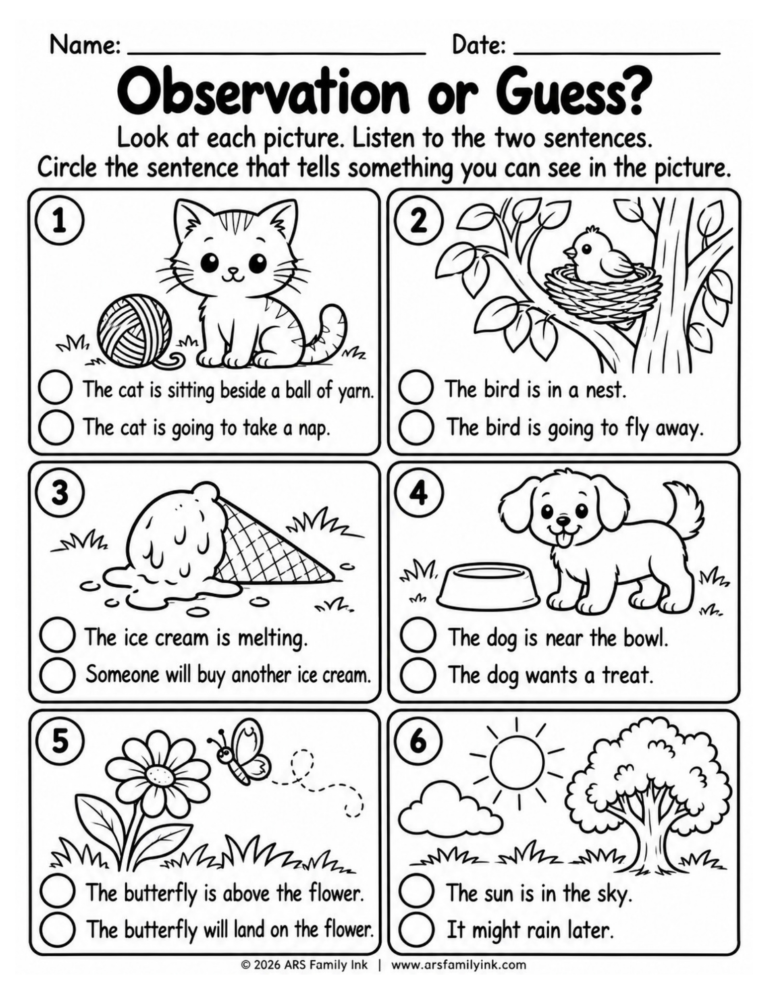
In Observation or Guess?, children look carefully at six illustrated scenes. An adult reads two statements about each picture, and the child circles the statement that describes something they can actually see.
The activity encourages children to slow down, examine the available evidence, and ask an important beginning-science question:
“Can I actually see that in the picture, or am I guessing?”
Download your free worksheet below:
What This Worksheet Teaches
This worksheet teaches children that an observation is based on something they can notice directly.
Children examine pictures and decide which statement is supported by visible information.
They also begin recognizing that a statement can sound possible without actually being something they can observe. A dog might want a treat, a bird might fly away, or it might rain later—but the pictures do not provide enough information to know those things for certain.
This distinction encourages children to base descriptions on the evidence available to them rather than automatically treating a guess as an observation.
How to Use This Worksheet
Begin by explaining that scientists try to describe what they actually observe.
Tell your child that they will look carefully at each picture and listen to two sentences. Their job is to circle the sentence that tells something they can see in the picture.
Read both choices aloud without indicating the answer.
Then ask:
“Which one can you actually see?”
If your child chooses the guessing statement, return to the picture and ask:
“What in the picture shows us that?”
For example, a child might think that the dog wants a treat. Rather than simply saying the answer is wrong, ask whether the picture actually shows what the dog is thinking or wanting.
Continue through all six pictures, encouraging your child to use visible details to make each choice.
Why This Skill Matters
Careful observation is an important part of learning science.
Children naturally make guesses and predictions about the world around them. Those are useful kinds of thinking, but they are different from describing something that can be directly observed.
Learning to distinguish the two helps children begin asking:
“What do I actually notice?”
“What evidence do I have?”
“Am I describing what I see, or am I guessing about something I cannot know from this information?”
This foundation becomes useful as children later make observations, compare objects, investigate materials, notice patterns, record results, and explain what they discover.
Skills Practiced
This worksheet gives children practice with several important beginning science skills:
Careful Observation: Examining a picture closely and noticing visible details.
Observation vs. Guess: Distinguishing information that can be directly observed from an unsupported guess.
Evidence-Based Thinking: Choosing a statement based on information available in the picture.
Scientific Reasoning: Thinking about whether there is enough evidence to support a statement.
Visual Interpretation: Using details in an illustration as information.
Listening Comprehension: Listening to two adult-read statements and considering their meanings.
Making Decisions: Comparing two possibilities and selecting the one supported by the observation.
Explaining Thinking: Beginning to describe why an answer is supported by what can be seen.
Learning Goals
After completing this worksheet, children should be working toward being able to:
✔ Understand that an observation describes something that can be noticed directly
✔ Look carefully at a picture before making a choice
✔ Identify a statement that is supported by visible evidence
✔ Recognize when a statement makes a guess or prediction
✔ Distinguish what can be seen now from what might happen later
✔ Avoid assuming what an animal or person wants without observable evidence
✔ Use observations to support simple scientific thinking
✔ Explain why a statement matches what can be seen
Parent & Teacher Tips:
When your child chooses an answer, try asking:
“What do you see that makes you say that?”
This encourages your child to connect their answer with visible evidence instead of simply guessing which sentence sounds right.
If a child says that the bird is going to fly away, for example, you do not need to tell them that flying away is impossible. Instead, explain that it could happen, but we cannot know that just by looking at the picture.
This distinction is important: a guess or prediction is not necessarily wrong—it simply is not the same thing as a direct observation.
Extend the Learning
Continue practicing observations and guesses with simple everyday activities:
Look Out the Window: Make one statement about something you can see and one guess about what might happen later. Ask your child which is the observation.
Picture Detective: Choose a picture in a book. Ask your child to tell you two things they can actually see and one thing they can only guess.
What Makes You Say That?: When your child makes a statement about an object or picture, ask what they observed that supports the idea.
Observation or Prediction?: Say statements such as “The sky has dark clouds” and “It will rain soon.” Discuss which describes something observable now and which predicts what may happen.
Pet Detective: Observe a pet or animal picture. Describe its location, appearance, or actions, then compare those observations with guesses about what the animal might want or do next.
Prove It: Make a simple observation and ask your child to point to the evidence that supports it.
These activities help children practice using evidence without suggesting that guessing or predicting is bad. Instead, they learn that observations, guesses, and predictions are different kinds of thinking.
Materials Needed
This activity requires only a few simple materials:
Observation or Guess? worksheet
Pencil, crayon, or marker
An adult to read the statements aloud as needed
No additional science materials are required.
Perfect for Homeschool or Classroom Learning
The Observation or Guess? worksheet is designed for easy use in homeschool and classroom science lessons.
Homeschool families can use it after an introductory observation lesson to help children practice deciding whether a statement is supported by what they can actually observe.
Teachers and classroom educators can use the worksheet during whole-group science instruction, small groups, science centers, partner discussions, or individual practice.
This resource is perfect for:
✔ Homeschool kindergarten science
✔ Kindergarten classrooms
✔ Observation lessons
✔ Beginning scientific reasoning
✔ Evidence-based thinking
✔ Science centers
✔ Small-group discussion
✔ One-on-one learning
✔ Science skill review
Building Early Science Skills
The previous Science Is Noticing activity introduced children to looking closely and describing details. This worksheet builds naturally on that skill by asking children to think about which statements are actually supported by their observations.
The progression becomes:
Look closely → Notice details → Describe what you observe → Ask what the evidence shows
Children do not need formal scientific vocabulary or lengthy explanations at this stage. The goal is to develop the habit of separating what they can directly observe from what they are assuming, predicting, or guessing.
That habit provides an early foundation for evidence-based scientific thinking.
You may also like:
Science
Simple science concepts, observation skills, and early exploration.
Numbers & Math
Counting, number recognition, basic math skills, and early problem-solving.
Reading & Writing
Early reading comprehension, handwriting, and sentence building skills.
Support Our Free Worksheets
If you enjoy these free worksheets, you can support our site by sharing with others, following us on social media, or joining our email list for more resources. It’s as easy as clicking the links at the bottom of the page. Your support helps us continue creating free printable learning materials.