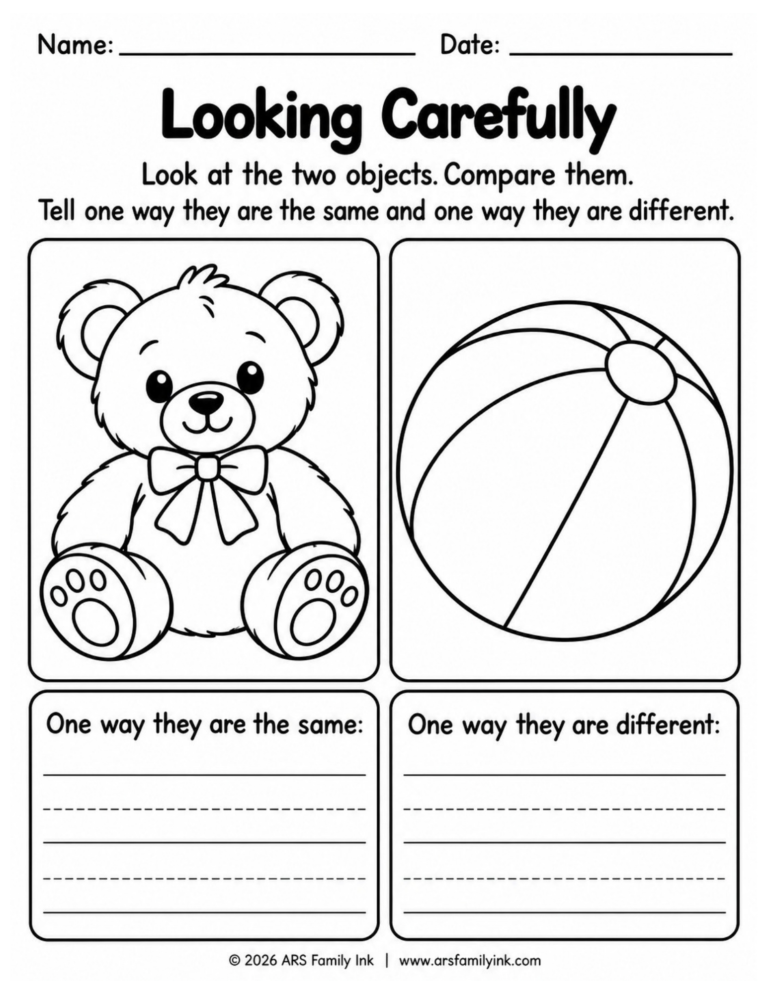
Help your child practice looking closely, comparing objects, and describing what they notice with this free Looking Carefully kindergarten science worksheet.
Children examine two familiar objects—a teddy bear and a ball—and think about their visible features. They then identify one way the objects are the same and one way they are different.
This simple activity builds on beginning observation skills by showing children how scientists can use what they notice to compare objects.
Download your free worksheet below:
What This Worksheet Teaches
This worksheet teaches children that careful observations can be used to compare objects.
When children look closely at two objects, they can notice characteristics the objects share as well as characteristics that make them different.
For example, a child might notice that both objects have rounded parts but that the teddy bear has ears while the ball does not.
There may be more than one reasonable answer. The important part is that children base their comparisons on features they can actually observe.
How to Use This Worksheet
Begin by giving your child time to look carefully at both pictures.
Ask:
“What do you notice about the teddy bear?”
Then ask:
“What do you notice about the ball?”
After discussing several observations, ask:
“What is one way these two objects are the same?”
Encourage your child to use something visible in the pictures to support the answer.
Next ask:
“What is one way they are different?”
Have your child record an answer in each box or write their spoken response for them.
Avoid looking for one specific “correct” comparison. More than one answer may be reasonable as long as the child can connect the response to something observable in the pictures.
Why This Skill Matters
Comparing is an important beginning science skill.
Scientists frequently observe objects, organisms, materials, and events and then look for similarities, differences, and patterns.
For kindergarten children, this begins with familiar questions:
“What do you notice?”
“How are these alike?”
“How are they different?”
Learning to answer these questions encourages children to look beyond simply naming an object and begin paying attention to its characteristics.
These comparison skills will later help children sort and classify objects, compare materials, examine plants and animals, recognize patterns, and describe results from simple investigations.
Skills Practiced
This worksheet gives children practice with several important beginning science skills:
Careful Observation: Looking closely at objects and noticing visible details.
Comparing: Examining two objects together to identify similarities and differences.
Identifying Similarities: Recognizing characteristics that two objects share.
Identifying Differences: Recognizing characteristics that distinguish one object from another.
Describing Characteristics: Using words to communicate observable features.
Evidence-Based Thinking: Basing a comparison on details that can actually be observed.
Scientific Communication: Sharing observations orally or through simple written responses.
Attention to Detail: Looking beyond an object’s name to notice specific features.
Learning Goals
After completing this activity, children should be working toward being able to:
✔ Look carefully at two objects before comparing them
✔ Notice visible characteristics of an object
✔ Identify one similarity between two objects
✔ Identify one difference between two objects
✔ Describe observations using their own words
✔ Use observable details to support a comparison
✔ Understand that there can be more than one useful way to compare the same objects
✔ Participate in a simple science discussion about similarities and differences
Parent & Teacher Tips:
There is not just one correct similarity or difference for this activity.
Encourage your child to look closely and explain what they notice. If an answer is reasonable and supported by something observable, it can be accepted.
If your child has difficulty getting started, avoid immediately supplying an answer. Instead, guide their observation with questions such as:
“What shapes do you notice?”
“What parts does the bear have?”
“Does the ball have those parts?”
“Can you find anything that looks similar?”
You can also record your child’s spoken answer if writing is difficult. The purpose of this worksheet is to practice science observation and comparison, not to measure kindergarten writing ability.
Extend the Learning
Continue practicing comparison with real objects around your home or classroom:
Compare Two Toys: Choose two toys and find one way they are alike and one way they are different.
Compare Two Leaves: Look at their size, shape, edges, patterns, or other observable features.
Same or Different Colors: Compare two objects and discuss whether their colors are alike or different.
Feel and Compare: When safe and appropriate, compare how two objects feel. Are they smooth, rough, hard, soft, or bumpy?
Compare School Supplies: Examine two crayons, pencils, blocks, or other familiar materials and describe similarities and differences.
Find Another Answer: After identifying one similarity and difference, challenge your child to find another of each.
Using real objects gives children additional opportunities to practice observation and comparison through direct experience.
Materials Needed
This activity requires only a few simple materials:
Looking Carefully worksheet
Pencil crayon or marker
An adult may write the child’s responses if the child can explain the comparison orally but is not yet ready to record the answer independently.
Perfect for Homeschool or Classroom Learning
The Looking Carefully worksheet is easy to use in both homeschool and classroom science lessons.
Homeschool families can use the worksheet as a short science activity and then extend the lesson by comparing real household objects, toys, or natural materials.
Teachers and classroom educators can use it during whole-group modeling, small-group science instruction, science centers, partner discussions, or individual practice.
This worksheet is perfect for:
✔ Homeschool kindergarten science
✔ Kindergarten classrooms
✔ Observation practice
✔ Comparing similarities and differences
✔ Beginning scientific reasoning
✔ Science centers
✔ Small-group instruction
✔ One-on-one learning
✔ Science skill review
Building Early Science Skills
This activity builds naturally on the observation skills introduced in Science Is Noticing and Observation or Guess?
Children first learned to look closely and notice details. They then practiced distinguishing something they could actually observe from something they were only guessing.
Now they use those observations to compare two objects.
The learning progression becomes:
Look closely → Notice details → Use observable evidence → Compare similarities and differences
These skills prepare children for future science activities involving sorting, classifying, describing materials, comparing living things, and recognizing patterns.
You may also like:
Science
Simple science concepts, observation skills, and early exploration.
Numbers & Math
Counting, number recognition, basic math skills, and early problem-solving.
Reading & Writing
Early reading comprehension, handwriting, and sentence building skills.
Support Our Free Worksheets
If you enjoy these free worksheets, you can support our site by sharing with others, following us on social media, or joining our email list for more resources. It’s as easy as clicking the links at the bottom of the page. Your support helps us continue creating free printable learning materials.