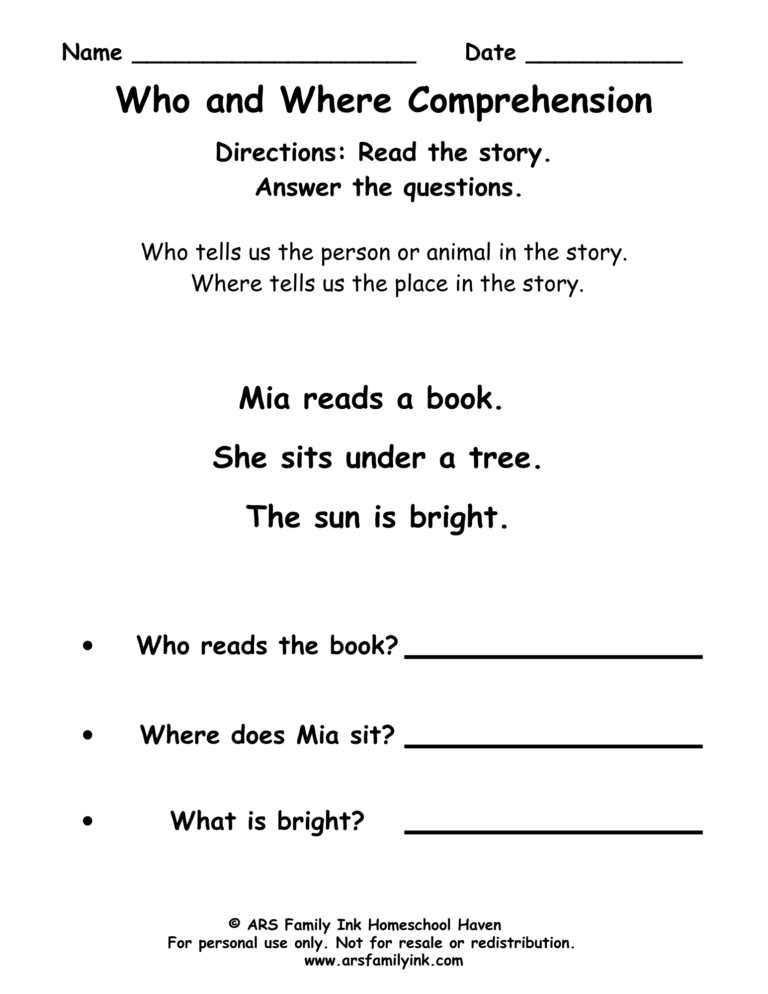
Help beginning readers strengthen their comprehension skills with this free Who and Where Reading Comprehension Worksheet. Children read a short passage about Mia reading a book under a tree and answer questions about who is in the story, where the story takes place, and an important story detail.
This simple printable is suitable for kindergarten and early first grade reading practice and works well for homeschool lessons, literacy centers, independent practice, or extra comprehension review.
Download your free worksheet below:
What Children Will Practice
This worksheet helps children practice:
✔ Reading a short passage
✔ Identifying the character (Who)
✔ Identifying the setting (Where)
✔ Finding information directly stated in a text
✔ Recalling an important story detail
✔ Answering comprehension questions
✔ Building reading confidence
How To Use This Worksheet
Have your child read the three-sentence passage independently or read it aloud together.
After reading, ask your child to answer each question using information from the story. Encourage your child to look back at the passage when needed rather than relying only on memory.
For children who are still developing independent reading skills, a parent or teacher can read the passage aloud while allowing the child to answer the comprehension questions.
Why Who and Where Questions Matter
Understanding who a story is about and where events happen gives young readers a foundation for understanding what they read.
These questions teach children to pay attention to important information in a text. As reading skills develop, recognizing characters, settings, and key details supports retelling, sequencing, summarizing, and more advanced comprehension.
Skills Covered
Character Identification
Children determine who is performing the main action in the passage.
Setting Recognition
Students identify where the character is sitting.
Key Detail Comprehension
The final question asks children to recall another explicitly stated detail from the story.
Text-Based Answers
Each answer can be found directly in the passage, giving beginning readers practice returning to a text to locate information.
Learning Goals
After completing this worksheet, children should be able to:
✔ Identify who a short passage is about
✔ Identify where an event takes place
✔ Recall a directly stated story detail
✔ Answer questions using information from a text
✔ Demonstrate basic understanding of a short passage
Parent & Teacher Tips:
If your child has difficulty answering a question, return to the story together and look for the sentence containing the answer.
You can also ask your child to point to the words that helped them answer. This reinforces an important comprehension habit: using the text to find evidence instead of guessing.
For children ready for an additional challenge, ask them to answer orally using complete sentences, such as, “Mia reads the book.”
Extend the Learning
Retell the Passage
Ask your child to tell you what happened without looking at the worksheet.
Find the Evidence
Have your child point to the sentence that answers each question.
Draw the Setting
Draw a picture of Mia sitting under a tree reading her book.
Add Another Detail
Ask your child to imagine one additional sentence that could be added to the story.
Questions To Ask Children:
What is Mia doing?
Where is Mia sitting?
What is the weather probably like?
Why might sitting under a tree be a nice place to read?
Where is your favorite place to read?
Building Early Reading Comprehension
Beginning readers benefit from short passages that allow them to focus on understanding what they read without becoming overwhelmed by a large amount of text.
Practicing Who, Where, and simple detail questions helps children learn to identify important information, return to a passage for answers, and gradually develop the comprehension habits they will need for longer and more complex texts.
You may also like:
Science
Simple science concepts, observation skills, and early exploration.
Numbers & Math
Counting, number recognition, basic math skills, and early problem-solving.
Reading & Writing
Early reading comprehension, handwriting, and sentence building skills.
Support Our Free Worksheets
If you enjoy these free worksheets, you can support our site by sharing with others, following us on social media, or joining our email list for more resources. It’s as easy as clicking the links at the bottom of the page. Your support helps us continue creating free printable learning materials.