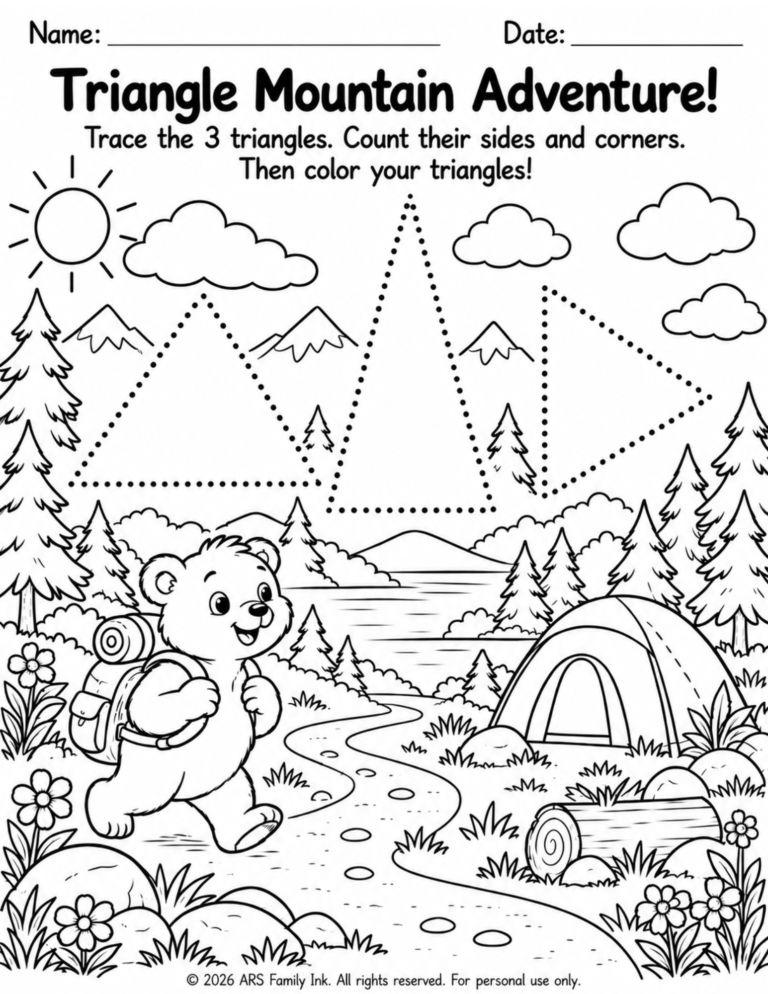
Get ready for a mountain adventure filled with triangle discoveries! Our Triangle Mountain Adventure! Preschool Worksheet helps young learners explore triangles through tracing, counting, and coloring.
Children follow the dotted lines to trace three triangles, count their sides and corners, and color their shapes. With a cheerful camping scene featuring a backpack-wearing bear, trees, mountains, and a tent, this printable brings a playful outdoor theme to early geometry practice.
Perfect for preschool homeschool lessons, classroom math centers, or extra shape practice at home!
Download your free worksheet below:
What This Worksheet Teaches
This preschool math worksheet introduces children to important characteristics of triangles through a simple, hands-on activity.
Children practice recognizing triangles in different sizes and orientations while tracing along dotted outlines. As they count each triangle’s sides and corners, they begin to understand what makes a triangle a triangle.
The activity also encourages careful observation, pencil control, and shape vocabulary. Coloring the completed triangles gives children an opportunity to enjoy their work while reinforcing the shapes they have explored.
How to Use This Worksheet
Begin by looking at the three dotted triangles together. Point to one triangle and explain that a triangle has three straight sides and three corners.
Invite your child to:
Find the three dotted triangles on the worksheet.
Trace each triangle by following the dotted lines.
Count the three sides of each triangle.
Point to and count the three corners.
Color the triangles after tracing and counting.
For younger preschoolers, demonstrate tracing the first triangle with your finger before introducing a crayon or pencil. Children who are ready for an additional challenge can compare the sizes and directions of the triangles.
The surrounding mountain camping illustration can also be colored as an optional extension.
Why This Skill Matters
Recognizing shapes is an important part of early mathematical learning. When preschoolers explore triangles, they begin noticing characteristics such as straight sides, corners, and differences in size or orientation.
Tracing helps children coordinate their hand movements with what they see, providing useful fine motor practice for future drawing and writing activities.
Counting the sides and corners also connects early geometry with counting skills. By exploring the same shape in different positions, children can begin recognizing that a triangle remains a triangle even when it looks different from a familiar example.
Skills Practiced
Triangle Recognition: Identifying triangles in different sizes and orientations.
Shape Tracing: Following dotted outlines to form triangles.
Counting: Counting three sides and three corners.
Early Geometry Vocabulary: Practicing the words triangle, side, and corner.
Visual Observation: Noticing similarities and differences among shapes.
Fine Motor Coordination: Developing controlled hand movements through tracing and coloring.
Following Directions: Completing a short sequence of learning activities.
Learning Goals
With age-appropriate guidance and practice, children will work toward:
Recognizing and naming a triangle.
Tracing three triangle outlines.
Identifying and counting a triangle’s three sides.
Identifying and counting a triangle’s three corners.
Recognizing triangles in different sizes and positions.
Building confidence with early shape exploration and fine motor activities.
Preschool children develop these skills at different rates. Some may complete the activity independently, while others benefit from adult modeling, pointing, and counting together.
Parent & Teacher Tips:
Start with finger tracing. Encourage children to follow a triangle’s dotted outline with one finger before using a writing tool.
Count together. Touch each side and corner as you count aloud. This helps children connect the numbers with the parts of the shape.
Notice different triangles. The three triangles are not identical. Talk about how they can look different while still having three sides and three corners.
Offer flexible tools. Thick crayons or other comfortable writing tools may be easier for children who are still developing their grip.
Keep the activity encouraging. Focus on exploring shapes rather than tracing perfectly. Allow breaks or complete one triangle at a time when needed.
Extend the Learning
Continue the triangle adventure with these simple hands-on activities:
Triangle Hunt: Search for triangular objects around your home, classroom, or outdoors.
Build a Triangle: Arrange three craft sticks into a triangle and count the sides and corners.
Draw More Triangles: Invite your child to draw a triangle beside their completed worksheet or on separate paper.
Compare Shapes: Draw a triangle and a square, then talk about how their numbers of sides and corners differ.
Mountain Art: Create a mountain picture using triangle shapes cut from colored paper, with adult assistance as needed.
These optional activities give children additional opportunities to recognize and explore triangles beyond the printable page.
Materials Needed
Printed Triangle Mountain Adventure! worksheet
Crayons, colored pencils, or pencils
A comfortable, flat workspace
Optional: Craft sticks or colored paper for additional triangle activities.
Perfect for Homeschool or Classroom Learning
Triangle Mountain Adventure! is a flexible printable for introducing or reviewing triangles with preschool learners.
Homeschool families can use it during a short math lesson, a shape-themed learning day, or a quiet activity. Teachers can include it in preschool math centers, small-group instruction, or individual shape practice.
Because the worksheet combines tracing, counting, and coloring, adults can adapt the activity to each child’s readiness while keeping the focus on exploring triangles.
Building Early Geometry and Shape Recognition Skills
Early geometry begins with opportunities to notice, explore, and describe shapes. For preschoolers, this often means looking closely at familiar shapes, tracing their outlines, and talking about what makes them alike or different.
Triangle Mountain Adventure! introduces the defining features of a triangle in a child-friendly way. By tracing three differently positioned triangles and counting their sides and corners, children practice recognizing shapes based on their characteristics rather than only their appearance.
These early experiences help establish a foundation for later geometry learning, including comparing, drawing, and describing two-dimensional shapes.
You may also like:
Alphabet & Phonics
Letter recognition, letter sounds, phonics skills, and early reading development.
Numbers & Math
Counting, number recognition, basic math skills, and early problem-solving.
Reading & Writing
Early reading comprehension, handwriting, and sentence building skills.
Support Our Free Worksheets
If you enjoy these free worksheets, you can support our site by sharing with others, following us on social media, or joining our email list for more resources. It’s as easy as clicking the links at the bottom of the page. Your support helps us continue creating free printable learning materials.