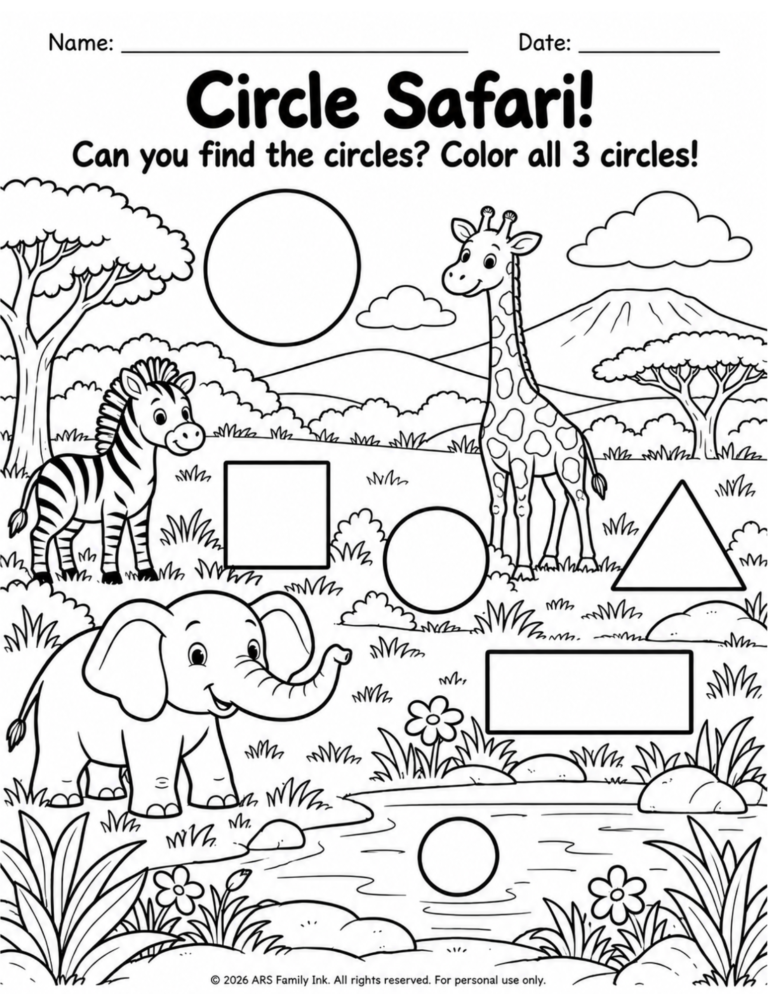
Get ready for a shape-finding adventure with Circle Safari! This free printable preschool math worksheet invites young learners to explore a safari scene while searching for three circles.
Children will discover a zebra, giraffe, and elephant surrounded by familiar shapes and scenery. Their mission is simple: find all three circles and color them!
This engaging activity provides a playful opportunity to practice circle recognition, visual discrimination, and fine motor skills while enjoying a creative coloring experience.
Download your free worksheet below:
What This Worksheet Teaches
Circle Safari! introduces and reinforces circle recognition by encouraging children to identify circles among other geometric shapes.
The worksheet features three large circles along with a square, triangle, and rectangle. Children practice looking carefully at each shape and recognizing the round outline of a circle.
By combining shape identification with coloring, this activity gives preschoolers a simple, hands-on way to strengthen early math observation skills.
How to Use This Worksheet
Print the Circle Safari! worksheet.
Read the directions aloud: “Can you find the circles? Color all 3 circles!”
Invite your child to look carefully at the safari scene.
Encourage your child to point to each circle before coloring it.
Have your child color all three circles using crayons or colored pencils.
After completing the activity, count the colored circles together.
Children may also enjoy coloring the safari animals and scenery after finishing the circle-finding activity.
Why This Skill Matters
Recognizing circles is an important part of early geometry learning. As preschoolers explore shapes, they begin noticing characteristics such as round edges, straight sides, and corners.
Finding circles among other shapes also encourages visual discrimination, the ability to notice similarities and differences in what children see.
These early observation skills help children sort, compare, and describe objects in their everyday environment. Coloring the circles also provides an opportunity to practice hand control and coordination.
Skills Practiced
Circle recognition and identification
Visual discrimination between shapes
Early geometry vocabulary
Careful observation and attention
Counting a small group of three
Fine motor control through coloring
Following simple directions
Learning Goals
After completing this activity, children will have opportunities to:
Identify circles in a picture containing different shapes.
Distinguish a circle from a square, triangle, and rectangle.
Locate and color three circles.
Practice using the word “circle” to describe a shape.
Strengthen observation and coloring skills.
Children may accomplish these goals with varying levels of adult guidance depending on their readiness.
Parent & Teacher Tips:
Begin by showing your child what makes a circle different from shapes with straight sides. You might trace a round shape in the air with your finger before starting.
For children who are just beginning to recognize shapes, point to the largest circle first and invite them to find another one independently.
For children who already recognize circles, ask them to explain how they know a shape is a circle. You can also invite them to identify the square, triangle, and rectangle without requiring them to color those shapes.
Keep the activity relaxed and encouraging. The goal is to build familiarity and confidence with shapes rather than focus on perfectly staying inside the lines.
Extend the Learning
Keep the shape adventure going with these simple activities:
Circle Hunt: Look around your home or classroom for round objects such as plates, wheels, or clocks.
Shape Sorting: Gather safe household objects and sort them into round objects and objects with straight edges.
Draw a Circle: Invite your child to draw circles of different sizes on a separate sheet of paper.
Count the Circles: Count the three circles together using one-to-one pointing.
Safari Talk: Name the zebra, giraffe, and elephant and talk about what children notice in the picture.
These optional activities encourage children to connect early geometry concepts with everyday experiences.
Materials Needed
Printed Circle Safari! worksheet
Crayons or colored pencils
A comfortable, flat coloring surface
Optional: Additional paper for drawing circles or practicing other shapes.
Perfect for Homeschool or Classroom Learning
Circle Safari! works well as a short preschool math activity for homeschool lessons, classroom learning centers, or independent coloring practice with adult guidance as needed.
Parents can use the worksheet during a shape-of-the-day lesson, while teachers may include it in a small-group geometry activity or preschool math center.
The familiar safari animals and open coloring spaces make the activity inviting for young learners, and the simple directions allow children to focus on recognizing circles at their own pace.
Building Early Geometry and Circle Recognition Skills
Preschool geometry begins with noticing and describing shapes in familiar surroundings. Children learn to recognize shapes by looking at their outlines, comparing their features, and exploring real objects.
Circle Safari! gives children an opportunity to identify circles even when other shapes and detailed illustrations are nearby. By finding three circles of different sizes, children can begin to understand that a circle remains a circle whether it is large or small.
Encourage your child to describe what they notice: circles are round, while squares, rectangles, and triangles have straight sides and corners. These simple conversations support early mathematical thinking and shape vocabulary.
You may also like:
Alphabet & Phonics
Letter recognition, letter sounds, phonics skills, and early reading development.
Numbers & Math
Counting, number recognition, basic math skills, and early problem-solving.
Reading & Writing
Early reading comprehension, handwriting, and sentence building skills.
Support Our Free Worksheets
If you enjoy these free worksheets, you can support our site by sharing with others, following us on social media, or joining our email list for more resources. It’s as easy as clicking the links at the bottom of the page. Your support helps us continue creating free printable learning materials.