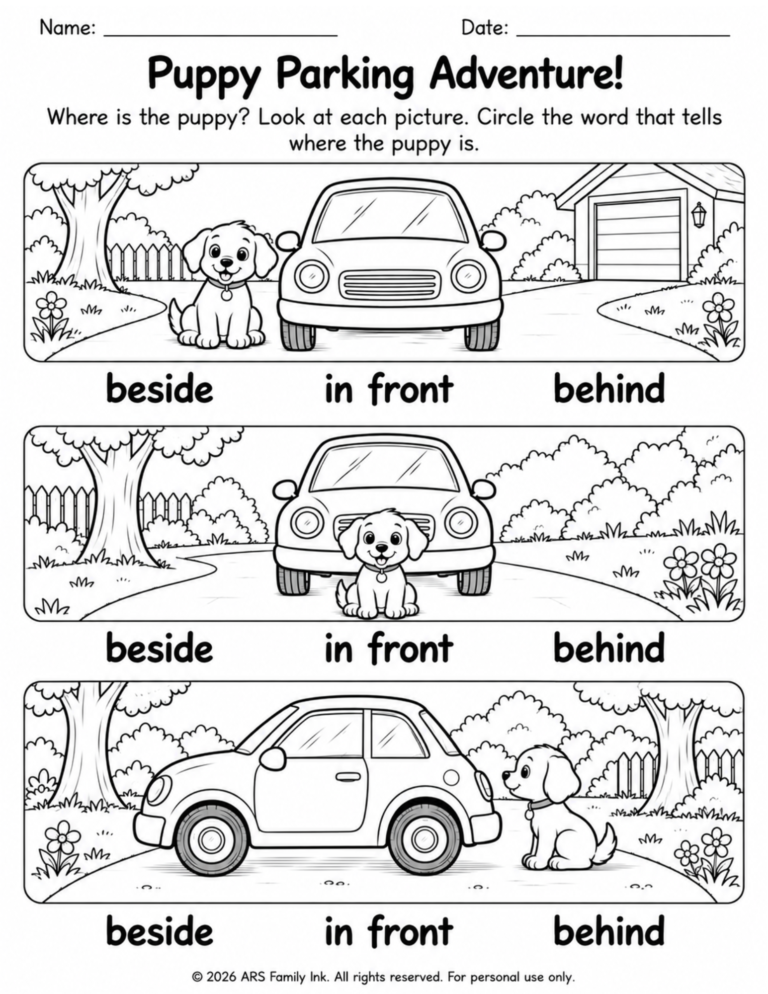
Help your preschooler explore position words with our free Puppy Parking Adventure! printable worksheet! This playful math activity introduces spatial vocabulary as children discover where an adorable puppy is sitting in relation to a car.
Children look at three pictures and circle the word that correctly describes the puppy’s position: beside, in front, or behind. With easy-to-follow illustrations and simple choices, this worksheet offers a fun way to practice early spatial awareness and observation skills.
Perfect for homeschool lessons, preschool classrooms, or extra practice at home!
Download your free worksheet below:
What This Worksheet Teaches
Puppy Parking Adventure! helps preschoolers recognize and describe where objects are located in relation to one another.
Children explore three important position words:
Beside: The puppy is next to the car.
In front: The puppy is positioned in front of the car.
Behind: The puppy is positioned behind the car.
By examining each picture and selecting the correct word, children practice connecting spatial vocabulary with visual examples.
This activity also encourages careful observation, listening, and early word recognition with adult support when needed.
How to Use This Worksheet
Print the Puppy Parking Adventure! worksheet.
Read the directions aloud: “Where is the puppy? Look at each picture. Circle the word that tells where the puppy is.”
Look at the first picture together and ask your child where the puppy is sitting.
Read the three word choices aloud if your child is not yet reading independently.
Have your child circle the correct position word.
Repeat with the remaining two pictures.
Parent Tip: Before beginning, demonstrate each position using a toy car and a small stuffed animal. Place the animal beside, in front of, and behind the car while saying each position word aloud.
Children who need additional support can point to the correct answer before attempting to circle it.
Why This Skill Matters
Understanding position words is an important part of early spatial awareness. Preschoolers use these words to describe where people and objects are located in their everyday surroundings.
Words such as beside, in front, and behind help children follow directions, describe what they observe, and communicate more clearly.
Spatial vocabulary also supports later learning in mathematics, including understanding shapes, locations, and relationships between objects.
By practicing with familiar pictures, children begin connecting the words they hear with the positions they see.
Skills Practiced
Spatial Awareness: Identifying where the puppy is positioned relative to the car.
Positional Vocabulary: Understanding beside, in front, and behind.
Visual Observation: Examining pictures to recognize spatial relationships.
Picture Interpretation: Connecting an illustrated scene with its correct description.
Early Language Development: Using words to describe object locations.
Fine Motor Practice: Circling the correct answers with a pencil or crayon.
Learning Goals
With appropriate guidance and practice, children will work toward:
Recognizing the positions beside, in front of, and behind.
Identifying the puppy’s location in three illustrated scenes.
Matching a picture to the correct position word.
Using positional vocabulary to describe familiar objects.
Following simple directions and circling a selected answer.
Preschool Learning Note: Children do not need to read the words independently to benefit from this activity. An adult may read the choices aloud while the child focuses on understanding the spatial relationships.
Parent & Teacher Tips:
Introduce the Words First: Use familiar objects to demonstrate beside, in front of, and behind before completing the worksheet.
Encourage Complete Sentences: Ask your child to say, “The puppy is beside the car,” instead of answering with only one word.
Provide Reading Support: Read the answer choices aloud and point to each word so emerging readers can participate without frustration.
Make It Active: Invite your child to stand beside a chair, in front of a table, or behind a sofa to demonstrate each position safely.
Offer an Extra Challenge: Ask your child to place a toy in different positions and describe where it is without looking at the worksheet.
Praise careful observation and effort, even when your child needs help selecting an answer.
Extend the Learning
Keep exploring position words after finishing the worksheet with these simple activities.
Toy Car Adventure: Use a toy car and a stuffed puppy or another small animal. Move the animal beside, in front of, and behind the car. Ask your child to name each position.
Position Word Hunt: Look around your home or classroom and describe where familiar objects are located. For example, “The shoes are beside the door.”
Follow the Directions: Give simple movement instructions such as “Stand behind the chair” or “Place your teddy bear in front of the box.”
Draw Your Own Scene: Invite your child to draw a car and a puppy. Ask them to choose where the puppy should sit and explain its position.
These optional activities provide hands-on opportunities to use positional vocabulary in everyday situations.
Materials Needed
Printed Puppy Parking Adventure! worksheet
Pencil or crayon
Optional: Toy car and stuffed animal for hands-on demonstrations
This simple black-and-white worksheet requires minimal preparation and can also be colored after the position-word activity is complete.
Perfect for Homeschool or Classroom Learning
Puppy Parking Adventure! is a flexible activity for preschoolers learning to recognize and describe positions.
For Homeschool Families: Include this worksheet in a short preschool math lesson or pair it with a hands-on toy activity.
For Preschool Classrooms: Use the worksheet during small-group instruction, math centers, or guided independent practice.
For Extra Practice at Home: Review position words with familiar household objects before completing the printable together.
Because the worksheet uses clear illustrations and only three questions, children can focus on understanding each position without a lengthy written assignment.
Building Early Math and Spatial Awareness Skills
Spatial awareness is an important part of preschool mathematics. Children develop this understanding as they explore where objects are located and how those objects relate to one another.
Puppy Parking Adventure! introduces three useful position words through familiar pictures. By observing the puppy’s location in relation to the car, children practice describing spatial relationships in a meaningful way.
These early experiences can help prepare children for future activities involving shapes, patterns, directions, and problem-solving.
Continue reinforcing these concepts through everyday conversations, movement games, and hands-on play. Repeated opportunities to use position words can help children become more comfortable describing the world around them.
You may also like:
Alphabet & Phonics
Letter recognition, letter sounds, phonics skills, and early reading development.
Numbers & Math
Counting, number recognition, basic math skills, and early problem-solving.
Reading & Writing
Early reading comprehension, handwriting, and sentence building skills.
Support Our Free Worksheets
If you enjoy these free worksheets, you can support our site by sharing with others, following us on social media, or joining our email list for more resources. It’s as easy as clicking the links at the bottom of the page. Your support helps us continue creating free printable learning materials.