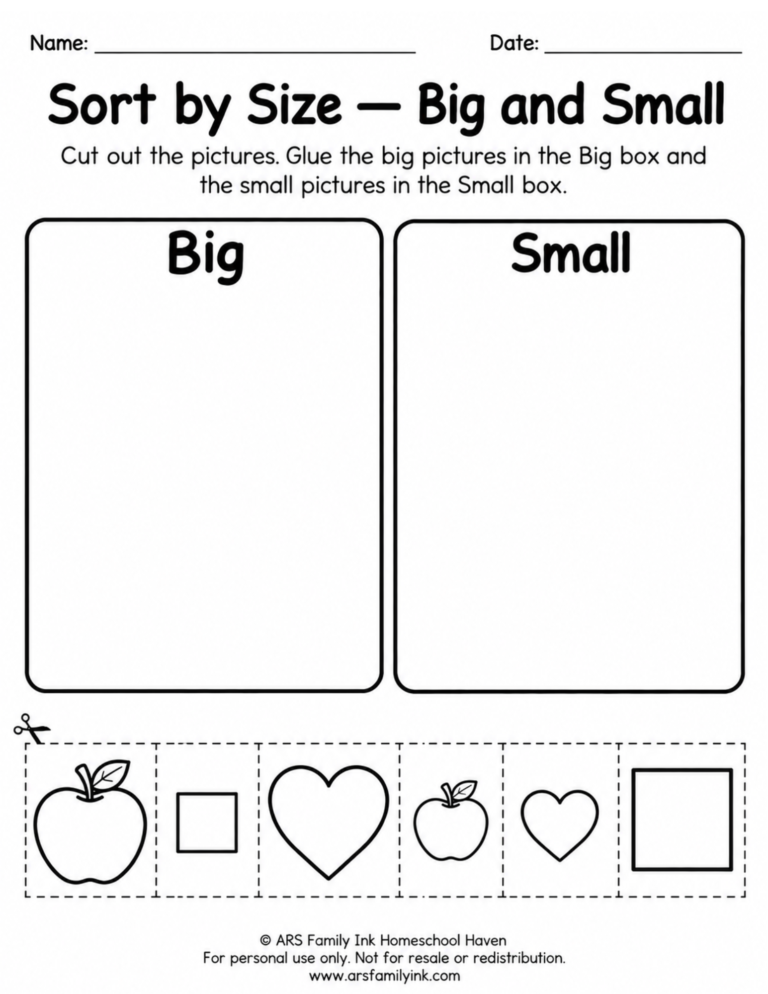
Help your preschooler explore big and small pictures and sorting by size with this free Sort by Size — Big and Small worksheet.
Children cut out mixed picture cards and glue them into the matching big or small group.
This hands-on activity builds size comparison, classification, and fine motor skills through playful practice.
Download your free worksheet below:
What This Worksheet Teaches
Children compare pictures by size and sort the cut-out cards into big and small groups.
They practice recognizing big and small, comparing sizes, sorting by an observable attribute, and cutting and gluing.
How to Use This Worksheet
Print the worksheet and gather child-safe scissors and a glue stick.
Point to the two sorting boxes labeled Big and Small. Talk about what these words mean, using the pictures as examples.
Help your child cut along the dashed lines to separate the six picture cards. Look at each picture together and decide whether it is big or small.
Have your child glue the big pictures into the Big box and the small pictures into the Small box.
Ask your child how they decided where each picture belonged. Offer cutting assistance as needed.
Why This Skill Matters
Understanding big and small helps preschoolers develop early mathematical thinking. When children compare objects by size, they begin recognizing differences, identifying measurable attributes, and organizing information.
Sorting also encourages children to observe carefully, make decisions, and explain their thinking.
These foundational skills support later learning in measurement, comparing quantities, classification, and problem-solving.
Skills Practiced
Recognizing big and small pictures
Comparing objects by size
Sorting pictures into two groups
Matching pictures with the correct size category
Developing visual observation and discrimination skills
Strengthening fine motor coordination through cutting and gluing
Using descriptive words such as big, small, bigger, and smaller
Learning Goals
After completing this activity, children will have opportunities to:
Identify pictures that are big or small.
Compare two pictures of the same object by size.
Sort six pictures into the correct Big and Small groups.
Describe why a picture belongs in a particular group.
Practice cutting and gluing with increasing independence.
Children develop these skills at different rates. Provide guidance or simplify the activity as needed.
Parent & Teacher Tips:
Start with matching pairs. Show your child the big apple and small apple. Ask, “Which apple is big? Which apple is small?” Repeat with the hearts and squares.
Model the activity. Demonstrate how to compare two pictures before placing one in the correct sorting box.
Use everyday examples. Compare big and small toys, books, cups, or blocks to help children connect the worksheet to familiar objects.
Offer cutting support. Younger preschoolers may need help cutting out the picture cards. You can prepare the pieces ahead of time so they can focus on sorting.
Encourage conversation. Ask questions such as “How do you know this one is bigger?” or “Can you find another small picture?”
Extend the Learning
Big and Small Scavenger Hunt: Find a big and small version of the same type of object around your home or classroom, such as two books or two blocks.
Sort Real Objects: Gather toys or classroom materials in different sizes. Have your child sort them into big and small groups.
Make Matching Pairs: Place the big and small picture cards side by side. Ask your child to match each apple, heart, and square with its corresponding picture.
Size Talk: Encourage your child to use words such as big, small, bigger, and smaller when comparing familiar objects.
Try a Challenge: Introduce three objects of noticeably different sizes and ask your child to arrange them from smallest to biggest.
Materials Needed
Printed Sort by Size — Big and Small worksheet
Child-safe scissors
Glue stick
Crayons or colored pencils (optional)
Teacher or Parent Note: For children who are not yet ready to use scissors independently, cut out the picture cards ahead of time. Children can still practice comparing and sorting the pictures.
Perfect for Homeschool or Classroom Learning
This free preschool sorting worksheet is a simple, hands-on way to introduce size comparison during everyday learning.
Homeschool families can use it as a short math activity, while preschool teachers can include it in math centers, small-group instruction, or independent practice.
The black-and-white design is printer-friendly and gives children the option to color their pictures before cutting and sorting.
With clear directions and familiar pictures, this activity can be adapted for different preschool readiness levels.
Building Early Math and Observation Skills
Learning to recognize and compare sizes is an important part of early math development.
As preschoolers examine the apples, hearts, and squares, they practice noticing differences between big and small versions of the same picture.
Sorting the six picture cards encourages children to observe, compare, classify, and make decisions based on a shared characteristic.
These playful experiences help build a foundation for future learning in measurement, sorting, patterns, and mathematical reasoning.
You may also like:
Alphabet & Phonics
Letter recognition, letter sounds, phonics skills, and early reading development.
Numbers & Math
Counting, number recognition, basic math skills, and early problem-solving.
Reading & Writing
Early reading comprehension, handwriting, and sentence building skills.
Support Our Free Worksheets
If you enjoy these free worksheets, you can support our site by sharing with others, following us on social media, or joining our email list for more resources. It’s as easy as clicking the links at the bottom of the page. Your support helps us continue creating free printable learning materials.