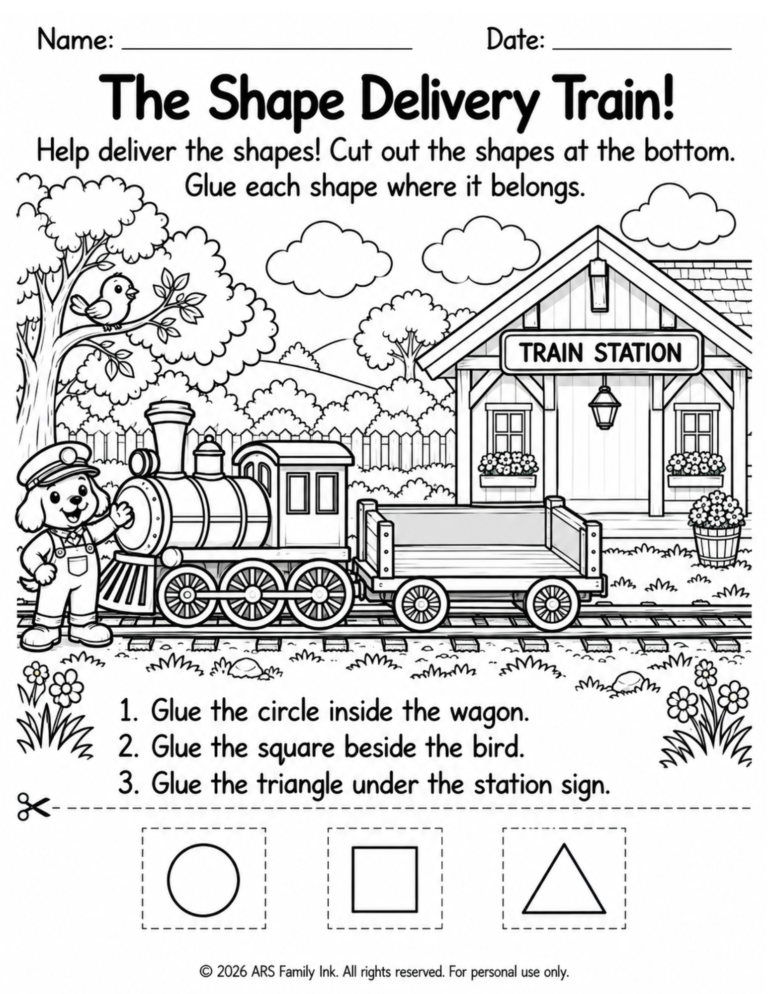
All aboard for a fun preschool shape adventure! In The Shape Delivery Train!, children help deliver three familiar shapes to their correct places in a cheerful train station scene. This free printable preschool math worksheet invites little learners to identify a circle, square, and triangle while following simple positional directions. With cutting, gluing, and a picture to explore, children can practice early geometry concepts in an engaging, hands-on way.
Download your free worksheet below:
What This Worksheet Teaches
The Shape Delivery Train! introduces children to the connection between shapes and their positions in space. Children identify three basic shapes—a circle, square, and triangle—and follow directions using the words inside, beside, and under. As they decide where each shape belongs, they practice listening, understanding spatial language, and applying directions to a picture. The cut-and-paste format also provides an opportunity to strengthen hand coordination and fine motor control.
How to Use This Worksheet
Begin by looking at the train station picture together. Point out the wagon, bird, and station sign so your child can recognize the locations mentioned in the directions.
Read the instructions aloud, or invite a child who is ready to help read them. Review the circle, square, and triangle at the bottom of the page. Help your child cut out the shapes along the dashed boxes, providing adult assistance with scissors as needed.
Follow the three numbered directions in order:
Glue the circle inside the wagon.
Glue the square beside the bird.
Glue the triangle under the station sign.
Encourage your child to point to each location before gluing. Once the shapes are attached, review their names and positions together. Children may also enjoy coloring the train station scene after completing the activity.
Why This Skill Matters
Recognizing shapes and understanding positional words are important foundations for early mathematical thinking. When children learn to describe where objects are located, they develop spatial awareness that supports everyday communication, movement, and later geometry learning.
Words such as inside, beside, and under help children understand and follow directions in familiar situations. Cutting and placing shapes also gives them hands-on opportunities to coordinate their eyes and hands while practicing careful movements.
Skills Practiced
Identifying circles, squares, and triangles
Understanding inside, beside, and under
Following simple step-by-step directions
Observing pictures to find specific locations
Developing spatial awareness
Practicing cutting and gluing
Strengthening hand-eye coordination and fine motor skills
Learning Goals
After completing this activity with appropriate support, children will have opportunities to:
Recognize and name a circle, square, and triangle.
Demonstrate understanding of inside, beside, and under by placing shapes in the correct locations.
Follow three simple picture-based directions.
Use scissors and glue with increasing control according to developmental readiness.
Describe where shapes are located using positional vocabulary.
Parent & Teacher Tips:
Introduce the positional words with real objects before beginning the worksheet. For example, place a toy inside a box, beside a book, or under a chair.
For younger preschoolers, complete one direction at a time and point to the matching location together. Adults can pre-cut the shapes for children who are not yet comfortable using scissors.
Encourage children to say the shape name and positional word before gluing. For an additional challenge, ask them to explain where each shape is after completing the activity.
Remember that preschool children develop fine motor and language skills at different rates. Focus on understanding and participation rather than perfectly cut shapes.
Extend the Learning
Keep the shape adventure going with simple activities beyond the worksheet.
Shape Hunt: Search around your home or classroom for circles, squares, and triangles.
Toy Train Delivery: Use a toy train, wagon, or small box to practice putting objects inside, beside, and under different items.
Position Game: Give playful directions such as placing a block under a table or beside a chair.
Shape Sorting: Cut out additional paper shapes and sort them into groups by shape.
Train Station Coloring: Invite your child to color the completed train scene and talk about the objects they notice.
For children ready for a challenge, introduce additional positional words such as above, behind, and in front of during hands-on play.
Materials Needed
Printed copy of The Shape Delivery Train! worksheet
Child-safe scissors
Glue stick or school glue
Crayons or colored pencils (optional)
Adult assistance as needed
Perfect for Homeschool or Classroom Learning
The Shape Delivery Train! is a flexible activity for preschool homeschool lessons, early math centers, small-group instruction, or individual practice. Parents can guide children through the directions at their own pace, while teachers can use the worksheet to reinforce shape recognition and positional vocabulary during a geometry or spatial-awareness lesson.
Because the activity combines a familiar train scene with simple shape placement, it offers a hands-on way to connect early math language with visual examples. It can also be paired with building blocks, toy vehicles, and everyday objects for additional practice.
Building Early Geometry and Spatial Awareness Skills
Preschool geometry begins with exploring shapes and noticing how objects relate to one another. Children gradually learn to recognize familiar shapes, compare their features, and describe where things are located.
The Shape Delivery Train! brings these ideas together through a simple cut-and-paste challenge. As children match each shape to its instructed location, they practice using mathematical vocabulary in a meaningful picture-based activity.
These early experiences help build a foundation for later learning about shapes, positions, directions, and spatial relationships. Most importantly, children can explore these concepts through play, conversation, and hands-on discovery.
You may also like:
Alphabet & Phonics
Letter recognition, letter sounds, phonics skills, and early reading development.
Numbers & Math
Counting, number recognition, basic math skills, and early problem-solving.
Reading & Writing
Early reading comprehension, handwriting, and sentence building skills.
Support Our Free Worksheets
If you enjoy these free worksheets, you can support our site by sharing with others, following us on social media, or joining our email list for more resources. It’s as easy as clicking the links at the bottom of the page. Your support helps us continue creating free printable learning materials.