Make early math practice a colorful adventure with our free Shape Parade! Preschool Shape and Color Matching Worksheet!
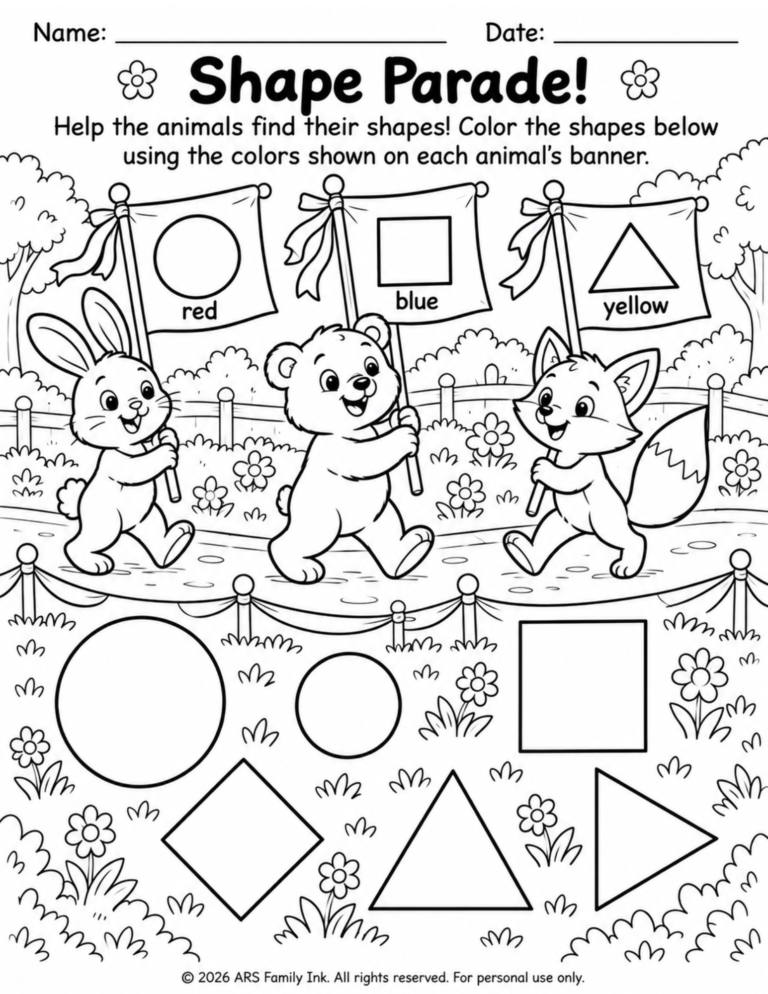
Children join a cheerful rabbit, bear, and fox as they carry banners featuring familiar shapes and color words. Using these banners as a guide, little learners find and color the matching circles, squares, and triangles.
This playful, black-and-white printable offers hands-on practice with shape recognition, color matching, and following directions. It’s a simple addition to preschool homeschool lessons, early math centers, or quiet learning time.
Download your free worksheet below:
What This Worksheet Teaches
Shape Parade! introduces children to three familiar geometric shapes: circles, squares, and triangles.
Each animal carries a banner showing a shape and its matching color word:
Circle — red
Square — blue
Triangle — yellow
Children look at the banners, find the corresponding shapes below, and color them using the indicated colors.
The activity encourages children to notice shape features, match visual examples, recognize basic colors, and follow simple directions. An additional diamond shape provides an opportunity to notice and discuss a shape that does not appear on the banners.
How to Use This Worksheet
Print the Shape Parade! worksheet and provide red, blue, and yellow crayons or colored pencils.
Look at the three animals and their banners together. Name each shape and read its color word aloud.
Invite your child to find the circles, squares, and triangles in the lower portion of the page.
Have your child color the circles red, the square blue, and the triangles yellow.
Review the completed shapes together and ask your child to name each shape and color.
For younger preschoolers, begin with one banner at a time and help them locate the matching shapes.
The diamond is not included in the banner directions. You may leave it uncolored or use it for an optional conversation about different shapes.
Why This Skill Matters
Recognizing shapes is an important part of early mathematical learning. As preschoolers explore circles, squares, and triangles, they begin noticing how objects can be grouped by their visual features.
Matching shapes to examples also supports observation and visual discrimination. Children practice looking carefully, recognizing similarities, and distinguishing one shape from another.
Adding simple color directions gives children opportunities to listen, remember instructions, and make purposeful choices. Coloring the shapes also provides practice controlling crayons and working within outlined spaces.
These experiences help build a foundation for later geometry, sorting, comparing, and other early math activities.
Skills Practiced
Recognizing circles, squares, and triangles
Matching shapes to visual examples
Identifying red, blue, and yellow
Following simple color directions
Observing similarities and differences between shapes
Developing visual discrimination
Practicing hand-eye coordination and crayon control
Building early math vocabulary
Learning Goals
With developmentally appropriate support, children will have opportunities to:
Identify and name circles, squares, and triangles.
Match outlined shapes to the examples on the animal banners.
Associate each featured shape with its assigned color.
Follow simple directions to complete a coloring activity.
Describe basic differences between familiar shapes.
Strengthen fine motor coordination through coloring.
Children can work toward these goals at their own pace. Younger learners may need help identifying shapes or remembering the color directions.
Parent & Teacher Tips:
Start with shape names. Before coloring, point to the banners and name each shape together. Let your child trace the outline with a finger.
Work one color at a time. For children who are just beginning to follow multiple directions, start with the red circles before moving to the blue square and yellow triangles.
Talk about shape features. Point out that circles are round, squares have four straight sides, and triangles have three sides.
Offer gentle support. Some preschoolers may recognize shapes without consistently naming them. Pointing to the correct shape is also a meaningful way to participate.
Encourage effort over perfection. Coloring outside the lines is developmentally normal. Focus on recognizing shapes and following the activity rather than achieving perfectly neat coloring.
Extend the Learning
Keep the shape parade going with a few simple activities!
Shape Hunt: Look around your home or classroom for round objects, square items, and triangular shapes.
Shape Sorting: Cut out paper circles, squares, and triangles and invite your child to group matching shapes.
Count the Shapes: Ask how many circles, squares, and triangles appear in the lower activity area.
Explore the Diamond: Look at the extra diamond shape and compare its appearance with the square.
Create a Parade: Draw your own shape banners and let your child choose colors for a new coloring game.
For children ready for an extra challenge, ask them to describe how they know a shape is a circle, square, or triangle.
Materials Needed
Printed Shape Parade! worksheet
Red, blue, and yellow crayons or colored pencils
A comfortable, flat coloring surface
Optional: Additional paper and crayons for drawing or sorting shapes after the worksheet is complete.
Perfect for Homeschool or Classroom Learning
Shape Parade! is an easy-to-use activity for preschool homeschool lessons, early childhood classrooms, math centers, and small-group practice.
Parents can work alongside their children to introduce shapes and color directions, while teachers can use the worksheet to reinforce previously introduced shape vocabulary.
The black-and-white design lets children add their own color while practicing important early math skills. With simple directions and familiar shapes, this printable can be adapted for different preschool readiness levels.
Building Early Geometry and Shape Recognition Skills
Preschool geometry begins with noticing, exploring, and describing shapes in everyday surroundings.
Shape Parade! gives children a chance to recognize circles, squares, and triangles in different sizes and orientations. For example, the worksheet includes triangles that face different directions, helping children see that a shape remains a triangle even when it is turned.
Children also encounter two circles of different sizes, encouraging them to focus on shape characteristics rather than size alone.
Through playful observation, shape matching, and coloring, preschoolers develop familiarity with geometric vocabulary and begin building the visual reasoning skills they will use in future math learning.
You may also like:
Alphabet & Phonics
Letter recognition, letter sounds, phonics skills, and early reading development.
Numbers & Math
Counting, number recognition, basic math skills, and early problem-solving.
Reading & Writing
Early reading comprehension, handwriting, and sentence building skills.
Support Our Free Worksheets
If you enjoy these free worksheets, you can support our site by sharing with others, following us on social media, or joining our email list for more resources. It’s as easy as clicking the links at the bottom of the page. Your support helps us continue creating free printable learning materials.