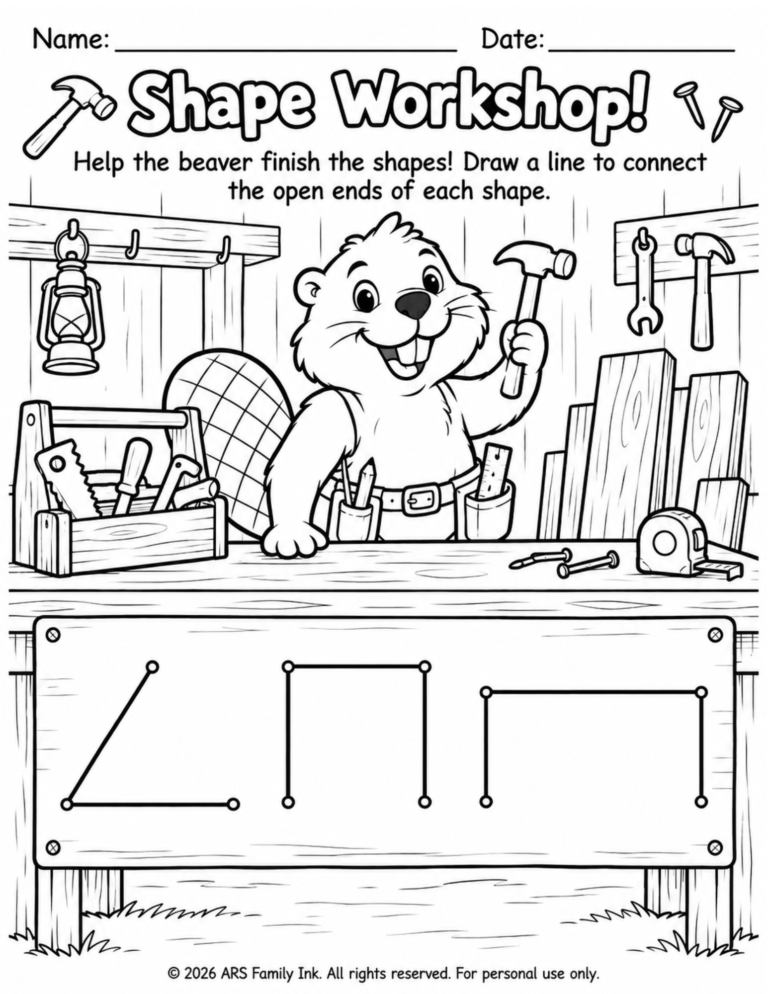
Get ready for some shape-building fun with our Shape Workshop! Preschool Shapes Worksheet from ARS Family Ink Homeschool Haven!
In this engaging printable math activity, children help a friendly beaver finish three incomplete shapes by drawing lines to connect their open endpoints. As they work, preschoolers can explore the triangle, square, and rectangle while practicing careful observation and pencil control.
This free black-and-white worksheet offers a simple, hands-on way to introduce early geometry through drawing and playful learning.
Download your free worksheet below:
What This Worksheet Teaches
The Shape Workshop! worksheet introduces preschoolers to the idea that shapes are made from lines that connect to form a complete outline.
Children examine three unfinished shapes and identify where each missing side belongs. By drawing a line between the open endpoints, they complete the shape and can begin recognizing its familiar form.
The activity provides opportunities to practice:
Recognizing a triangle, square, and rectangle.
Observing incomplete shapes.
Identifying where a missing line belongs.
Connecting two points with a pencil.
Developing visual attention and hand-eye coordination.
Children can also explore the number of sides and corners in each completed shape with adult guidance.
How to Use This Worksheet
Using the Shape Workshop! worksheet is simple and requires very little preparation.
Print the worksheet and provide your child with a pencil or crayon.
Read the directions aloud: “Help the beaver finish the shapes! Draw a line to connect the open ends of each shape.”
Look at the first unfinished shape together. Encourage your child to find the two open endpoints.
Have your child draw a line connecting those endpoints.
Repeat the activity with the remaining shapes.
Once all three shapes are complete, talk about their names and count their sides together.
For children who are still developing pencil control, demonstrate the movement with your finger before inviting them to draw independently.
Why This Skill Matters
Recognizing and completing shapes helps preschoolers develop foundational early geometry skills.
When children notice that a shape is missing a side, they practice observing visual details and understanding how lines fit together. Completing the missing lines also encourages spatial awareness and introduces the idea that familiar shapes have recognizable outlines.
Drawing between two points gives children an opportunity to strengthen pencil control and hand-eye coordination, skills that are also useful in early writing and other fine motor activities.
These simple experiences help children build familiarity with shapes through meaningful, age-appropriate practice.
Skills Practiced
Shape Recognition: Identifying familiar shapes, including triangles, squares, and rectangles.
Visual Discrimination: Noticing missing parts of an incomplete shape.
Spatial Awareness: Understanding where a line belongs to complete a shape.
Fine Motor Control: Using a pencil or crayon to draw straight lines.
Hand-Eye Coordination: Guiding drawing movements between two points.
Early Geometry Vocabulary: Exploring words such as side, corner, line, and shape.
Learning Goals
With developmentally appropriate guidance, children will have opportunities to:
Observe and recognize familiar geometric shapes.
Identify the open endpoints of an incomplete shape.
Draw a missing line to complete a shape.
Practice naming triangles, squares, and rectangles.
Explore the idea that shapes have sides and corners.
Build confidence using drawing tools for simple math activities.
Children may need different levels of assistance depending on their age, experience, and fine motor development.
Parent & Teacher Tips:
Make this activity encouraging and interactive by talking about the shapes as your child works.
For younger preschoolers or beginners: Point to the two open endpoints and invite your child to trace the missing line in the air or with a finger before drawing. Offer hand-over-hand assistance only if welcomed and needed.
For children ready for more independence: Encourage them to find the missing side without pointing it out. Ask them to name each completed shape.
For an optional challenge: Count the sides and corners together. Compare the square and rectangle and talk about what looks similar or different.
Keep the focus on exploration and effort rather than perfectly straight lines. A child can benefit from the activity even when their drawing is not precise.
Extend the Learning
Continue exploring shapes with simple activities using materials you already have at home or in the classroom.
Shape Hunt: Look around the room for objects shaped like squares, rectangles, and triangles.
Build a Shape: Use craft sticks or strips of paper to create familiar shapes.
Draw Together: Draw an incomplete shape on a separate piece of paper and invite your child to finish it.
Count the Sides: Point to each side of a completed shape and count aloud.
Color the Workshop: After completing the shapes, let your child color the beaver and workshop illustration.
These optional activities encourage children to connect what they see on the worksheet with shapes in their everyday surroundings.
Materials Needed
You only need a few basic supplies to complete this activity.
Printed Shape Workshop! worksheet
Pencil or crayon
Optional: Colored pencils or crayons for coloring the workshop illustration after completing the shapes.
No cutting, gluing, or special materials are required.
Perfect for Homeschool or Classroom Learning
The Shape Workshop! worksheet is a convenient activity for preschool homeschool lessons, early math centers, small-group instruction, or individual practice.
Homeschool families can use it as a short introduction to shapes or as additional practice after exploring shapes with everyday objects.
Preschool teachers can include the worksheet in a geometry-themed activity or provide it as a quiet drawing task during math learning time.
Because the worksheet is black and white and requires only a pencil or crayon, it is easy to prepare and offers an additional opportunity for creative coloring.
Building Early Geometry and Shape Recognition Skills
Early geometry begins with noticing shapes in the world around us. Preschool children learn about shapes through looking, touching, building, drawing, and comparing.
The Shape Workshop! worksheet gives children an opportunity to explore how straight lines connect to create familiar shapes. By finishing a triangle, square, and rectangle, children can begin noticing that shapes have different numbers of sides and corners.
For preschool learners, hands-on experiences are especially valuable. Pairing this worksheet with blocks, craft sticks, shape puzzles, or everyday objects can help children connect printed shapes with real-world examples.
At ARS Family Ink Homeschool Haven, we encourage playful, developmentally appropriate learning experiences that help children explore early math concepts at their own pace.
You may also like:
Alphabet & Phonics
Letter recognition, letter sounds, phonics skills, and early reading development.
Numbers & Math
Counting, number recognition, basic math skills, and early problem-solving.
Reading & Writing
Early reading comprehension, handwriting, and sentence building skills.
Support Our Free Worksheets
If you enjoy these free worksheets, you can support our site by sharing with others, following us on social media, or joining our email list for more resources. It’s as easy as clicking the links at the bottom of the page. Your support helps us continue creating free printable learning materials.