Help your little learner explore squares and rectangles with our free Shape Builders! preschool math worksheet!
In this playful construction-themed activity, children join a friendly puppy as they explore two structures made from geometric blocks. Their mission is to find and color two squares and put an X on two long rectangles.
This printable offers a fun way to introduce early geometry, encourage careful observation, and help preschoolers notice how shapes can be used to build familiar structures. It’s a simple addition to homeschool lessons, preschool classrooms, or hands-on math practice at home.
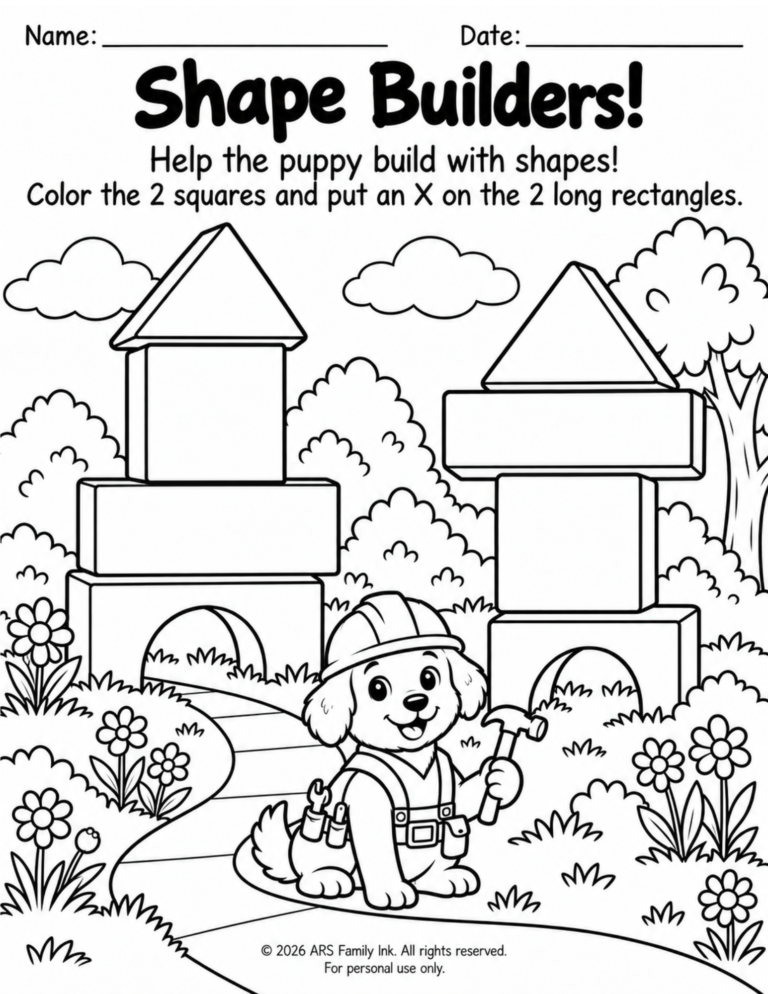
Download your free worksheet below:
What This Worksheet Teaches
The Shape Builders! worksheet introduces children to two common 2D shapes: squares and rectangles.
As children examine the block structures, they practice recognizing shapes based on their appearance rather than their position in the picture. With adult guidance, they can begin noticing that squares have four equal sides, while rectangles can have two longer sides and two shorter sides.
The activity also encourages children to look carefully, follow simple instructions, and identify specific shapes within a larger illustration.
This worksheet focuses on recognizing and comparing shapes, rather than measuring sides or formally classifying geometric figures.
How to Use This Worksheet
Print the Shape Builders! worksheet and gather crayons or colored pencils.
Invite your child to look at the puppy and the two block structures.
Point out a square and a long rectangle, discussing what makes them look different.
Read the worksheet directions aloud: “Help the puppy build with shapes! Color the 2 squares and put an X on the 2 long rectangles.”
Encourage your child to examine the blocks carefully before making each mark.
After completing the activity, review the selected shapes together.
For younger learners: Point to one block at a time and ask whether it looks like a square or a long rectangle. Provide help as needed.
For children ready for a challenge: Ask them to explain how they recognized each shape. They can also look for squares and rectangles in everyday objects around the room.
Why This Skill Matters
Recognizing and comparing shapes is an important part of early mathematical development.
As preschoolers learn to identify squares and rectangles, they begin noticing characteristics such as sides, corners, and overall shape. These observations help build a foundation for later geometry and spatial reasoning.
Shape recognition also supports everyday learning. Children encounter geometric shapes in building blocks, books, windows, doors, and toys.
By examining shapes within a larger picture, children practice paying attention to visual details and making simple comparisons.
The goal at the preschool level is to encourage exploration, recognition, and mathematical conversation—not to expect formal geometric definitions or perfect accuracy on the first attempt.
Skills Practiced
Shape Recognition: Identifying squares and long rectangles.
Visual Discrimination: Noticing differences in shape proportions.
Early Geometry: Exploring sides, corners, and familiar 2D shapes.
Observation: Finding specific shapes within a detailed picture.
Following Directions: Completing two different marking instructions.
Fine Motor Skills: Practicing coloring and making X marks.
Math Vocabulary: Using words such as square, rectangle, side, corner, long, and short.
Learning Goals
With developmentally appropriate guidance, children will work toward:
Recognizing squares and rectangles in a picture.
Identifying two squares and two long rectangles.
Noticing visible differences between squares and longer rectangles.
Following simple two-part activity directions.
Practicing controlled coloring and making X marks.
Describing shapes using basic mathematical vocabulary.
Children may need different levels of adult support depending on their experience with shapes and fine motor activities.
Parent & Teacher Tips:
Introduce the shapes first. Before beginning, show your child a square block and a longer rectangular block. Discuss how they look alike and how they look different.
Use simple shape language. Talk about straight sides and corners. Explain that the squares have sides of equal length, while the long rectangles have a stretched-out appearance.
Make the activity interactive. Ask questions such as, “Which block looks like a square?” or “Can you find a block that is longer than it is tall?”
Allow time for observation. Encourage children to look carefully before coloring or marking their answers.
Offer fine motor support. Children who find coloring difficult can point to the correct shapes first or use a thicker crayon.
Focus on learning, not perfection. Praise careful looking, participation, and attempts to explain shape choices. Mistakes can become opportunities to compare the shapes again.
Extend the Learning
Continue exploring squares and rectangles with these simple activities:
1. Build with Blocks
Gather square and rectangular building blocks. Encourage your child to create a small house, tower, or other structure using both shapes.
2. Go on a Shape Hunt
Look around your home or classroom for objects shaped like squares and rectangles. Try picture frames, books, windows, and building toys.
3. Sort the Shapes
Cut out simple paper squares and rectangles in different sizes. Invite your child to sort them into groups and explain their choices.
4. Draw a Shape Building
Help your child draw a structure using squares, rectangles, and triangles. Talk about which shapes were used and where they appear.
5. Try a Shape Challenge
For children who are ready, include squares and rectangles in different sizes or orientations. Discuss why a shape remains a square or rectangle even when it is turned.
These optional activities extend the worksheet into hands-on shape exploration without requiring additional printable materials.
Materials Needed
Printed Shape Builders! worksheet
Crayons or colored pencils
Pencil for making X marks
Optional materials for extended learning:
Square and rectangular building blocks
Construction paper
Child-safe scissors with adult supervision
Additional paper for drawing shapes
No special supplies are required to complete the worksheet.
Perfect for Homeschool or Classroom Learning
The Shape Builders! worksheet provides a simple, flexible way to practice early geometry skills.
For homeschool families, it can be included in a short preschool math lesson, used after playing with building blocks, or offered as independent practice once the directions are understood.
For preschool teachers, the activity works well for guided small-group lessons, shape-recognition practice, or math centers.
Because the worksheet is black and white, children can also enjoy coloring the puppy and surrounding scenery after completing the shape activity.
Whether used at home or in a classroom, this printable encourages children to observe, compare, and talk about familiar shapes in an engaging setting.
Building Early Geometry and Shape Comparison Skills
Learning to recognize squares and rectangles helps preschoolers develop an understanding of how shapes are alike and different.
In Shape Builders!, children explore two block structures and search for specific shapes. The activity encourages them to look beyond the overall picture and pay attention to individual geometric forms.
As children become more familiar with squares and rectangles, adults can introduce simple conversations about straight sides, corners, and side lengths.
It is also helpful to explain that a square belongs to the rectangle family in formal geometry, even though early preschool activities often distinguish squares from longer rectangles to make visual comparisons easier.
These early experiences support mathematical vocabulary, visual reasoning, and growing confidence with geometry through playful, age-appropriate practice.
You may also like:
Alphabet & Phonics
Letter recognition, letter sounds, phonics skills, and early reading development.
Numbers & Math
Counting, number recognition, basic math skills, and early problem-solving.
Reading & Writing
Early reading comprehension, handwriting, and sentence building skills.
Support Our Free Worksheets
If you enjoy these free worksheets, you can support our site by sharing with others, following us on social media, or joining our email list for more resources. It’s as easy as clicking the links at the bottom of the page. Your support helps us continue creating free printable learning materials.