Make early counting practice fun with our Find the Three! Free Preschool Counting Worksheet from ARS Family Ink Homeschool Haven!
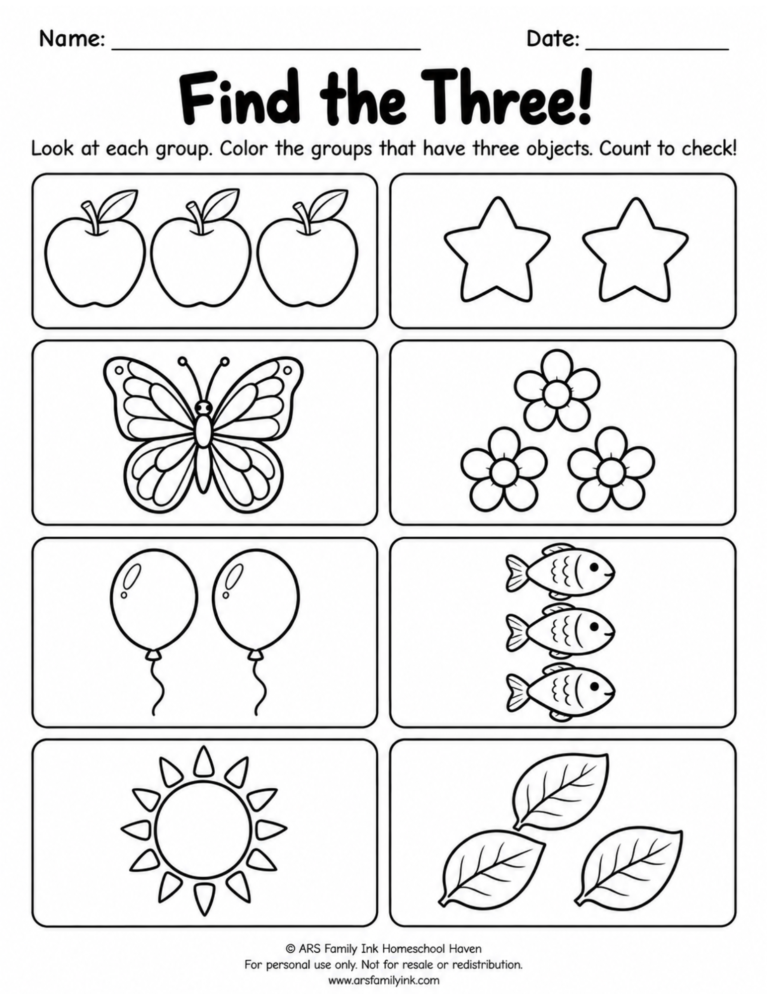
This simple, engaging preschool math activity encourages children to look carefully at groups of familiar objects, count how many they see, and color only the groups containing exactly three objects.
With apples, flowers, fish, and other recognizable pictures, children can practice early number sense while enjoying a hands-on coloring activity. The black-and-white design makes this worksheet easy to print and use during homeschool lessons, preschool math time, or independent practice with adult support.
Download your free worksheet below:
What This Worksheet Teaches
The Find the Three! worksheet introduces and reinforces the idea that a group can contain a specific number of objects, regardless of what those objects are.
Children examine eight picture groups containing one, two, or three objects. Their task is to identify and color only the groups that contain exactly three.
Through this activity, preschoolers practice:
Counting objects one at a time.
Recognizing groups containing three objects.
Comparing small groups with different quantities.
Connecting the spoken number word “three” to an actual quantity.
Paying attention to visual details and following simple directions.
The activity focuses on understanding the quantity three rather than writing or identifying the numeral 3.
How to Use This Worksheet
Print the worksheet. Give your child the Find the Three! worksheet and crayons or colored pencils.
Read the directions together. Say, “Look at each group. Color the groups that have three objects. Count to check!”
Practice counting. Point to the objects in one group and count aloud together, touching or pointing to each object once.
Find the groups of three. Encourage your child to examine each picture group and decide whether it contains exactly three objects.
Color the correct groups. Have your child color the groups containing three apples, three flowers, three fish, and three leaves.
Count to check. After coloring, revisit the groups and count the objects together to confirm each answer.
Allow children to work at their own pace. If counting is still new, demonstrate with one group before inviting them to try another.
Why This Skill Matters
Recognizing and counting small groups of objects is an important part of developing early number sense.
When preschoolers count objects one at a time, they begin connecting number words with actual quantities. They also learn that the final number spoken when counting tells how many objects are in the group.
Finding groups of three helps children notice the difference between quantities of one, two, and three. These early experiences provide a foundation for later work with comparing quantities, recognizing numerals, and exploring simple addition and subtraction.
Combining counting with coloring also gives children an opportunity to practice following directions, concentrating on a task, and using fine motor skills.
Skills Practiced
Counting: Counting up to three objects using one-to-one correspondence.
Quantity Recognition: Identifying groups that contain exactly three objects.
Early Number Sense: Understanding that three describes a specific quantity.
Visual Discrimination: Noticing differences between groups of one, two, and three objects.
Following Directions: Selecting and coloring only the groups that meet the instructions.
Fine Motor Coordination: Practicing controlled coloring movements.
Math Vocabulary: Using words such as one, two, three, count, and how many.
Learning Goals
With developmentally appropriate guidance and practice, children can work toward the following goals:
Count groups containing up to three objects.
Point to each object once while counting.
Identify which picture groups contain exactly three objects.
Recognize that groups containing different kinds of objects can have the same quantity.
Distinguish groups of three from groups containing one or two objects.
Follow simple counting and coloring directions.
Check an answer by counting again.
These goals are flexible. Some preschoolers may complete the activity independently, while others may benefit from counting aloud with an adult or using physical objects for additional practice.
Parent & Teacher Tips:
Start with real objects. Before beginning the worksheet, place three blocks, buttons, or other safe counting objects on a table. Count them together to demonstrate what a group of three looks like.
Point while counting. Encourage children to touch or point to each picture once as they count. This helps connect one number word to one object.
Use simple questions. Ask, “How many apples do you see?” or “Does this group have three?” Give children time to think and respond.
Provide a simpler starting point. For children who are just beginning to count, focus on one or two picture groups at a time and count together before coloring.
Offer an optional challenge. Invite children who are ready to explain how they know a group contains three objects or to make their own group of three using small toys.
Keep the experience encouraging. If a child colors a group with a different quantity, count it together again rather than focusing only on whether the answer is correct.
Extend the Learning
Continue exploring the number three with simple hands-on activities after completing the worksheet.
Find Three Around the House: Invite your child to collect three crayons, three blocks, or three toy animals.
Make a Group of Three: Start with a small pile of objects and ask your child to choose exactly three.
Clap Three Times: Count together while clapping, tapping, or gently stomping three times.
Compare Small Groups: Place two objects beside three objects and ask which group has three.
Draw Three: Encourage your child to draw three circles, flowers, or other simple pictures.
Count During Everyday Routines: Look for opportunities to count three snacks, three steps, or three items being put away.
These playful activities help children explore the same quantity in different settings without requiring additional worksheets.
Materials Needed
Only a few basic supplies are needed for this activity:
Printed Find the Three! worksheet.
Crayons or colored pencils.
A comfortable, flat coloring surface.
Optional: Three small counting objects, such as blocks or toy animals, for hands-on demonstrations.
No cutting, gluing, or additional preparation is required.
Perfect for Homeschool or Classroom Learning
The Find the Three! worksheet is a flexible addition to preschool math activities at home or in the classroom.
Homeschool families can use it during a short number sense lesson, as extra counting practice, or as a follow-up to hands-on activities with small groups of objects.
Preschool teachers can incorporate it into a math learning center, small-group lesson, or guided counting activity. Children who are comfortable counting may work more independently, while beginners can count each picture with an adult.
Because the worksheet uses familiar illustrations and straightforward directions, it offers a simple way to reinforce counting and quantity recognition without complicated preparation.
Building Early Math and Quantity Recognition Skills
Understanding the number three involves more than memorizing a number word. Children gradually learn that three represents a particular quantity, whether they are counting apples, flowers, fish, or leaves.
This worksheet encourages children to connect spoken counting with visible groups of objects. By identifying groups containing exactly three items and distinguishing them from smaller groups, preschoolers practice meaningful early math thinking.
The activity also introduces the idea that the number of objects in a group stays the same even when the objects look different or are arranged differently.
Paired with hands-on counting and everyday number conversations, Find the Three! provides an approachable opportunity to strengthen early counting and quantity recognition skills.
You may also like:
Alphabet & Phonics
Letter recognition, letter sounds, phonics skills, and early reading development.
Numbers & Math
Counting, number recognition, basic math skills, and early problem-solving.
Reading & Writing
Early reading comprehension, handwriting, and sentence building skills.
Support Our Free Worksheets
If you enjoy these free worksheets, you can support our site by sharing with others, following us on social media, or joining our email list for more resources. It’s as easy as clicking the links at the bottom of the page. Your support helps us continue creating free printable learning materials.