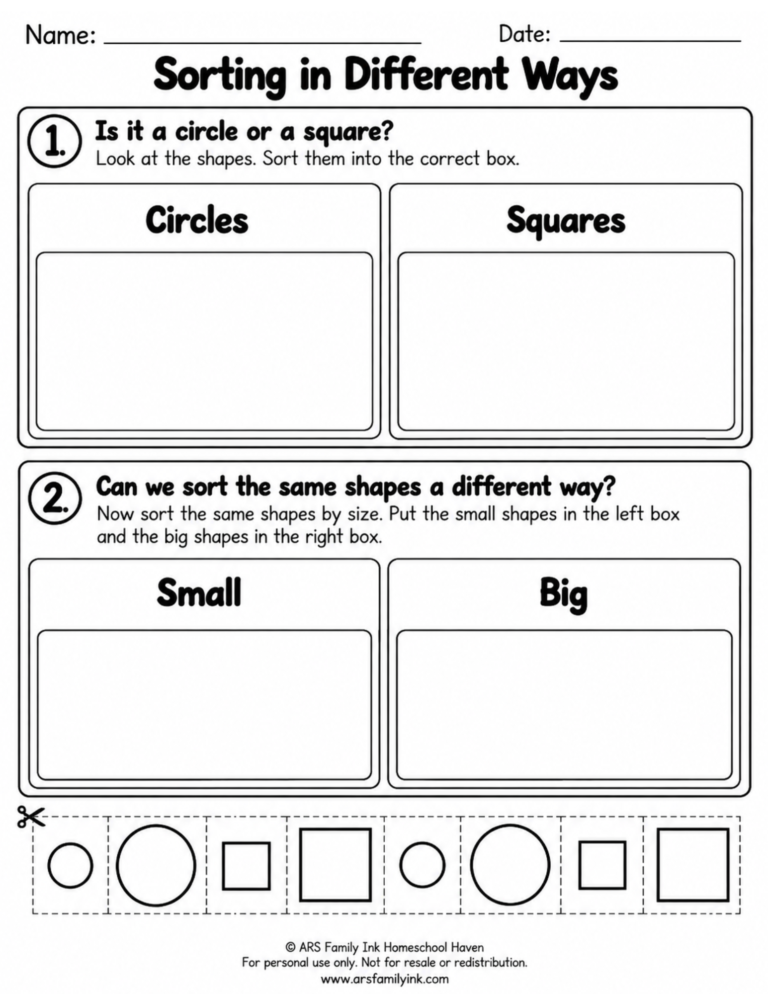
Help your preschooler discover that the same objects can be sorted in different ways with this free Sorting in Different Ways preschool math worksheet from ARS Family Ink Homeschool Haven!
This hands-on printable introduces children to sorting by shape and size. First, children identify circles and squares and place them into the correct groups. Next, they use the same shapes to create new groups based on whether each shape is small or big.
With eight cutout shapes and clearly labeled sorting boxes, this activity gives young learners an opportunity to practice observing, comparing, and classifying objects. It is a simple way to introduce early mathematical thinking through a fun, interactive activity.
Perfect for homeschool lessons, preschool classrooms, math centers, or extra practice at home!
Download your free worksheet below:
What This Worksheet Teaches
This preschool math worksheet introduces children to the idea that objects can be organized into different groups depending on the sorting rule.
The worksheet includes two activities:
Activity 1 – Sorting by Shape: Children examine the cutout shapes and sort them into two categories: Circles and Squares.
Activity 2 – Sorting by Size: Children use the same shapes again, this time sorting them into Small and Big categories.
By changing the sorting rule, children begin to understand that one object can belong to different groups depending on which characteristic they are observing.
The activity also provides opportunities to practice shape vocabulary, size comparisons, following directions, and explaining choices.
How to Use This Worksheet
Download and print the Sorting in Different Ways worksheet.
Introduce the shapes. Point to the circles and squares at the bottom of the page. Talk about how they look and how they are different.
Prepare the pieces. Help your child cut along the dashed lines to separate the eight shapes. Adults can prepare the pieces ahead of time when needed.
Complete Activity 1. Ask your child to place the circles in the Circles box and the squares in the Squares box.
Discuss the groups. Ask questions such as, “How do you know this is a circle?” or “What makes this a square?”
Change the sorting rule. Collect the same shapes and explain that they will now be sorted by size instead of shape.
Complete Activity 2. Have your child place the small shapes in the Small box and the big shapes in the Big box.
Review together. Talk about how the shapes stayed the same even though the groups changed.
Helpful Tip: Have children arrange the pieces before gluing. Because both activities use the same eight shapes, they should complete the first sorting activity without gluing, then move the pieces to the second activity. They may glue the pieces into the second set of boxes after finishing if desired.
Why This Skill Matters
Sorting and classifying are important early math experiences because they encourage children to notice similarities, recognize differences, and organize information.
When preschoolers sort objects, they practice paying attention to a particular characteristic, such as shape, size, or color. Learning to change the sorting rule also helps children understand that objects can be grouped in more than one meaningful way.
These experiences support early mathematical reasoning and prepare children for later activities involving patterns, comparisons, shapes, and organizing information.
Sorting is also a useful everyday skill. Children can practice it while putting away toys, organizing blocks, matching socks, or grouping household objects.
Skills Practiced
Recognizing circles and squares
Identifying small and big shapes
Sorting objects by shape
Sorting objects by size
Comparing observable characteristics
Changing a sorting rule
Following simple directions
Using descriptive math vocabulary
Developing visual discrimination
Practicing fine motor coordination through handling and placing cutout shapes
Learning Goals
With developmentally appropriate guidance, children will have opportunities to:
Recognize and distinguish between circles and squares.
Notice differences between small and big shapes.
Group objects according to a stated characteristic.
Practice sorting the same collection in two different ways.
Describe or point to a characteristic used for sorting.
Participate in a hands-on activity involving observation and comparison.
Children may demonstrate these skills through pointing, placing objects, gestures, or spoken responses. Independent completion is not required for every preschool learner.
Parent & Teacher Tips:
Model the activity first. Demonstrate sorting one or two shapes before inviting your child to continue.
Focus on one rule at a time. Complete the shape-sorting activity before introducing sorting by size.
Use simple language. Repeat familiar words such as circle, square, small, big, same, and different.
Allow hands-on exploration. Let children move the pieces around and check their choices before gluing.
Offer extra support when needed. Begin with four pieces instead of all eight, or have an adult place the first shape in each group.
Provide an optional challenge. Ask children to explain why a shape belongs in a particular group or whether a big circle can also belong in the Circles group.
Support fine motor development. Adults may cut the pieces in advance. Sorting skills can be practiced without requiring independent scissor use.
Extend the Learning
Continue practicing sorting and comparing with simple activities using familiar objects.
Sort Household Objects: Gather a few safe household items and invite your child to group them by size or shape.
Build and Compare: Use building blocks to make a small tower and a big tower. Talk about how they are different.
Shape Hunt: Look around your home or classroom for objects shaped like circles and squares.
Change the Rule: Sort a small collection of blocks by color, then mix them up and sort them by size.
Talk About Sorting: Ask, “Can we sort these a different way?” Encourage children to share ideas through words, pointing, or demonstrations.
These playful extensions reinforce the worksheet’s main concept while helping children recognize sorting opportunities in everyday life.
Materials Needed
Printed Sorting in Different Ways worksheet
Child-safe scissors or adult-prepared cutout shapes
Glue stick (optional, after completing both sorting activities)
Crayons or colored pencils (optional)
The worksheet is designed in black and white for easy printing. Children can complete the sorting activity without coloring the shapes.
Perfect for Homeschool or Classroom Learning
This printable preschool math activity can be used in a variety of early learning environments.
For homeschool families, it offers a short, hands-on lesson that can be completed together at the kitchen table or incorporated into a daily math routine.
For preschool teachers, it can be used during small-group instruction, guided math activities, or learning centers. Adults can prepare the cutout shapes in advance to make the activity easier to manage.
The worksheet can also be revisited as children become more comfortable identifying shapes, comparing sizes, and following different sorting rules.
Because preschool children develop at different rates, the activity can be adjusted to each child’s readiness and attention span.
Building Early Math and Sorting Skills
Learning to sort objects in different ways helps preschool children explore an important foundation of mathematical thinking: classification.
In this activity, children begin by focusing on shape. They identify circles and squares and organize them into matching groups. Then, they change their focus to size and organize the same shapes into small and big groups.
This change encourages children to recognize that objects have more than one characteristic and that different sorting rules can produce different groups.
Through hands-on practice and simple conversations, children strengthen their observation skills, develop mathematical vocabulary, and begin making connections between sorting activities and everyday experiences.
At ARS Family Ink Homeschool Haven, we believe early math learning should be engaging, approachable, and connected to meaningful experiences. This printable provides one more opportunity to explore important preschool concepts through guided play and discovery.
You may also like:
Alphabet & Phonics
Letter recognition, letter sounds, phonics skills, and early reading development.
Numbers & Math
Counting, number recognition, basic math skills, and early problem-solving.
Reading & Writing
Early reading comprehension, handwriting, and sentence building skills.
Support Our Free Worksheets
If you enjoy these free worksheets, you can support our site by sharing with others, following us on social media, or joining our email list for more resources. It’s as easy as clicking the links at the bottom of the page. Your support helps us continue creating free printable learning materials.