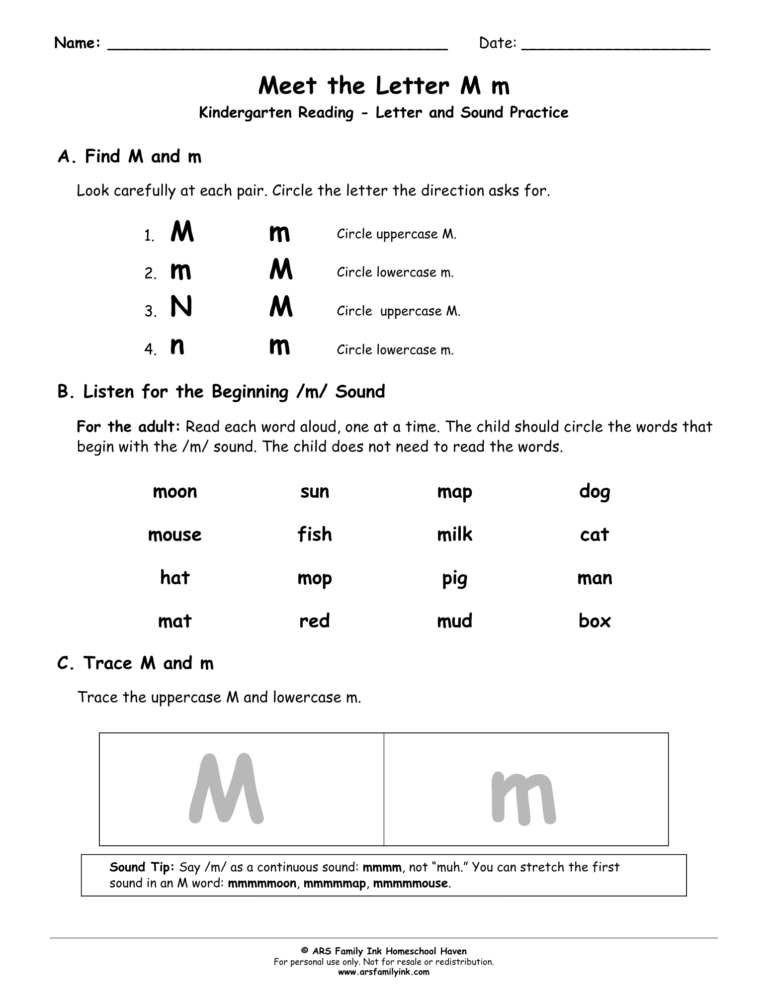
Introduce uppercase M, lowercase m, and the beginning /m/ sound with this free Meet the Letter M m kindergarten worksheet.
This early reading activity combines three important skills in one focused lesson. Children practice visually recognizing uppercase M and lowercase m, listening for the /m/ sound at the beginning of spoken words, and tracing both forms of the letter.
The beginning-sound activity is designed to be adult-supported, so children do not need to read the printed words independently.
Download your free worksheet below:
What This Worksheet Teaches
This worksheet helps children connect three aspects of early letter learning: what a letter looks like, the sound it represents, and how its shape is formed.
Children first learn to visually distinguish uppercase M and lowercase m from other letters. They then listen for /m/ at the beginning of spoken words, helping them connect the printed letter with its sound.
Finally, tracing provides brief practice with the physical formation of uppercase M and lowercase m.
Combining these experiences helps children develop a stronger understanding of the letter rather than practicing its appearance, sound, or formation entirely in isolation.
How To Use This Worksheet
Begin by showing your child uppercase M and lowercase m. Talk about how the two forms look different but represent the same letter.
For Part A, read each direction aloud as needed. Have your child look carefully at the pair of letters and circle the requested uppercase M or lowercase m.
For Part B, read each word aloud one at a time. Your child should listen to the word rather than try to read it independently. Ask whether the word begins with /m/. If it does, have your child circle it.
When producing /m/, use a continuous sound such as “mmmm” rather than “muh.” You can stretch the beginning sound in words such as mmmmmoon, mmmmmap, and mmmmmouse to make the sound easier to hear.
For Part C, have your child slowly trace the uppercase M and lowercase m. Encourage careful movement rather than speed.
Why This Skill Matters
Learning letters involves more than memorizing their names. Beginning readers need to recognize printed letters accurately and connect those letters with the sounds they represent in spoken language.
When children learn to recognize M and m and connect them with /m/, they begin building the alphabetic understanding needed for later phonics and decoding.
Listening for /m/ at the beginning of spoken words also develops phonemic awareness by directing children’s attention to an individual sound within a word.
Brief tracing practice adds another way to interact with the letter and begins developing familiarity with its written form.
Together, these skills help build the foundation children will eventually use to connect sounds with letters when reading and spelling words.
Skills Practiced
This worksheet gives children practice with several important beginning reading skills:
Uppercase Letter Recognition: Identifying uppercase M among other printed letters.
Lowercase Letter Recognition: Identifying lowercase m among other printed letters.
Visual Letter Discrimination: Looking carefully at letter forms and distinguishing M/m from other letters.
Letter-Sound Knowledge: Connecting the printed letter M with the /m/ sound.
Beginning-Sound Awareness: Listening for /m/ at the beginning of spoken words.
Phonemic Awareness: Paying attention to the first individual sound in a spoken word.
Letter Formation: Tracing uppercase M and lowercase m to become familiar with their written forms.
Listening and Following Directions: Listening as an adult says words and responding based on the sound heard.
Learning Goals
After completing this worksheet, children should be working toward being able to:
✔ Recognize uppercase M
✔ Recognize lowercase m
✔ Distinguish M and m from other printed letters
✔ Connect the letter M with the /m/ sound
✔ Listen for /m/ at the beginning of spoken words
✔ Identify spoken words that begin with /m/
✔ Trace uppercase M and lowercase m
✔ Produce /m/ as a continuous sound without adding an extra vowel sound
Parent & Teacher Tips:
When practicing the /m/ sound, try not to add an extra vowel after the consonant.
Instead of saying “muh,” produce /m/ as a continuous sound:
“mmmmmm.”
This makes it easier for children to hear the actual sound represented by M and later helps when they begin blending sounds together to read words.
During Part B, remember that your child does not need to read the printed words. Read each word aloud and allow your child to concentrate on listening for its beginning sound.
Extend the Learning
Continue exploring the letter M with simple activities at home or in the classroom:
M Sound Hunt: Look around the room for objects whose names begin with /m/.
Stretch the Sound: Say words such as moon, map, mouse, and milk while stretching the first sound: “mmmmmoon.”
M or Not M? Say pairs of words such as map/sun or milk/fish. Ask which word begins with /m/.
Letter Hunt: Look through a favorite book and find uppercase M and lowercase m.
Make an M Collection: Draw or collect pictures of things beginning with /m/, such as a moon, mouse, map, or mop.
Practice Writing: After tracing, let your child try writing M and m independently on blank paper, a dry-erase board, or another writing surface.
Keep the activities short and playful. The goal is repeated exposure to M, m, and /m/ rather than mastering everything in one lesson.
Materials Needed
This activity requires only a few simple materials:
Meet the Letter M m worksheet
Pencil or crayon
An adult to read the words in Part B aloud
No additional materials are required.
Perfect for Homeschool or Classroom Learning
The Meet the Letter M m worksheet is designed for flexible use in homeschool and classroom settings.
Homeschool families can use it as a focused kindergarten reading lesson introducing or reinforcing the letter M and its beginning sound.
Teachers and classroom educators can use it during explicit letter-sound instruction, small groups, literacy centers, individual practice, or review.
This worksheet is perfect for:
✔ Homeschool kindergarten reading
✔ Kindergarten classrooms
✔ Letter recognition practice
✔ Letter-sound instruction
✔ Beginning-sound practice
✔ Phonemic awareness practice
✔ Alphabet review
✔ Small-group literacy instruction
✔ One-on-one learning
Building Early Reading Readiness
Learning to connect speech sounds with printed letters is an important step toward reading.
Children first need opportunities to hear sounds in spoken language and become familiar with the letters that represent those sounds. Focused letter activities allow children to build these connections gradually.
With this worksheet, children move through a simple progression:
See M/m → Hear /m/ → Find /m/ in spoken words → Trace M/m
As children build secure letter-sound connections across the alphabet, they become better prepared to blend sounds, decode simple words, and use sounds and letters when beginning to spell.
You may also like:
Science
Simple science concepts, observation skills, and early exploration.
Numbers & Math
Counting, number recognition, basic math skills, and early problem-solving.
Reading & Writing
Early reading comprehension, handwriting, and sentence building skills.
Support Our Free Worksheets
If you enjoy these free worksheets, you can support our site by sharing with others, following us on social media, or joining our email list for more resources. It’s as easy as clicking the links at the bottom of the page. Your support helps us continue creating free printable learning materials.