Make early counting practice fun with our free Fill the Picnic Plates! Preschool Counting Worksheet from ARS Family Ink Homeschool Haven!
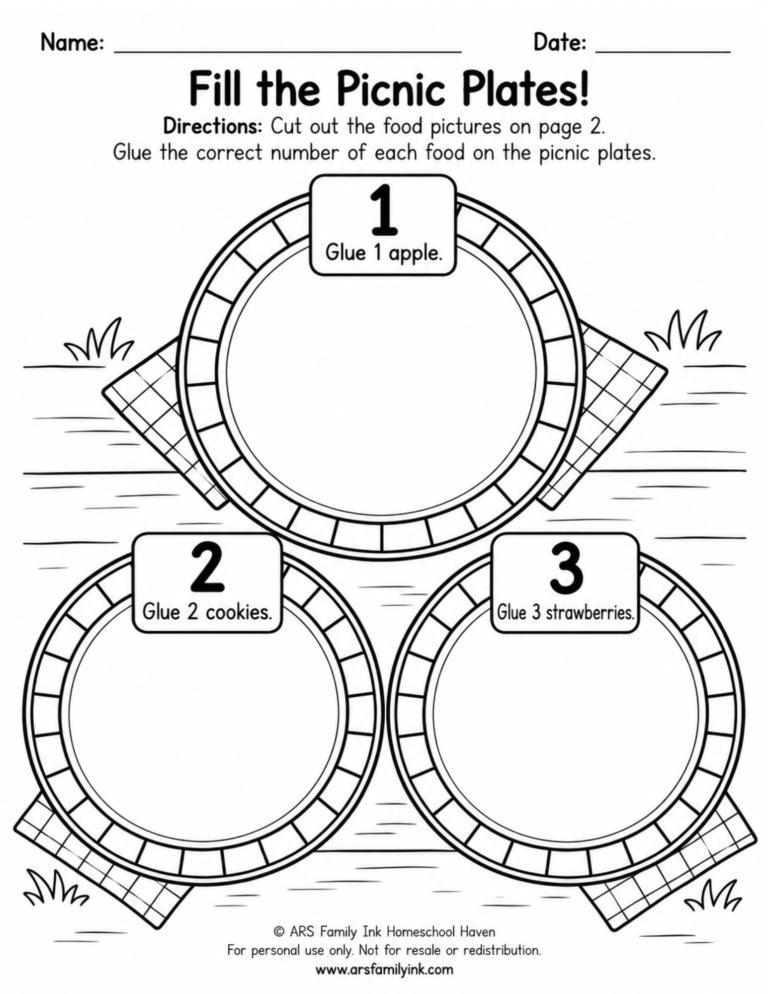
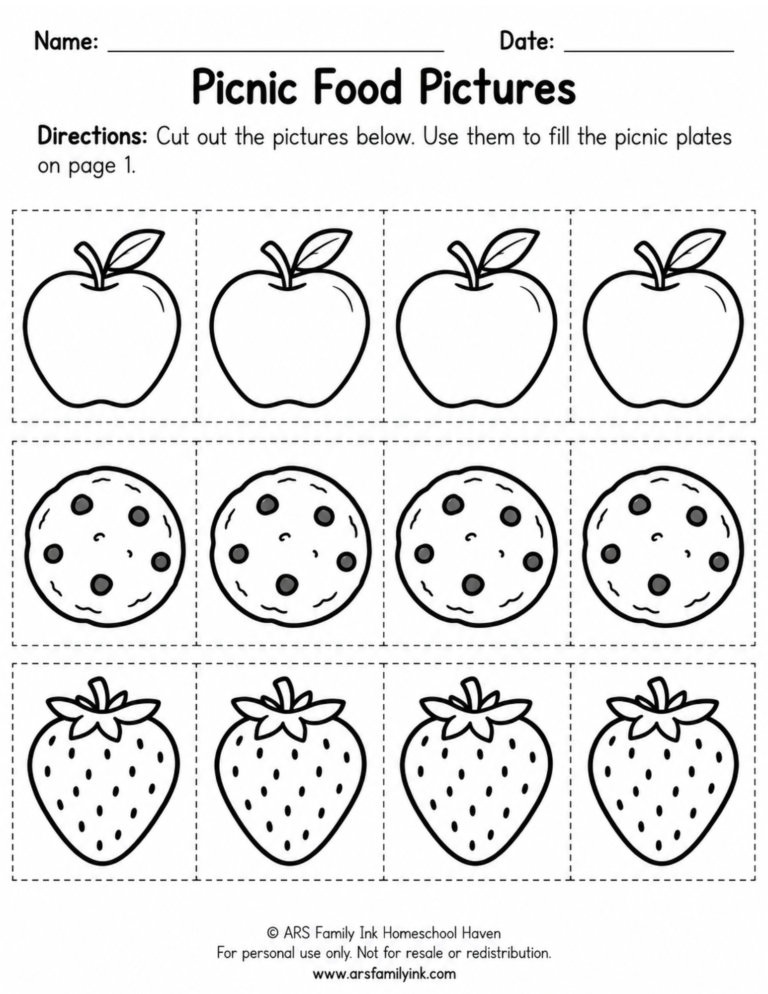
In this hands-on picnic-themed activity, children practice counting objects from 1 to 3 by filling three picnic plates with the correct number of food pictures. Young learners cut out apples, cookies, and strawberries, then match each group of pictures to the number shown on its plate.
This two-page printable combines early math practice with cutting and gluing, making it a playful addition to preschool homeschool lessons, math centers, or small-group activities.
Download your free worksheet below:
What This Worksheet Teaches
The Fill the Picnic Plates! worksheet introduces young learners to the relationship between written numbers and the quantities they represent.
Children work with three small quantities:
Number 1: Glue one apple onto the first picnic plate.
Number 2: Glue two cookies onto the second picnic plate.
Number 3: Glue three strawberries onto the third picnic plate.
As children count each food picture, they practice connecting spoken number words, written numerals, and actual quantities.
The activity also provides opportunities to develop hand coordination through cutting, arranging, and gluing the food pictures onto the plates.
How to Use This Worksheet
This activity includes two printable pages: a picnic plate worksheet and a separate page of food pictures.
Print both pages of the Fill the Picnic Plates! worksheet.
Look at the three picnic plates on page one and read the numbers and directions together.
Cut out the food pictures from page two along the dashed lines. Provide adult assistance with scissors as needed.
Begin with the first plate. Help your child find one apple and glue it onto the plate.
Continue with the second plate by counting and gluing two cookies.
Complete the third plate by counting and gluing three strawberries.
Count the pictures on each completed plate together to check the quantities.
Encourage your child to point to each picture while counting aloud. Children who are still learning to count may benefit from working with one plate at a time and using adult guidance.
The extra food pictures can be saved for additional counting or sorting practice.
Why This Skill Matters
Counting small groups of objects is an important part of early mathematical development.
Before children work with larger numbers, they benefit from repeated opportunities to explore small quantities and connect them to spoken number words and written numerals.
This worksheet encourages children to count individual objects, recognize numbers 1–3, and understand that each number represents a specific quantity.
By touching or pointing to each food picture while counting, children can practice one-to-one correspondence—counting each object once.
The picnic theme makes these early math concepts more concrete and approachable through a familiar everyday activity.
Skills Practiced
This preschool counting activity provides practice with several early learning skills:
Counting 1–3: Counting small groups of food pictures.
Numeral Recognition: Identifying the written numbers 1, 2, and 3.
Quantity Matching: Matching the correct number of objects to each numeral.
One-to-One Correspondence: Counting each food picture once.
Visual Discrimination: Identifying apples, cookies, and strawberries.
Fine Motor Coordination: Cutting, positioning, and gluing pictures.
Following Directions: Completing a simple activity with multiple steps.
Children can practice these skills at their own pace with support based on their readiness.
Learning Goals
With appropriate guidance and repeated practice, children can work toward the following learning goals:
Recognize and name the numerals 1, 2, and 3.
Count groups containing one, two, or three objects.
Match a written numeral to a corresponding quantity.
Practice counting objects one at a time.
Identify and group familiar food pictures.
Strengthen fine motor coordination through hands-on work.
Follow simple directions to complete a counting activity.
These goals are intended to support early preschool math exploration rather than serve as a formal assessment of mastery.
Parent & Teacher Tips:
Help children feel comfortable and successful by adjusting the activity to their current abilities.
For children just beginning to count:
Start with the plate labeled 1. Show one apple, say “one,” and help your child place it on the plate. Continue to the other plates when your child is ready.
For children developing counting confidence:
Encourage your child to point to each food picture while counting aloud. Ask them to check the number on the plate before gluing.
For children ready for an additional challenge:
After completing the plates, ask questions such as “Which plate has more food?” or “How many more strawberries are there than apples?” Use the pictures to help children compare the quantities.
Fine motor support:
If cutting is difficult, an adult can cut out the pictures ahead of time so the child can focus on counting and matching.
Keep the activity relaxed and allow time for children to explore the numbers without rushing.
Extend the Learning
Continue the picnic counting fun with a few simple activities using everyday materials.
Create a pretend picnic: Gather toy foods or safe household objects. Ask your child to place one item on one plate, two items on another, and three items on a third.
Count real snacks: During snack time, invite your child to count small groups of crackers, fruit pieces, or other appropriate foods.
Compare the picnic plates: Look at the completed worksheet and talk about which plate has the most food and which has the least.
Sort the extra pictures: Use the remaining food cutouts to create groups of apples, cookies, and strawberries.
Explore one more: Start with one object and add another. Count again to discover how the quantity changes.
These simple extensions provide additional opportunities to explore counting through play and everyday experiences.
Materials Needed
To complete this activity, you will need:
Printed Fill the Picnic Plates! worksheet (both pages)
Child-safe scissors
Glue stick or school glue
Crayons or colored pencils (optional)
Adult supervision and assistance are recommended when children use scissors.
Perfect for Homeschool or Classroom Learning
The Fill the Picnic Plates! worksheet is a flexible resource for preschool learning at home or in the classroom.
Homeschool families can use it during a short math lesson, a picnic-themed learning day, or a hands-on activity session.
Preschool teachers can include it in small-group instruction, supervised math centers, or additional counting practice.
Because the activity focuses on just three small quantities, children can complete it gradually, with support tailored to their readiness.
The black-and-white design also allows children to color the food pictures before or after completing the activity if they enjoy adding a creative element.
Building Early Counting and Number-Matching Skills
Early counting involves more than memorizing number words. Children gradually learn to connect spoken numbers, written numerals, and groups of real objects.
The Fill the Picnic Plates! worksheet supports this developing understanding by giving children a concrete task: placing the correct quantity of food pictures onto each numbered plate.
Working with numbers 1–3 allows young learners to focus on small, manageable groups while practicing careful counting and quantity matching.
Parents and teachers can reinforce these ideas by counting together, pointing to each object, and asking children to describe what they notice.
Repeated experiences with small quantities through play, conversation, and hands-on activities help children build a foundation for exploring larger numbers and more complex mathematical ideas.
You may also like:
Alphabet & Phonics
Letter recognition, letter sounds, phonics skills, and early reading development.
Numbers & Math
Counting, number recognition, basic math skills, and early problem-solving.
Reading & Writing
Early reading comprehension, handwriting, and sentence building skills.
Support Our Free Worksheets
If you enjoy these free worksheets, you can support our site by sharing with others, following us on social media, or joining our email list for more resources. It’s as easy as clicking the links at the bottom of the page. Your support helps us continue creating free printable learning materials.