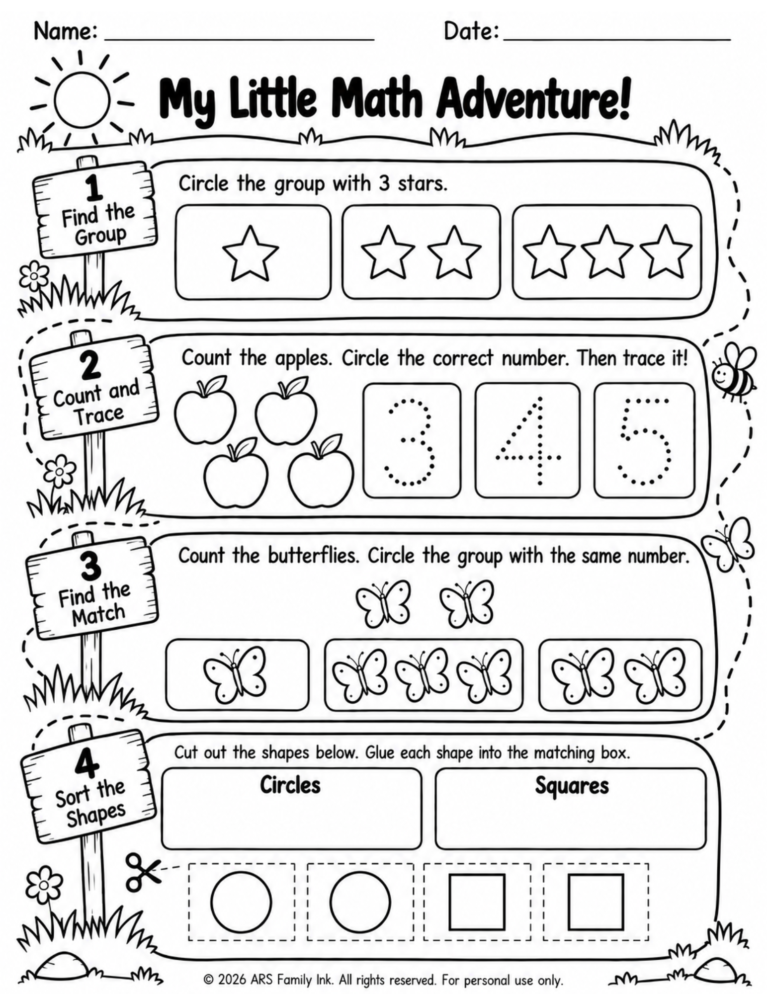
Make early math practice an exciting adventure with My Little Math Adventure! This free printable preschool math worksheet brings together four hands-on activities that help young learners explore counting, number recognition, matching quantities, and sorting shapes.
Children will count stars, identify and trace the number 4, match butterfly groups, and sort circles and squares. With simple directions and playful illustrations, this worksheet offers a fun way to practice foundational math skills at home or in the classroom.
Download your free worksheet below:
What This Worksheet Teaches
My Little Math Adventure! introduces and reinforces several important preschool math concepts through four activities:
Find the Group: Children identify and circle the group containing exactly three stars.
Count and Trace: Children count four apples, select the matching numeral, and trace the number 4.
Find the Match: Children count two butterflies and identify another group containing the same quantity.
Sort the Shapes: Children cut out circles and squares and glue each shape into its matching category.
Together, these activities encourage children to connect numbers with quantities, compare groups, recognize basic shapes, and practice early pencil and scissor skills.
How to Use This Worksheet
Print the worksheet and provide your child with a pencil or crayon, child-safe scissors, and glue.
Activity 1: Find the Group
Ask your child to look at the three groups of stars. Encourage them to count the stars in each group and circle the group containing three stars.
Activity 2: Count and Trace
Have your child count the apples, touching or pointing to each one as they count. Ask them to circle the correct number from the three choices (3, 4, and 5), then trace the dotted numeral.
Activity 3: Find the Match
Ask your child to count the two butterflies shown above the answer choices. Then have them count the butterflies in each group and circle the group with the same number.
Activity 4: Sort the Shapes
Help your child cut along the dashed lines surrounding the four shapes at the bottom of the page. Have them identify each shape and glue the circles into the box labeled “Circles” and the squares into the box labeled “Squares.”
Allow children to complete the activities at a comfortable pace. Younger learners may benefit from having the directions read aloud and receiving assistance with cutting and gluing.
Why This Skill Matters
Early math learning begins with understanding quantities, noticing similarities and differences, and recognizing shapes in everyday surroundings.
Counting objects helps preschoolers develop one-to-one correspondence, the understanding that each object counted receives one number word. Matching groups encourages children to recognize equal quantities, while number tracing introduces the connection between written numerals and the amounts they represent.
Sorting circles and squares supports early geometry and classification skills. Children practice recognizing shapes by their features and placing similar objects together.
These foundational experiences help prepare children for more advanced counting, comparing, and problem-solving activities as they develop.
Skills Practiced
Counting small groups of objects
Recognizing quantities from 1 to 4
Identifying the numeral 4
Tracing a dotted numeral
Matching groups with equal quantities
Recognizing circles and squares
Sorting objects by shape
Developing visual discrimination
Practicing pencil control, cutting, and gluing
Learning Goals
With appropriate guidance and practice, children will work toward the following goals:
Count three stars and identify the matching group.
Count four apples using one-to-one correspondence.
Recognize the numeral 4 among other number choices.
Trace the numeral 4 with increasing control.
Identify two groups containing the same number of butterflies.
Distinguish between circles and squares.
Sort four shapes into the correct categories.
Follow simple, sequential activity directions.
Children may need different levels of support depending on their age, experience, and developmental readiness.
Parent & Teacher Tips:
Count Together First: Model counting slowly while pointing to each object. Invite your child to count with you before trying independently.
Use Real Objects: If counting pictures is challenging, provide blocks, buttons, or other safe counting objects to represent the groups.
Encourage Number Recognition: Point to the numerals 3, 4, and 5 and say each number aloud before asking your child to choose the correct answer.
Support Tracing: Demonstrate how to follow the dotted lines of the number 4. Allow children to practice with a finger before using a pencil or crayon.
Talk About Shapes: Ask children to describe what makes a circle different from a square. Introduce words such as “round,” “straight,” and “corners.”
Adapt for Readiness: For children who are not ready to use scissors, an adult can prepare the shape cutouts. Children can then focus on identifying and sorting the shapes.
Celebrate Effort: Encourage children to explain their answers and recognize their progress rather than emphasizing speed or perfect tracing.
Extend the Learning
Continue the math adventure with simple hands-on activities using objects around your home or classroom.
Star Counting: Draw groups of one, two, three, and four stars. Ask your child to find different quantities.
Apple Counting: Use four toy apples, blocks, or other small objects. Practice counting them and connecting the group to the numeral 4.
Matching Quantities: Create two groups of objects and ask whether they contain the same number.
Shape Hunt: Look around the room for objects shaped like circles and squares.
Shape Sorting: Provide paper circles and squares in different sizes or colors. Encourage your child to sort them by shape.
Optional Challenge: Invite children who are ready to create their own group of four objects or explain how they know two groups have equal quantities.
These activities reinforce worksheet concepts through movement, conversation, and hands-on exploration.
Materials Needed
Printed My Little Math Adventure! worksheet
Pencil or crayons
Child-safe scissors
Glue stick
Optional: Counting objects, such as blocks or counters, for additional practice.
Adult supervision and assistance with scissors are recommended as appropriate for the child’s readiness.
Perfect for Homeschool or Classroom Learning
My Little Math Adventure! is a flexible addition to preschool math activities in both homeschool and classroom settings.
Homeschool families can use the worksheet during a short math lesson, as review after hands-on counting activities, or as part of a themed learning day.
Preschool teachers can incorporate it into small-group instruction, math centers, or individual practice. Because the worksheet includes four different activities, educators may also guide children through one section at a time.
The combination of counting, tracing, matching, and sorting provides opportunities to observe how children approach several early math concepts without requiring a lengthy lesson.
Building Early Math, Number Sense, and Shape Recognition Skills
Preschool mathematics involves much more than memorizing number names. Young children gradually develop an understanding of how numbers represent quantities, how objects can be compared, and how shapes can be recognized and organized.
My Little Math Adventure! brings these concepts together in one printable activity page. Counting stars and apples encourages children to connect number words with objects. Matching butterfly groups reinforces the idea that different groups can contain the same quantity. Sorting circles and squares introduces early geometric thinking through identifying and classifying shapes.
The worksheet also provides opportunities to strengthen fine motor coordination through number tracing, circling answers, cutting, and gluing.
For the greatest benefit, combine worksheet practice with counting games, shape exploration, and everyday math conversations. Repeated, playful experiences help children build familiarity and confidence as their early mathematical understanding develops.
You may also like:
Alphabet & Phonics
Letter recognition, letter sounds, phonics skills, and early reading development.
Numbers & Math
Counting, number recognition, basic math skills, and early problem-solving.
Reading & Writing
Early reading comprehension, handwriting, and sentence building skills.
Support Our Free Worksheets
If you enjoy these free worksheets, you can support our site by sharing with others, following us on social media, or joining our email list for more resources. It’s as easy as clicking the links at the bottom of the page. Your support helps us continue creating free printable learning materials.