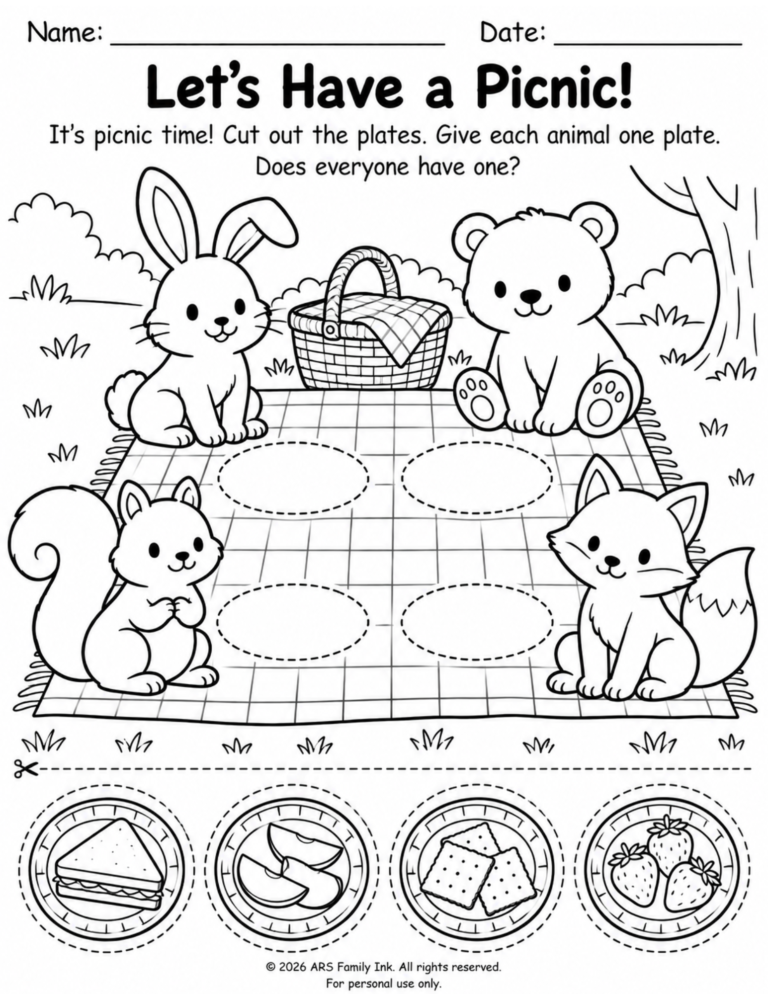
Make early math practice fun with our free Let’s Have a Picnic! Preschool Worksheet! This hands-on cut-and-paste activity introduces one-to-one correspondence as children prepare a picnic for four adorable animals.
Children will cut out four illustrated food plates and give one plate to each animal. As they work, they can count the animals, match each animal with a plate, and discover whether everyone has one.
This playful preschool math activity combines counting, matching, and fine motor practice in a familiar picnic setting. It’s a simple way to explore the idea of giving one item to each member of a group.
Download your free worksheet below:
What This Worksheet Teaches
This preschool math worksheet introduces one-to-one correspondence, an important early math concept that involves matching one item with one other item.
Children practice this concept by giving each of the four picnic animals exactly one plate.
As they complete the activity, children can explore how to:
Give one item to each member of a group.
Count up to four animals and four plates.
Recognize when every animal has received a plate.
Match objects through a hands-on activity.
Practice cutting and placing paper pieces.
The goal is to help children understand that each animal needs one plate, rather than simply memorizing a counting sequence.
How to Use This Worksheet
Print the Let’s Have a Picnic! worksheet.
Invite your child to look at the picnic scene and identify the four animals.
Count the animals together, touching or pointing to each one as you count.
Help your child cut out the four circular food plates along the dashed outlines.
Ask your child to give each animal one plate by placing a cutout on each of the four spaces on the picnic blanket.
When all four plates are placed, ask, “Does everyone have one?”
Count the plates together and check that each animal has received one.
Children may leave the plates loose so they can repeat the activity or glue them in place to finish their worksheet.
Younger preschoolers may need adult help cutting out the plates. The primary learning goal is matching one plate to each animal, not cutting independently.
Why This Skill Matters
One-to-one correspondence is an important foundation for early counting and number understanding.
Before children can reliably count objects, they need opportunities to connect each counted item with one number word. Matching one plate to each animal introduces a related idea: pairing items so that each member of a group receives exactly one.
Everyday activities provide natural opportunities to practice this skill. Children might give one napkin to each family member, place one toy in each container, or set one cup at each place at the table.
Our Let’s Have a Picnic! worksheet gives preschoolers a visual, hands-on way to explore this concept while developing confidence with simple matching and counting activities.
Skills Practiced
One-to-One Correspondence: Matching one plate to each animal.
Early Counting: Counting four animals and four plates.
Visual Matching: Identifying which picnic spaces still need plates.
Problem-Solving: Checking whether every animal has received one plate.
Fine Motor Coordination: Cutting out and positioning paper pieces.
Following Directions: Completing a simple sequence of steps.
Learning Goals
After completing this activity, children will have opportunities to:
Match one plate to each of four animals.
Count up to four objects with support as needed.
Recognize whether an animal has or has not received a plate.
Explore the meaning of “one for each.”
Practice placing and arranging cutout pieces.
Respond to the question, “Does everyone have one?”
Children develop these skills at different rates. Younger learners may focus on giving each animal a plate, while children who are ready can count and explain how they know everyone has one.
Parent & Teacher Tips:
Start with fewer animals. If matching four plates feels challenging, begin by covering part of the picnic scene and working with just two animals and two plates.
Model the first match. Place one plate on the blanket and explain, “This plate is for the rabbit. Now let’s find a plate for another animal.”
Use simple questions. Ask, “Who needs a plate?” or “Does the bear have one?” These questions encourage children to notice which animals still need plates.
Encourage careful counting. Point to each animal once as you count together. Then count the plates and compare the two groups.
Allow repeated practice. Keep the pieces loose rather than gluing them immediately. Children can remove the plates and try again.
Support cutting safely. Offer child-safe scissors and supervise cutting. Adults can prepare the pieces ahead of time for children who are still developing scissor skills.
Keep the activity relaxed and playful. The focus is understanding one plate for each animal, not completing the worksheet quickly.
Extend the Learning
Continue exploring one-to-one correspondence with simple activities at home or in the classroom.
Set a pretend picnic. Gather a few stuffed animals and give each one a toy plate, cup, or napkin.
Practice at snack time. Ask your child to place one napkin or snack container at each seat.
Try a missing-plate challenge. Set out the picnic plates, then remove one. Ask your child to identify which animal still needs a plate.
Count and compare. Count the animals and plates separately. Ask whether there are enough plates for everyone.
Add an optional challenge. Give your child an extra paper plate and ask what happens when everyone already has one. This introduces the idea of having more items than needed.
These activities reinforce the worksheet’s main concept through everyday play and practical experiences.
Materials Needed
Printed Let’s Have a Picnic! worksheet
Child-safe scissors
Crayons or colored pencils (optional)
Glue stick (optional)
For repeated practice, leave the plates unattached so children can move and match them again.
Perfect for Homeschool or Classroom Learning
The Let’s Have a Picnic! worksheet is a flexible addition to preschool math lessons, homeschool activities, and early learning centers.
Homeschool families can use it during a short, hands-on math lesson or alongside a picnic-themed activity. Teachers can include it in a small-group lesson, math center, or individual practice session.
Because the worksheet uses a familiar situation—giving everyone a plate—children can connect the activity to real experiences.
The black-and-white design also allows children to color the picnic scene before or after completing their math activity.
Building Early Counting and One-to-One Correspondence Skills
Learning to count involves more than saying number words in order. Children also need opportunities to connect numbers with objects and recognize when each item has been counted or matched.
The Let’s Have a Picnic! worksheet encourages preschoolers to explore these early math ideas through a simple, meaningful task: making sure every animal has one plate.
As children distribute the four plates, they practice matching items, noticing which spaces are empty, and checking their work.
These early experiences support developing number sense and prepare children for more advanced counting and comparing activities as they grow.
You may also like:
Alphabet & Phonics
Letter recognition, letter sounds, phonics skills, and early reading development.
Numbers & Math
Counting, number recognition, basic math skills, and early problem-solving.
Reading & Writing
Early reading comprehension, handwriting, and sentence building skills.
Support Our Free Worksheets
If you enjoy these free worksheets, you can support our site by sharing with others, following us on social media, or joining our email list for more resources. It’s as easy as clicking the links at the bottom of the page. Your support helps us continue creating free printable learning materials.