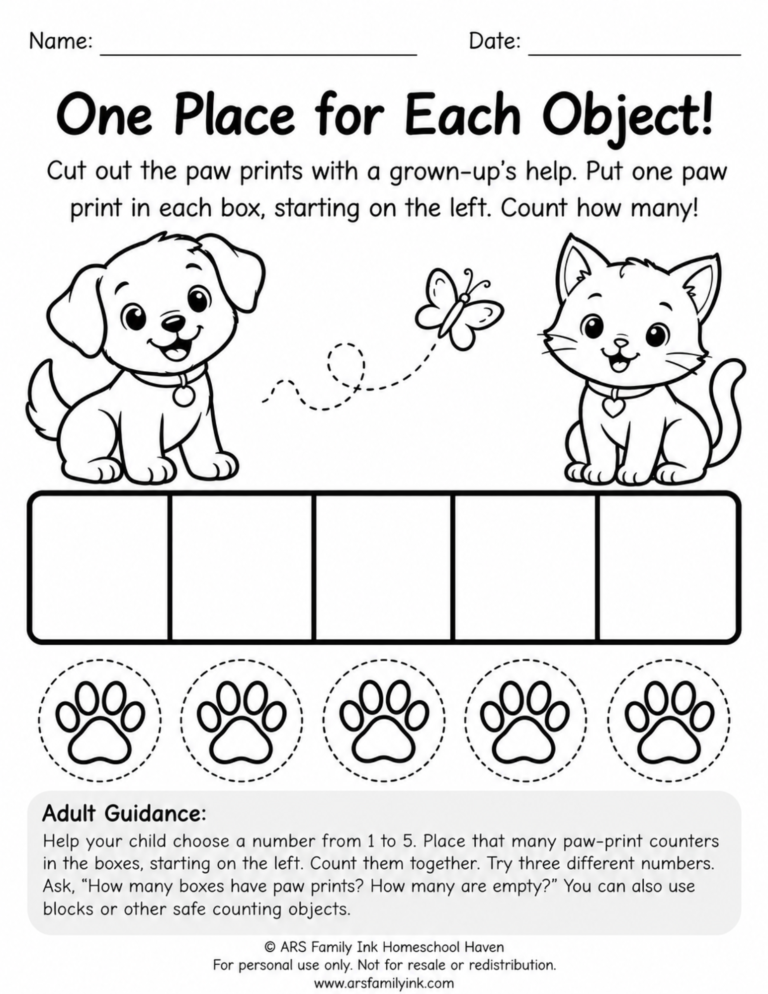
Make early counting practice fun and hands-on with our free One Place for Each Object! preschool math worksheet!
This adorable puppy-and-kitten activity helps young learners explore numbers from 1 to 5 while practicing an important early math skill: one-to-one correspondence.
Children place one paw-print counter in each box, starting on the left, and count how many they have placed. With five counting boxes and five paw-print counters, the activity can be repeated using different numbers to help children connect counting words with actual quantities.
Perfect for homeschool lessons, preschool classrooms, or extra math practice at home, this printable offers a playful way to explore early number concepts.
Download your free worksheet below:
What This Worksheet Teaches
This preschool math worksheet introduces one-to-one correspondence, the understanding that each object being counted receives one counting word.
Children practice placing one paw-print counter in each box while counting the counters they have used.
The activity also introduces:
Counting quantities from 1 to 5.
Placing one object in each space.
Working from left to right.
Recognizing how many boxes are filled and how many remain empty.
Connecting spoken number words with groups of objects.
The worksheet encourages children to explore counting through physical movement and repeated hands-on practice.
How to Use This Worksheet
Print the worksheet. Print the one-page activity and gather child-safe scissors.
Prepare the paw prints. With a grown-up’s help, cut out the five paw-print counters along the dashed circles.
Choose a number. Help your child choose a number from 1 to 5.
Place the counters. Starting with the box on the left, place one paw-print counter in each box until the chosen number has been reached.
Count together. Point to each paw print and count aloud.
Explore the empty boxes. Ask how many boxes contain paw prints and how many remain empty.
Try again. Remove the counters and repeat with a different number. The worksheet suggests trying three different numbers.
For additional practice, use blocks or other safe counting objects instead of the paper paw prints.
Why This Skill Matters
One-to-one correspondence is an important foundation for early number understanding.
Before children can count groups accurately, they need opportunities to connect one counting word with one object. Hands-on activities help make this relationship easier to observe and practice.
Placing one paw print in each box gives children a clear visual space for each counter. Counting the completed row also provides opportunities to understand that the final number spoken tells how many objects are in the group.
These early experiences support later learning about comparing quantities, recognizing numbers, and exploring simple addition and subtraction.
Young children develop counting skills at different rates, so repeated practice with small groups and patient adult guidance can be especially helpful.
Skills Practiced
One-to-One Correspondence: Placing exactly one paw-print counter in each box.
Counting 1–5: Counting small groups of objects aloud.
Quantity Recognition: Connecting a chosen number with the number of counters placed.
Left-to-Right Placement: Filling boxes in order, beginning on the left.
Visual Organization: Recognizing filled and empty spaces.
Fine Motor Coordination: Handling, moving, and positioning paper counters.
Listening and Following Directions: Completing a short counting activity with adult support.
Learning Goals
With developmentally appropriate support, children will have opportunities to:
Explore quantities from 1 to 5.
Place one counting object in each box.
Count objects while touching or pointing to each one.
Practice starting at the left and moving across the row.
Notice the difference between filled and empty boxes.
Begin recognizing that the last number counted represents the total quantity.
Build confidence through repeated counting experiences.
Children who are just beginning may work with one or two counters, while children who are ready can explore larger quantities up to five.
Parent & Teacher Tips:
Start small. If your child is new to counting, begin with just one or two paw prints. Increase the number as they become more comfortable.
Model the counting process. Demonstrate how to place one counter in a box while saying one number word.
Encourage touching and pointing. Have your child touch each paw print as they count to help keep the spoken number words connected to the objects.
Allow time to explore. Some children may enjoy moving the counters several times before completing the activity.
Use simple questions. Ask, “How many paw prints do you see?” or “How many boxes are empty?”
Keep it playful. Celebrate careful counting and effort rather than expecting every attempt to be correct.
Adults should supervise cutting and help children handle small materials safely.
Extend the Learning
Continue practicing one-to-one correspondence with simple activities using everyday materials.
Count with blocks. Place one block in each worksheet box and count together.
Try different quantities. Fill two boxes, remove the counters, and then try four. Talk about how the groups look different.
Explore full and empty. Fill all five boxes and ask whether any are empty. Remove one counter and discuss what changed.
Count everyday objects. Give each stuffed animal one pretend treat or place one spoon beside each plate during a play activity.
Add a challenge. For children who are ready, ask, “If we have three paw prints, how many more do we need to fill all five boxes?” Allow them to use the counters to discover the answer.
These activities reinforce the same early math concepts through play and everyday experiences.
Materials Needed
Printed One Place for Each Object! worksheet.
Child-safe scissors with adult assistance.
A flat surface for arranging the counters.
Optional: Blocks or other safe counting objects.
No glue is required for the reusable placement activity. Keep the paw-print counters loose so children can practice with different quantities.
Perfect for Homeschool or Classroom Learning
This printable counting worksheet is a flexible addition to preschool math activities at home or in the classroom.
Homeschool families can use it during short, one-on-one math lessons or as a hands-on activity after counting everyday objects.
Preschool teachers can introduce the activity during small-group instruction or use it at a supervised math learning center.
Because the same worksheet can be practiced with different quantities, children can return to the activity as their counting skills develop.
The friendly animal illustrations and movable paw-print counters make it a welcoming introduction to early number concepts.
Building Early Counting and One-to-One Correspondence Skills
Early math learning begins with meaningful experiences using real objects.
In One Place for Each Object!, children can see and touch each counter as they place it into an individual box. This provides a concrete way to explore the relationship between counting words and quantities.
The five-box arrangement also helps children notice how groups change when counters are added or removed. With adult guidance, they can compare filled and empty spaces and begin understanding how many objects are present.
Through playful repetition, children gain valuable practice with the foundational counting concepts that support future mathematical learning.
You may also like:
Alphabet & Phonics
Letter recognition, letter sounds, phonics skills, and early reading development.
Numbers & Math
Counting, number recognition, basic math skills, and early problem-solving.
Reading & Writing
Early reading comprehension, handwriting, and sentence building skills.
Support Our Free Worksheets
If you enjoy these free worksheets, you can support our site by sharing with others, following us on social media, or joining our email list for more resources. It’s as easy as clicking the links at the bottom of the page. Your support helps us continue creating free printable learning materials.