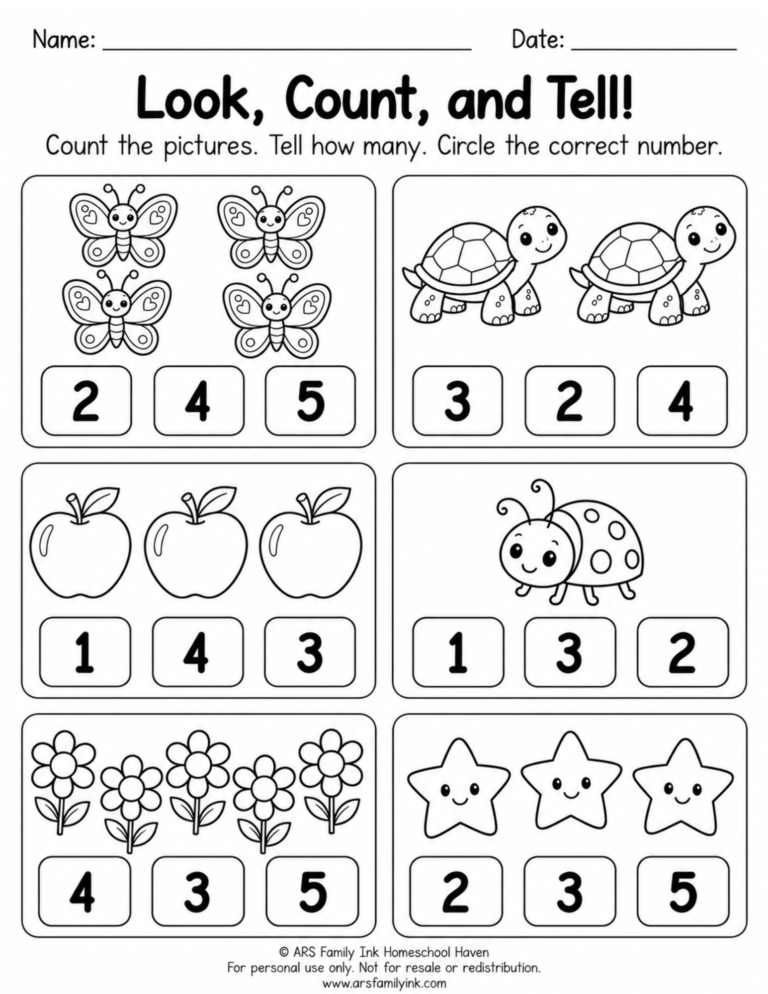
Make early counting practice fun with our Look, Count, and Tell preschool counting worksheet! This free printable math activity helps young learners practice counting objects from 1 to 5 while connecting the number of pictures they see with the correct written numeral.
Children will count cheerful butterflies, turtles, apples, a ladybug, flowers, and stars. After counting each group, they say how many they see and circle the matching number.
Perfect for homeschool lessons, preschool classrooms, or extra practice at home, this simple activity encourages children to slow down, look carefully, and build confidence with early number skills.
Download your free worksheet below:
What This Worksheet Teaches
This preschool counting worksheet introduces and reinforces important early math concepts through six picture-counting activities.
Children practice:
Counting groups containing 1 to 5 objects.
Touching or pointing to each picture while counting.
Understanding that the last number counted tells how many objects are in a group.
Connecting a counted quantity with its written numeral.
Recognizing numerals from 1 to 5.
Selecting and circling the correct number from three choices.
The combination of pictures, spoken counting, and numeral choices gives children several ways to engage with early number concepts.
How to Use This Worksheet
Print the Look, Count, and Tell! worksheet.
Read the directions aloud: “Count the pictures. Tell how many. Circle the correct number.”
Begin with the butterflies in the first box.
Encourage your child to point to each butterfly while counting aloud.
Ask, “How many butterflies are there?”
Help your child find and circle the numeral that matches the number counted.
Continue through the remaining picture groups.
Allow children to work at a comfortable pace. If counting all six groups feels overwhelming, complete just one or two sections and return to the others later.
Children who are not yet ready to recognize written numerals independently can count with an adult and receive help finding the correct number.
Why This Skill Matters
Learning to count objects is an important part of early mathematical development. Children gradually discover that number words represent quantities and that each object should be counted once.
When children point to pictures as they count, they practice one-to-one correspondence. When they recognize that the final number tells how many objects are present, they begin developing an understanding of quantity, also called cardinality.
Connecting these quantities to written numerals helps children understand that numbers are meaningful symbols rather than simply marks on a page.
These early counting experiences provide a foundation for comparing groups, exploring more and less, and eventually working with simple addition and subtraction.
Skills Practiced
Counting objects: Counting picture groups from 1 to 5.
One-to-one correspondence: Matching one spoken number word to each object.
Quantity recognition: Identifying how many objects are in a group.
Numeral recognition: Recognizing written numbers 1–5.
Number-to-quantity matching: Choosing the numeral that represents the counted group.
Visual attention: Looking carefully at each picture without skipping or counting it twice.
Oral language: Saying number words and telling how many.
Fine motor coordination: Circling the selected numeral with a pencil or crayon.
Learning Goals
With appropriate guidance and practice, children will work toward the following goals:
Count up to five pictured objects using one-to-one correspondence.
Say how many objects are in a group after counting.
Recognize and identify written numerals from 1 to 5.
Match a group of objects to its corresponding numeral.
Follow simple spoken directions during a counting activity.
Develop greater comfort participating in early math activities.
Preschool children develop counting skills at different rates. Some may complete the worksheet independently, while others benefit from counting together with a parent or teacher. Both approaches provide valuable opportunities for learning.
Parent & Teacher Tips:
Count together first. If your child is just beginning to count objects, demonstrate how to point to each picture while saying the numbers in order.
Encourage careful counting. Help children move from one picture to the next so they do not accidentally skip an object or count one twice.
Ask children to tell you how many. After counting, ask, “How many did you count?” This helps reinforce the connection between counting and quantity.
Use hands-on objects when needed. If a child struggles with a picture group, try counting a matching number of blocks or other small objects together.
Offer a simpler starting point. Begin with the single ladybug or the two turtles before moving to larger groups.
Add a gentle challenge. Invite children who are ready to explain how they know their answer is correct or recognize a small group without counting each picture.
Keep the experience encouraging and playful. Accuracy develops through repeated, meaningful counting experiences rather than pressure to finish quickly.
Extend the Learning
Continue practicing early counting skills with these simple activities:
Count everyday objects. Gather one to five blocks, crayons, toy animals, or other familiar objects. Ask your child to count them and tell how many there are.
Make your own picture groups. Draw small groups of stars, flowers, or circles on paper. Have your child count each group.
Match numbers to objects. Write the numerals 1–5 on separate pieces of paper. Invite your child to place the correct number of small objects beside each numeral.
Go on a counting hunt. Look around your home or classroom for small groups of objects to count, such as three books or four toy cars.
Explore one more and one less. Use a small group of blocks and ask what happens when you add one block or take one away.
Color the pictures. After completing the worksheet, children may enjoy coloring the butterflies, turtles, apples, ladybug, flowers, and stars.
These optional activities extend the worksheet into playful, hands-on learning experiences.
Materials Needed
Printed Look, Count, and Tell! worksheet.
Pencil or crayon for circling answers.
Optional crayons or colored pencils for coloring the pictures.
Optional small counting objects for additional practice.
No special supplies or preparation are required beyond printing the worksheet.
Perfect for Homeschool or Classroom Learning
The Look, Count, and Tell! worksheet is a flexible resource for parents, homeschool families, preschool teachers, and early childhood educators.
Use it during a preschool math lesson, in a small-group activity, as guided individual practice, or as a simple review of numbers 1–5.
Its six short activities make it easy to adjust the amount of work to each child’s attention span and readiness. Adults can model counting for beginners, while children with more experience can practice counting and selecting numerals more independently.
The black-and-white printable format also gives children the option to color the pictures after finishing their counting practice.
Building Early Counting and Number Recognition Skills
Counting is more than memorizing number words. Young children also need opportunities to connect those words with real quantities and written numerals.
The Look, Count, and Tell! worksheet supports this connection by asking children to observe a group of pictures, count each object, say the total, and identify the matching numeral.
The groups range from one to five objects, allowing children to practice with different quantities in a manageable number range.
As children become more comfortable counting, parents and teachers can introduce hands-on activities that explore comparing groups, recognizing small quantities, and discovering what happens when one object is added or removed.
By combining guided practice with everyday counting experiences, families and educators can help children develop a meaningful understanding of early numbers.
You may also like:
Alphabet & Phonics
Letter recognition, letter sounds, phonics skills, and early reading development.
Numbers & Math
Counting, number recognition, basic math skills, and early problem-solving.
Reading & Writing
Early reading comprehension, handwriting, and sentence building skills.
Support Our Free Worksheets
If you enjoy these free worksheets, you can support our site by sharing with others, following us on social media, or joining our email list for more resources. It’s as easy as clicking the links at the bottom of the page. Your support helps us continue creating free printable learning materials.