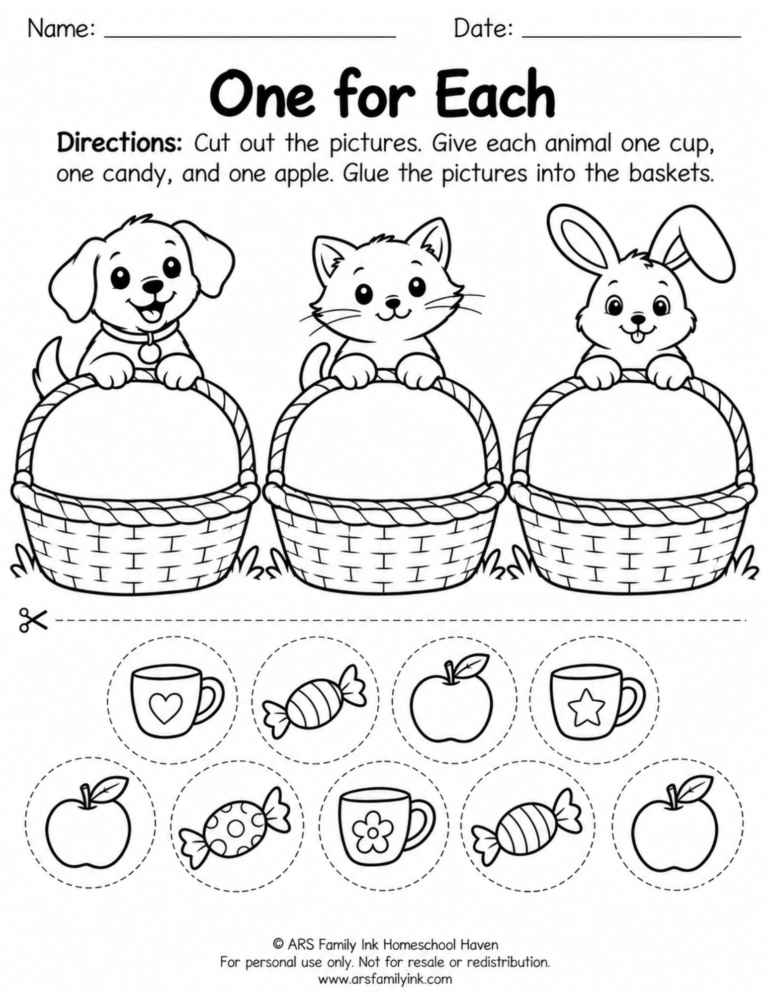
Make early math practice fun with our free One for Each preschool worksheet! In this hands-on cut-and-paste activity, children help three friendly animals—a dog, a cat, and a rabbit—receive one cup, one candy, and one apple each.
As children cut out and distribute the pictures, they explore the idea of giving one of each item to every animal. This simple activity introduces one-to-one correspondence and encourages children to notice whether each basket contains the same types and number of objects.
Perfect for homeschool lessons, preschool math centers, or guided classroom activities, this black-and-white printable combines early math learning with cutting, gluing, and opportunities for coloring.
Download your free worksheet below:
What This Worksheet Teaches
This worksheet introduces one-to-one correspondence through a familiar sharing activity. Children learn to give one cup, one candy, and one apple to each of the three animals.
Rather than simply counting pictures, children practice distributing objects one at a time and checking that no animal has been left out. They can also sort the pictures by type and compare the completed baskets to see that each animal received the same assortment of items.
The activity provides a concrete introduction to matching quantities and distributing objects equally, without requiring children to write numbers or solve formal equations.
How to Use This Worksheet
Print the One for Each worksheet.
Read the directions aloud and introduce the dog, cat, and rabbit.
Look at the cutout pictures together and identify the cups, candies, and apples.
Help your child cut out the nine pictures along the dashed circles, as needed.
Ask your child to give each animal one cup, one candy, and one apple by gluing the pictures inside the baskets.
Look at the finished baskets together. Ask whether each animal received one of every item.
Children who are not yet comfortable using scissors may have the pictures precut by an adult. The pictures can also be placed into the baskets before gluing so children can check their work.
Why This Skill Matters
One-to-one correspondence is an important foundation for early number understanding. Young children gradually learn that objects can be matched, distributed, and counted one at a time.
Giving one item to each animal helps make this idea visible and meaningful. Children can see that every animal needs a cup, candy, and apple, and they can check their choices by looking at what is already in each basket.
These early experiences support later counting, comparing quantities, and understanding how groups of objects relate to one another.
Skills Practiced
One-to-one correspondence
Distributing one of each item to each animal
Sorting and identifying familiar objects
Comparing groups of objects
Following multi-step directions
Visual attention and observation
Hand-eye coordination
Scissor and gluing practice
Learning Goals
With developmentally appropriate support, children will have opportunities to:
Identify cups, candies, and apples in the cutout pictures.
Give each animal one of every item.
Notice when an animal is missing an item.
Compare baskets to determine whether each contains the same assortment.
Practice cutting, placing, and gluing pictures.
Use simple mathematical language such as one, each, same, and all.
Children may reach these goals through guided participation, independent exploration, or repeated practice depending on their readiness.
Parent & Teacher Tips:
Begin by showing your child how to give one picture to one animal. You might say, “The dog needs one cup. Can you find a cup for the dog?” Then encourage your child to choose the next picture.
For children who need a simpler starting point, distribute just the three cups first, followed by the candies and apples. This reduces the number of choices while preserving the same learning goal.
For children ready for an extra challenge, mix all nine pictures together and encourage them to plan how to give each animal one of every item without assistance.
Before gluing, invite your child to check each basket. Ask, “Does every animal have an apple?” or “Who still needs a candy?” Focus on exploration and conversation rather than speed or perfect cutting.
Extend the Learning
Continue practicing one-to-one correspondence with everyday objects. At snack time, invite your child to give each family member one napkin or one cup. During pretend play, set a place for each stuffed animal with one plate and one spoon.
Try arranging three toy animals in a row and giving each one a block, button, or other age-appropriate object. Encourage your child to check that every animal received one.
For an additional challenge, ask your child to count how many cups, candies, or apples are pictured on the worksheet. You can also ask how many total pictures are in one completed basket.
Use larger, age-appropriate objects for hands-on practice when small items could pose a choking hazard.
Materials Needed
Printed One for Each worksheet
Child-safe scissors
Glue stick or school glue
Crayons or colored pencils (optional)
Adult assistance with cutting may be needed depending on the child’s age and fine motor readiness.
Perfect for Homeschool or Classroom Learning
The One for Each worksheet is a flexible addition to preschool math instruction. Homeschool families can use it as a short, guided lesson followed by a real-life sharing activity. Preschool teachers can include it in a math center, small-group lesson, or fine motor activity.
Because the worksheet uses familiar pictures and a simple sharing task, children can participate at different readiness levels. Adults can model the first few placements or encourage more independent work when appropriate.
The black-and-white design also gives children the option to color the animals and pictures before or after completing the activity.
Building Early Math and One-to-One Correspondence Skills
Understanding “one for each” helps children connect everyday sharing experiences with mathematical thinking. By giving a cup, candy, and apple to every animal, children practice matching objects to recipients and recognizing when a group is complete.
This activity provides a playful introduction to one-to-one correspondence, equal distribution, and early quantity awareness. These concepts can be revisited through counting games, pretend play, sorting activities, and daily routines.
Explore more free preschool math worksheets from ARS Family Ink Homeschool Haven to continue building early number sense through hands-on learning.
You may also like:
Alphabet & Phonics
Letter recognition, letter sounds, phonics skills, and early reading development.
Numbers & Math
Counting, number recognition, basic math skills, and early problem-solving.
Reading & Writing
Early reading comprehension, handwriting, and sentence building skills.
Support Our Free Worksheets
If you enjoy these free worksheets, you can support our site by sharing with others, following us on social media, or joining our email list for more resources. It’s as easy as clicking the links at the bottom of the page. Your support helps us continue creating free printable learning materials.